
Relish Presents: Flavor Without Borders
8/29/2026 | 26m 40sVideo has Closed Captions
From the kitchens of Mecca Bos + Amalia Moreno Damgaard
Two chefs find personal history, traditions and identity in food. A DNA test leads Chef Mecca Bos on a personal and culinary journey into her own identity. Chef Amalia Moreno-Damgaard relies on the dishes of her childhood to keep her connected to her home country, Guatemala.
Problems playing video? | Closed Captioning Feedback
Problems playing video? | Closed Captioning Feedback
Relish Presents is a local public television program presented by Minnesota PBS
Relish Presents: Flavor Without Borders
8/29/2026 | 26m 40sVideo has Closed Captions
Two chefs find personal history, traditions and identity in food. A DNA test leads Chef Mecca Bos on a personal and culinary journey into her own identity. Chef Amalia Moreno-Damgaard relies on the dishes of her childhood to keep her connected to her home country, Guatemala.
Problems playing video? | Closed Captioning Feedback
Where to Watch Relish Presents
Relish Presents is available to stream on pbs.org and the PBS app.
Providing Support for PBS.org
Learn Moreabout PBS online sponsorship- [Mecca] Some people might think, oh, it's just food, but that's not entirely true at all.
- [Amalia] Food is memory and food is nostalgia.
(instruments rumble) - [Mecca] What could we do to create more unity using food as a tool?
- [Amalia] I don't want these traditions to be lost to future generations.
- [Mecca] My tamale pie is a hot dish.
[Mecca] We come from all different kinds of backgrounds and we should be able to honor that.
- [Amalia] The main reason that I do what I do is to preserve those traditions.
(♪ It's like butter, like butter, like butter ♪) (knife sharpens) (calm music) - It's really difficult writing recipes when they don't exist.
(knife chops) Biracial cuisine isn't really a thing.
You sort of have to make it up.
My name is Mecca Bos and I am a longtime Twin Cities-based food writer and chef.
I'm writing a cookbook and it explores my background as a Biracial Chef and food writer, and I am co-founder and director of BIPOC Foodways Alliance and Immigrant Kitchen.
(energetic music) BIPOC Foodways Alliance began as a really sincere urge for my partner and I, Sean Sherman.
(glass clinks) To understand each other's culture a little more.
Welcome.
If you look around today, people still really self silo a lot.
So we started thinking like what could we do to create more unity, of course, using food as a tool.
- [Attendee] I really had a great time.
- I had a great time with you too.
- All right, well- - It was great.
- We invite BIPOC and immigrant communities to tell their own stories through the means of food.
The goal is to try to get people to understand and listen to people who they might perceive as different from them.
And hopefully, hopefully when they leave, they might feel like they're a little less different.
- What a delight, what a surprise.
- I know.
- I'm so happy.
- We're at a BIPOC Foodways Alliance slash Immigrant Kitchen event and tonight it's a little bit of a departure from what we normally do because we're featuring myself and my co-chef Tess.
(attendees cheer) Tess is Czech and Black and I'm Norwegian and Black.
So you'll be eating that tonight.
We come from all different kinds of backgrounds and we should be able to honor that just like everybody else honors their background.
It's kind of ironic that I showcase all of these folks who have this really strong connection to their cultural legacy food and I don't have that.
(singer "Easy like butter, coming back hotter") - [Producer] What are we making today?
- Today we're making my signature dish of tamale pie.
(♪ my life taking no any corner ♪) (♪ Shooting the stars and I'm wanting another ♪) (knife sharpens) (♪ Cause she want me now I tell her see you later (♪ Then I kiss her bye bye, see you later ♪) (swoosh) - I grew up in a family of white, wonderful white people.
Let me start that again.
(laughs) (meat sizzles) I grew up a little Brown girl in an all-white family who identifies as Norwegian and Dutch, but my father is Black.
This is the only photo that I am aware of with my mom and dad together.
Going to Grandma's house or going to Nana's house meant that we were gonna have this reliable ritual of dinner time.
At my grandmother's house, there was always a roast going.
I remember that.
So that was always a cozy feeling.
You'd come in and smell that roast.
You know, it was very like simple Midwestern fare.
I remember they always had whole milk.
I could never figure out why my mom's milk didn't taste that good 'cause she would buy 2% or something.
The ubiquitous white doll 'cause I don't remember having any Black dolls when I was a kid.
I don't remember even seeing any.
And they always had lots of butter.
And so the food was always just really like rich.
I'm very lucky to have a family who just really lavished love on me.
And then you go to school.
Me looking really sweet and you're not treated like that at all and you're thinking like, what is all of this?
I don't think my white family had any frame of reference for preparing me for understanding that the world wasn't going to treat me the way that they treated me.
(attendees chatter) Welcome everybody.
We have four dishes.
And then we'll talk about stuff in between.
Sabrina's actually gonna mostly be your emcee tonight and she's also my niece.
We found each other via ancestry DNA.
- I wanna talk to you guys about exploring reclaiming your Nigerian heritage.
- It feels exciting to start kind of tapping into this other side I haven't really known about before.
And also it feels really exciting to be of course with friends who also identify as biracial and us kind of like figuring out our stories together.
(keyboard clicks) - [Mecca] The idea of a DNA test for any sort of mixed race I think was like science fiction a little bit.
I got an early one, my family got it for a birthday present for me early on.
It's such a special feeling because prior to that, the narrative in this country is you're the descendant of slaves.
That's what you know about your Blackness.
To read on that report card, you're Nigerian, well that's really cool because now you can start to look at that place and you can research it, and you know, it made me wanna go out and get a Nigerian flag and fly it.
'cause all these things that like Europeans have access to, we never had access to those things.
(knife slices) Being able to understand that I have Nigerian background does help me with my culinary journey.
It sometimes opens up more questions than answers.
- It's gonna be a fufu dish.
- There's no better way to learn about cooking than to get in the kitchen with somebody.
Uche has been a great teacher to me and he's kind of helped me understand Nigerian cooking.
And he comes over in his dashiki and his big chunky coral jewelry, he's got two bottles of Heineken in his bag, and he turns on Fila.
and all of a sudden we're off to the races.
- In Nigeria, the way I grew up in the Igboland, in the Igbo culture, you get the cooked yam and you put it in a mortar and then you pound the hell out of it.
That's why they call it pounded yam.
- [Mecca] I'm constantly scared of getting it wrong.
You can't let that stop you.
One thing that Uche says when he eats my version of this food, he says, "It doesn't look like Africa but it tastes like Africa."
- [Uche] We don't choose our identities.
My children are biracial, you know?
For them to be whole, complete, they need to know and have pride in all the parts that they're made of.
- I also have to be careful when I'm on this journey to have Blackness or African-ness be an end point.
I think it's part of me, but I don't want that to be the end of the story.
So my grandmother was always braising a roast in the winter time, and it's just a really fond memory.
Like I don't think there's any more beautiful smell than meat braising in an oven.
If you're a vegetarian, sorry, but it's just a really beautiful comforting aroma.
The final savory dish is coming out now.
So this is tamale pie, this is the dish that I love.
Everybody wants dishes that they can call their own.
You have to look back on what your grandmother was cooking and what she left behind.
All of the influences from the people you've met and the travels that you've had.
In my tamale pie, you have Mexico, you have Africa, you have Minnesota, you have the American South, you have Texas, and you have hot dish.
I can incorporate all these pieces of me in this one dish.
You're gonna find a lot of tamales made with pork inside.
Thinking about the way I grew up, I started using beef.
(singer sings in Spanish) - [Mecca] I have to put chile into my tamale pie because that's my twist on things.
That's how I bring in the Caribbean and Africa.
So like for me it's all about the chile.
I'm gonna toast these until they get fragrant and beautiful and then we're gonna reconstitute them and blend them.
(singer sings in Spanish) And they got super fragrant.
It smells so delicious in here.
(pot sizzles) (water splashes) (blender whirs) (gentle music) Over the years as I've been on a culinary journey, I started traveling to Mexico and I discovered the Oaxaca style tamal.
And that is the one that's steamed in a banana leaf instead of a corn husk.
And I just fell in love with these tamales.
And you have what's called the tamale trail where tamales traveled all the way up to the American South where Black people get a hold of it to make in their own way.
They're little bit more like a meat cigar.
Of course you get America involved, you're like, well, do I have to do all that rolling?
That's a lot of work.
Let's just put all that stuff in a casserole dish.
I liked that because the casserole thing resonates with me as a Minnesotan.
We call it hot dish.
The casserole is the dish and what's inside is the hot dish, right?
(tongs clink) You should never let anybody tell you how your own braise should be.
Since I'm honoring Africa and a little bit Mexico, I'm putting spices that you're gonna find in those parts of the world.
So cumin and coriander, super delicious.
I love this Mexican oregano.
It's worth seeking out.
In the tamale trail, you're gonna find those hot tamales and they're gonna be like big cauldrons of tomato sauce and chili and cayenne pepper.
So I'm bringing out some cayenne, and then the tomatoes of course, and then of course our beautiful chile sauce that we made.
Low and slow.
I mean, I like leaving my braises in overnight at like 200 if you feel bold.
(pot clinks) Corn culture is everywhere, which is another thing that resonates with me.
You know sweet corn culture up here is a big deal.
I grew up on sweet corn, any Minnesotan worth their salt grew up on sweet corn.
To have sweet corn right out of the field for dinner at my grandpa's garden, of course.
I love sweet corn.
(laughs) (pan sizzles) (stove clicks) This is gonna go into the liquid for the grits.
(liquids splash) (whisk stirs) (calm music) And so I can make this dish that has grits honoring Black folks in the American South.
I incorporate some sweet corn into there.
I can have my grandmother's ubiquitous pot roast heavily laden with chile.
And I don't know that my Norwegian family would approve, but I approve.
(pot clinks) You're just gonna pour a layer in here.
It's gonna be the bottom layer.
This is of course the braise.
My nana says, cook in a hot oven until done.
And I think that's a really good cooking advice.
(oven squeaks) (foil rustles) (cheerful music) (attendees chatter) (cheerful music) (attendees chatter) - [Mecca] Sometimes I'm actually really surprised at how much you can change a person's attitude and outlook and way of just moving when food comes out.
Of course you know it's not gonna solve all of the world's problems.
But hey, could it solve problems for two hours?
Maybe.
But something about cooking and eating together just changes the entire vibe.
If you can get people to put their phones down and just look at each other in the eye and share the commonality of needing to eat for two hours.
My tamale pie is a hot dish.
You all know what to do with a hot dish.
So pass it around, share with your neighbors, save room for desserts 'cause there's a lot of it, and I hope you enjoy it.
(attendees applaud) - [Mecca] I think that there is a possibility for people to understand each other a little bit more.
- [Attendee] I love you these tins.
- [Attendee] That's grandma style right there.
- [Mecca] And some people might think, oh, it's just food, but that's not entirely true at all.
Food creates an entire ecosystem.
You know, where you're getting your ingredients from, who you're learning from, who you're inviting to your table, who you're supporting with your food, all of these things really can make up, I think a healthier society.
(attendees chatter) Hi, hi.
It's so nice to meet you.
- You too.
- Thank you so much for coming.
- Thank you for having me.
- No, I super appreciate it.
- No, and like hearing your stories behind everything has been beautiful.
You're doing an incredible job.
- Thank you so much.
- I'm very happy.
- Yeah, I'm glad you're here.
Please stay in touch, I wanna see what you're up to.
- For sure.
(cheerful music) - I love making it for people because it's rich and it's delicious and it resonates with us hardy Minnesotans, but it has a little bit of all of my elements in there.
I think I've learned through this work that there is hope.
I think that there is hope for us to understand each other a little bit better.
(cheerful music) How do you create a cuisine that resonates with all parts of you?
You have to uncover all these questions for yourself and it takes probably a lifetime.
(attendees chatter) (cheerful music) (food peels and crushes) (knives chop) (pigs squeal) (water splashes) - There are commonalities in the Latin culture, but we're not a monolith.
And the more diversity there is, the more confusion there is.
Because there are 21 countries in Latin America.
I am hoping that people become more aware.
If you understand their culture, that is a point that you can use to get closer to that person that creates belonging and that creates community.
My name is Amalia Moreno-Damgaard.
I am an award-winning author, chef, and storyteller, born and raised in Guatemala.
The mission of the work that I do is to help organizations develop a broader understanding and appreciation of Latin culture and nuances through presentations to diverse groups nationwide.
And we are going to start building our marinade.
Through writing, through my books, and through the media.
And the main reason that I do what I do is to preserve those traditions.
(upbeat music) - [Kenn] What are we getting first?
- Well, we're gonna go over there and get some potatoes.
So this is my husband Kenn.
Kenn was born and raised in Copenhagen, Denmark.
He is my VIP shopper and he is my all-around kitchen helper.
- [Speaker] Kenn.
- Our table is hybrid.
There are many times when we find ourselves eating herring sandwich with a pepián or maybe tamales.
- [Producer] What have you learned shopping for Chef Amalia?
- To listen to my instructions, and ask the questions before I leave the house.
[Amalia] Good answer!
[Kenn] Because once I'm out and about, Amalia is often busy.
Sometimes I get desperate.
- I have a list of about 22 different ingredients.
We are making a Guatemalan pepián.
(upbeat music) Pepián negro is a Mayan stew from the Mayan highlands of Guatemala, the central region of the country.
Arguably it is the national dish.
For me it's important to have those traditions because food is memory and food is nostalgia.
That is the way I reconnect to Guatemala.
I don't want those traditions to be lost to future generations.
I started touring Guatemala when I wrote my first book.
I found myself talking to different people and still not getting the answers that I needed.
And then along the way I realized that I needed to learn more.
(calm music) One of the reasons that I love what I do and cook Guatemalan and Mesoamerican food is because it connects me back to my land.
I go there to share what I know.
I go there to learn from them.
Guatemala is very diverse.
24 different ethnicities, 22 Mayan ethnicities, plus non-Maya groups such as the Xinca and the Garifuna.
Many of them don't speak Spanish.
So when I teach in some of these areas, I need a translator.
I consider my experiences an exchange.
The future of food is in our ancestors' practices because what we consider the New World, it is an ancient world.
For me, it's important to continue to expand my knowledge about Guatemala.
And every time I go, I return with new information and more enriched.
Many of those ingredients are coming from areas that are now being affected by climate change.
And the innovation comes from adapting those ingredients that are still hard to find here that are native to Guatemala.
Kinds of tomatillos here.
I think we need to get about four of those.
- Bigger ones?
- [Amalia] Three or four of the big ones.
- They are different in flavor, but also for what I am making, it's easier to roast them.
The other ones are going to fall apart very quickly because I am going to put 'em on the griddle.
(griddle sizzles) (Amalia laughs) I just heard that they are making fresh nixtamal tortillas.
Nixtamal tortillas are so special to me because the aroma, it takes me to my grandmother's kitchen.
I consider my grandmother my north star.
My grandmother was an entrepreneur and an excellent cook.
This is a very special process that we didn't have in the Twin Cities 10 years ago.
Calcium hydroxide prepares the corn to be made into a soft masa.
My grandmother would be so happy to see this.
(mmm) Tastes like heaven.
So they keep the fresh tortillas in a cooler.
If the coolers are sitting on the floor, people grab them, they take 'em home warm.
And I can use it to thicken sauces like we will see when we make the pepián.
(Amalia speaks in Spanish) (Amalia speaks in Spanish) (♪ hey hey yo ho hey hey yo ho ♪) - So I have a few more things to still get.
We're gonna get it at the other store.
(♪ hey hey yo ho hey hey yo ho ♪) - [Amalia] It's dangerous shopping with an empty stomach.
You'll buy the whole store!
And one of the reasons why I go to different markets is that there are new ingredients that are being imported.
I cannot find all ingredients in one market.
Pepián represents resilience, diversity of ingredients, hybrid mixture of the Old World and the New World.
(calm music) These guys are dancing a little bit.
So this chayote squash is called "güisquil" in Guatemala.
This one is really, really good because the skin is very thin and the texture is almost like cucumber.
- [Kenn] Is this my nickname when I haven't shaved for four days?
(Amalia Laughs) What's that?
- [Amalia] When I started cooking here in the US, I started looking for substitutions because I couldn't find Guatemalan ingredients.
This is what all immigrants have gone through.
Here's the mulato.
Chiles tend to age like a good wine.
There is a chile called "chile guaque" in Guatemala, both in fresh form and dry form.
In the U.S., I can find the Mexican chile guajillo.
Chile guajillo has a beautiful orange color, which is important in sauces.
- The first time I tasted a jalapeño was a one slice of pickled jalapeño.
And I took one bite of that and I had to wash it down with an entire glass of water.
- Now he even eats habanero, which is one of the hottest peppers.
- Yeah, this sensitive delicate Danish palate has evolved.
(laughs) (singer sings in Spanish) - And look, the coolers are out.
(singer sings in Spanish) - [Kenn] This was good.
- [Amalia] Why don't we take this to the car and come back and eat something?
- [Kenn] Sounds like a deal.
I'm in.
(scissors cut) - The key is to char some of the ingredients.
We want some burning because that is part of the flavor profile of pepián.
So we're going to toast the sesame and the pumpkin seeds.
(oven squeaks) All right.
(knife slices) (meat flops) - Big chunks.
And then we're gonna place it directly in the pot.
(upbeat music) (upbeat music) (liquid splashes) All these vegetables talk to me 'cause that's how I can remember to turn them.
I need to check on my pumpkin seeds.
The next ingredient will be to blacken these tortillas in a toaster oven.
(upbeat music) Now we are going to soak the tortillas because if I put 'em in the sauce this way, they're not going to fall apart and they're not going to blend in the sauce.
(tortilla cracks) All the charring is going to contribute to the color.
So we want to immerse the chiles here to reconstitute them, to make them soft so that we can blend them easily with the rest of the ingredients.
- It's to develop the flavor.
(griddle sizzles) Some people think that Guatemalan cuisine is spicy and it is not.
Oftentimes our spice is served on the side.
It is known for being diverse, very colorful, and very delicious.
All this stuff will go into the blender.
(gentle music) (gentle music) (seeds clink) (pepper mill clicks) (blender whirs) (gentle music) Our table is hybrid like everything else in America.
Herring sandwich with a pepián right next to it.
Or maybe tamales.
Scandinavia and then Mesoamerica.
Two big regions coming together into a plate and that is worthy of celebration.
(gentle music) (gentle music) (gentle music) - How's that?
- That's good.
- [Amalia] Would you like a tamal?
- [Kenn] Yes, please.
- [Amalia] This is finger food.
Buen Provecho!
- Buen Provecho.
- Not too spicy for you?
- Not too spicy for me.
It's perfect.
Minnesota nice spice.
- Almost like a, like a mole sauce, but it's not a mole.
It's very distinctive from that.
But there is a lot of complexity, a lot of nuance, and a lot of deliciousness.
A Scandinavian and a Guatemalan plate.
Just like us.
- Very much so.
(tape scratches) What we're gonna do is one of my favorite Danish sandwiches is the herring sandwich.
When we don't quite have enough leftovers, we'll compliment it with a Danish herring sandwich.
And I love it so much because two things might come together on a plate that you don't typically see.
With a Scandinavian slice of bread.
A nice quality butter.
So we'll take a couple of filets of the marinated herring here.
It's a white wine herring.
Add some red onion, and as you can see, now we're getting a little bit of color on here.
And then we'll add capers.
And then finally a nice sprig of dill on top.
And voila, you can eat this version by hand or with a knife and a fork.
(upbeat music) (upbeat music) (attendees chatter) (joyful noise)
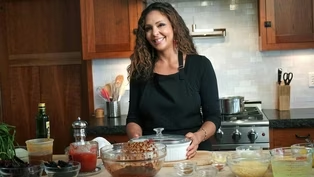
Preview: Relish Presents - Flavor Without Borders
Video has Closed Captions
A preview of Relish Presents: Flavor Without Borders (30s)
Providing Support for PBS.org
Learn Moreabout PBS online sponsorship
- Food
Christopher Kimball’s Milk Street Television
Transform home cooking with the editors of Christopher Kimball’s Milk Street Magazine.



Support for PBS provided by:
Relish Presents is a local public television program presented by Minnesota PBS