
Relish Presents: Cooking with Community
9/5/2026 | 26m 39sVideo has Closed Captions
From the kitchens of Karyn Tomlinson + Mateo and Erin Mackbee
Local Chefs use food to build community connection. For Chef Karyn Tomlinson, knowing where her food comes from is a key ingredient in the delicious dishes she serves at her restaurant. And Chefs Mateo and Erin Mackbee bring 100-year-old Cajun/Creole family recipes to small-town Minnesota in hopes of building community.
Problems playing video? | Closed Captioning Feedback
Problems playing video? | Closed Captioning Feedback
Relish Presents is a local public television program presented by Minnesota PBS
Relish Presents: Cooking with Community
9/5/2026 | 26m 39sVideo has Closed Captions
Local Chefs use food to build community connection. For Chef Karyn Tomlinson, knowing where her food comes from is a key ingredient in the delicious dishes she serves at her restaurant. And Chefs Mateo and Erin Mackbee bring 100-year-old Cajun/Creole family recipes to small-town Minnesota in hopes of building community.
Problems playing video? | Closed Captioning Feedback
Where to Watch Relish Presents
Relish Presents is available to stream on pbs.org and the PBS app.
Providing Support for PBS.org
Learn Moreabout PBS online sponsorship- Here we go.
I believe that food is the ultimate connector.
- When we know who is growing our ingredients, it holds us accountable to use everything to the best of our abilities.
- I think everything that I ever wanted to do, I can do using the power of food.
- This is where the future of food should be.
It's challenging though.
(wind whooshing) (knives clinking) So today, we are going to pick up our pie essentials: some beautiful apples and also a hog.
(pig snorting) (engine starting) I remember the anticipation of driving up to my grandparents' house, and the anticipation grew with each town that we would pass.
I still feel that way.
Finally, we would drive down their street and open the door.
Immediately, I would smell an apple pie that had been just baked.
There was something about that aroma that just cued love, cued acceptance.
It just always marked something special.
And for me, there was no better feeling.
Yeah, here's where my whole family is buried.
I actually have a grave plot out there.
It's kind of.
(Karyn laughing) - Yeah, I know.
- [Interviewer] Tell us a little bit about yourself.
- I'm Karyn Tomlinson.
I'm the chef/restaurant owner of Myriel in St.
Paul.
- Yeah, I won Best Chef Midwest for the James Beard Awards.
I was listed as one of Food and Wine's best new chefs.
I'm just gonna back up.
(film rewinding) I think that pie has a really important statement to make in our culture.
Our rituals and traditions have been changing as we add more and more to our schedules.
There's something to be said for longer, slower processes that we do by hand.
My grandmother was known for her great pies.
When I was just old enough to reach the counter, she showed me how to do the whole thing, start to finish.
And I felt so special.
(peeler scraping) (peeler clattering) (knife thudding) Once or twice a week, somebody from Myriel goes out to the Dassel/Cokato area.
We get grain, we get milk, we get produce.
There's so much that we get.
It excites me to know that I get to work with these incredible farmers, have their incredible ingredients, translate that into incredible food to serve to people.
That whole process is what gets me excited.
That's what got me into cooking in the first place.
It's so special to know the people who are growing the things that we get to cook.
(soft gentle music) Here's the apple farm.
(upbeat country music) (rooster crowing) Two of the most important requirements are what fat to use in the crust and what kinds of apples to use.
- [Farmer] Karyn.
- Hey.
- Hey.
- What a beautiful day.
- Good afternoon.
- [Farmer] It is a keeper.
- "In a pinch, Granny Smiths would do," she would say.
What's your rooster's name?
- Sir Lancelot.
- Sir Lancelot.
But Haralsons were definitely the best.
They're tart, firm, and it just tastes like a Minnesota fall.
(upbeat string music) So do the trees produce less fruit the older they get?
- As they get older, more mature, they probably aren't as strong and vital as when they were younger.
So they're producing, but every year changes.
Mother Nature sometimes is a little bit challenging.
- A little fickle?
- A little fickle.
- Yeah.
Did you grow up having pie in your family at all?
- [Farmer] I did.
- [Karyn] Do you know what apples?
- Haralson.
- They were Haralson.
- They were Haralson.
- [Karyn] I mean, we've been going through pies like crazy, so.
- Really?
- Yeah.
- It's a tart apple.
- Can I try this one?
- You may.
- Yeah, the structure of the Haralson is so nice.
That's why my grandma taught me that they're the best pie apple.
- [Farmer] You learned really well from your grandma.
- Beautiful food not only creates community, but it also comes from community.
(upbeat pop music) When we know who is growing our ingredients, it kind of, in a sense, holds us accountable to use everything to the best of our abilities.
All right.
- [Sean] Hi, Karyn.
- Sean, hey.
So is the hog ready?
- Yeah.
- How big was this?
- I think it was around 136 per half.
- That'll get us a good while.
- [Sean] Yeah.
(upbeat pop music) - Joe the barber, right next to Muriel, he has seen some interesting sights since we've opened.
And he's seen everything.
That's normal.
I think it's normal, right?
(Karyn laughing) (singer singing in foreign language) The lard in the crust?
That's what makes a really flaky texture.
As a culture, we tend to go all in.
So either you're abstaining completely from meat, it's all plant-based, or we eat a lot of it.
Maybe more than makes sense for what our land can support.
You know, I think that by using everything and learning to love, you know, some of the off cuts, you know, that's a really great way to respectfully steward our resources.
(singer singing in foreign language) Okay, I am gonna peel out some of this lard for you guys.
(singer singing in foreign language) Here, we're just starting the lard rendering process.
I just have this in some water and on a really low heat.
Basically, the water is just melting the fat down.
It's gonna be going all day today and then maybe even part of tomorrow.
I never saw my grandmother rendering lard, but she was a true depression era farm girl at heart.
Sometimes she left things for a questionable amount of time in a refrigerator.
But she truly did use everything.
My other grandma actually remembers having lard sandwiches in school.
♪ When we are apart ♪ ♪ I will remember ♪ So now I'm just adding the lard into a bowl of measured out flour and a little bit of salt.
Even in her later years when she had dementia, I would give her pie that I had made.
And she would ask me, "Karyn, what are you using in the crust?"
And I would tell her, "Grandma, I'm using lard."
And she would pat my hand and just say, "Good girl."
That's how strongly she felt about it.
She also checked on what kind of apples I was using too.
Kind of turning the bowl, letting that movement do some of the work.
Not mashing, I'm cutting, because this is lard that we rendered.
You can tell that it has a bit of a savory aroma.
And it's really nice when it combines with the flour.
♪ 'Til forever ♪ ♪ You'll be in my heart ♪ Basically go until a point where you know that if you just gently encourage it to come into two balls, it will.
(light soothing music) One thing that my grandmother showed me when she was teaching me how to make pies, which actually is a really good lesson in life too, I think, is that you don't need to worry if it's not quite behaving or if it's starting to fall apart.
There's a little tear, like there was just there.
You can usually do something to fix it.
I do think that this is where the future of food should be and where I'd like to see it going more and more.
It's challenging though, you know.
A lot of people are trying to figure out how they can connect with a smaller market.
I'm willing to drive out and go get things, but that doesn't look the same for everybody.
You know, a lot of our farmers, this is a conversation we often have together.
Alright, I'm gonna add some apples.
I love being a chef somewhere where there's a four season climate and there's a sense of looking ahead and preparing for the next one, and really embracing the one that you're in.
(singer singing in foreign language) - Yeah.
I get pretty excited about adding some apples.
Plus, I'm not worried about mixing it ahead of time into the apples.
Just simply putting it on top.
And now I'm adding a Grandma amount of butter to this.
(singer singing in foreign language) Okay, now's the fun part.
(singer singing in foreign language) Oh, this crust feels so nice, if I may say so.
Really, really leaning into the rustic look here, but that's, I think, what makes it charming.
You know, a person made it.
(light gentle music) Set timer for 20 minutes.
(light gentle music) This looks pretty on point here.
I love when there's a little bit of kind of caramelized sugar on top.
Oh yes.
Oh.
Sorry.
(light gentle music) It tastes like Grandma's pie.
That crust with the lard from the hogs that we butcher is just so perfectly flaky.
I'm really happy with it.
And I know my grandma would be happy with this too.
(utensil clinking) (light gentle music) Good piece of pie.
Do you wanna, do you guys wanna give it a taste or?
- [Interviewer] Yeah.
- [Karyn] I have an extra fork just for you.
- [Interviewer] Oh, thank you.
- Oh my God.
That is so good.
Oh my gosh.
Wow, Karyn, if no one's gonna take this, can I just- - I mean, just, yeah, keep going.
- Can I just box it up?
- I think we can arrange a deal.
- [Director] I'm gonna have to take that home.
- There really is no better combination than egg coffee and this pie.
(light gentle music) So Swedish egg coffee, it's a Swedish immigrant farmer tradition.
(whisk clinking) This is a method that people use to make their coffee grounds go further, but it also makes it taste better.
My grandmother would always have a teacup of already mixed egg in the refrigerator, and it looked so gross.
(fork clinking) So even if you don't have access to very good coffee, this really makes it taste better.
(dial clicking) Okay.
In Swedish on there, it says that coffee is the best of all earthly drinks.
So now that it's simmered for a little bit, we're going to shock it with some cold water to stop it from cooking longer.
(light soothing music) This is way stronger than my grandma made her coffee.
(wind whooshing) (knives clinking) [Erin] You take two city kids and you put them out in rural Minnesota for the first time, especially being a biracial couple.
Okay, who's gonna be nice to us?
Who's gonna accept us?
Who's gonna continue to support us?
- [Mateo] As a black man moving into a predominantly conservative white community, there was challenges in the beginning.
There was a lot of pushback, a lot of the "what are you taking away from us?"
[music] ♪ Here we go!
♪ Thanks for coming, Mom.
It's been a long time since we've cooked together.
I concentrated on making sure that people understood that I wasn't there to take.
- [Mary] This is always a lot of fun.
Brings back a lot of memories.
- That I was there to give, compliment, and build the community.
We try to accept everyone as they are when they walk in the door.
Embody the idea that everyone is welcome.
Providing a space that people feel like they can come be themselves and celebrate.
We have been completely embraced.
This is home.
- This is my husband, Chef Mateo Macbee.
Son of the Mary Macbee.
He has many accolades himself, but the most recent and proudest is being a semifinalist of Best Chef Midwest of James Beard.
- Our jumbo is yellow or white onion, celery, smoked sausage, sirloin, cubed ham, and you've got some shrimp, you've got chicken.
This is my wife, Erin Macbee.
She is co-owner of Flour and Flower Bakery, Krewe restaurant and Joetown Burgers.
She was named one of the 20 best bakeries in the United States by the New York Times.
♪ Lift me higher ♪ We don't use hot dogs in our recipe at the restaurant, but I remember eating it with my grandfather in New Orleans and finding hot dogs in there, and finding that to be really cool because I love hot dogs.
- [Mary] Well, with a family of seven, we would make a cheaper version of gumbo.
- Krewe serves Creole Cajun cuisine.
I've always wanted to try to celebrate my mother and grandfather's culture.
My mother is born and raised in the city of New Orleans.
My grandfather was a merchant marine chef on a cargo ship that would leave from the port.
I grew up in Minnesota and we would go down to New Orleans just about every summertime.
It was cousin time.
As soon as we showed up they all knew my grandfather was going to cook and he did not know how to cook for less than about 25 people.
And so there would be lots of food.
But I remember helping him standing on a stool, putting shrimp, putting sausage, stirring big huge pots on the stove, helping him plate stuff, grabbing the hot sauce out of the cabinet.
Food is love and can create memories.
We get a lot of memories through some of the experiences that we have and the people that we meet and kind of can reinvigorate us at times when we may feel like this is this job is very taxing.
I don't want to do anything else nor do I think my life's purpose is to do anything else.
I think everything that I ever wanted to do I can do using the power of food.
[Oliver panting] - No droppings Oliver.
He's hoping.
- [Erin] This is Oliver.
He loves to eat.
- And he loves people.
So he's just like us.
- [Erin] Making bread pudding, Mary Mackbee style, the only style as far as I'm concerned.
We've got day-old baguettes from Flour and Flower.
Imitation nut butter flavoring is the secret ingredient to the-- - Yeah, it's a typical New Orleans flavor.
You can't get it up here.
- The name Krewe is derived from the groups of people that get together to make the floats for Mardi Gras.
The basic idea of them is a group of people getting together to be creative and make things that are creative.
So, in the restaurant, we took that adage and just applied it to food.
And so we are a group of people coming together to be creative around authentic New Orleans food.
And then also have a little creativity mix in with that.
What New Orleans is, to me, is what we try to embody: Good people, good food, and a good time.
The little building that the bakery is in behind the restaurant was actually not part of our original plan.
Me being the dreamer that I am was like, we could create both of our dreams in one shot.
You alright?
- Yeah.
I'm good, how are you?
How's your day going?
- It's good.
- Is it busy over there?
In Flour and Flower, we sell everything from pies to laminated pastries to artisan breads to fresh bouquets of flowers in the summer and then dried bouquets in the winter.
The goal is really just to be a little magic witchy bakery shop tucked behind, you know, a New Orleans restaurant.
So it kind of, there is a theme there.
- Being only a hundred feet from one another, there's a lot of collaboration.
Nice big hunk of our Flour and Flower baguette to dip all that goodness in.
Things fly back and forth from place to place.
- He starts something in the restaurant, sometimes I'll finish it when I'm coming in for my baking shift, or he'll help me finish my lunch menu by throwing some savory ideas at me, and then I'll help with the dessert menu for Krewe.
You think we'll be busy tomorrow?
- There's 90 at night.
Gumbo just means soup.
Every family has their distinct recipe of gumbo.
Ours just happens to be ones thats made more in what you would consider a city style or Creole style where it's a more of a broth base.
We currently have three recipes that are approaching a hundred years old that have been passed down from my grandfather to my mother to me.
Our jumbalaya Our gumbo and our red beans and rice.
With New Orleans being the home of jazz improvisation, we kind of apply those philosophies inside the restaurant as well.
No dish I think is exactly the same and I think that's the beauty in the chaos of what we do in the kitchen on a daily basis.
[sizzling] ♪ ♪ Cajun Creole cuisine uses more cayenne pepper and paprika and smoke, and it's a warming heat versus a punchy, spicy heat.
Holy Trinity, which is green bell, onion, and celery.
I describe it as very familiar ingredients to you, just put together in an unfamiliar way.
When we first came, there was some apprehensions about folks in west central Minnesota, understanding the food, the level of beyond ketchup spiciness that was going to be involved.
We have toned down things, a few things just a little bit.
So there are other ones I'm like, no, we're not changing.
I absolutely have people being overwhelmed by the flavor.
There's a few dishes that only have black pepper, and then there's no other real seasoning, and they're just like, what's this spice in here?
It's just black pepper.
You're gonna be fine.
But those are very few, far in between.
- Are we ready for the herbs?
- Yes - Okay, do you wanna take scallions or parsley?
- I'll take scallions - Nice thin dice on the scallions and a mince on the parsley, please.
The greater community of St.
Joseph has really embraced the culture, the cuisine, everything that has to do with New Orleans.
[whisking] ♪ ♪ - Well, it's a lot like mine, so it's very good.
- She's always the boss - She's always in charge.
Especially when we first opened, Krewe, she would walk into the kitchen.
Almost all the chefs in the back would stop talking and just kind of wait to see what she did.
And she'd stick her spoon in the gumbo, adjust it from that way, stick her spoon in the jambalaya and adjust it how she liked it.
- I believe that the courage and everything that I needed to be in this space, in this time was because I watched my mother try to be a good person in the community and try to do good.
♪ ♪ For me, the four walls in a restaurant are like a microcosm of life.
♪ ♪ You learn so much about yourself, other people, other races, other ethnicities.
I believe that food is the ultimate connector.
It can give you a cultural experience without you having to get in a car or a plane.
It can give you southern hospitality feeling may never get if you've never been to the South.
- You want the scallions in half or circles?
- Circles, please.
Community is the foundation of everything that we do.
We build up from that.
It's who we are on a daily basis, even when we're not at the restaurant.
- We measure our wealth by our connections, our community members, the hugs we've had that week.
- Those are the things that are like, okay, we're doing something really good for ourselves.
(gumbo bubbling) (spoon tapping) ♪ upbeat music ♪ - I believe truly that we've been able to do a lot of good in this area, bringing attention to our community.
The amount of traffic that we've driven to that city, it's become a destination city.
St.
Joe is home for us between here and St.
Cloud, and so I think leaving home would be really, really hard to do.
And I think we would give in to some people's expectations of us that we were just here to come and take for a while and then leave, which we are not.
♪ ♪ - Mm, very flavorful.
- All that juice goes into the crab and it soaks it up in the meat too, so you get all that flavor inside of there.
- Very good.
- Does it taste like grandpa's?
- Yes.
Oh, the hot dog, I didn't try the hot dog.
I'll have to try the hot dog.
- I'm just very grateful that I can still do this with her and that she still critiques me at this point in time.
Keeps me humble, keeps my head down.
We always say in the kitchen, just keep your head down and cook.
Anything else will be fine if you can do that.
- We have succeeded in this chapter that we are in, but this is a very long book that we have started, and I think we have so many more chapters to go.
- As long as we can be here, we will stay and do everything that we can on a daily basis to be a part of the community.
- Bread pudding, for me, is kind of a funny subject.
I did grow up with a grandma who brought bread pudding to every family gathering, and it was horrible.
And I tell my grandma this so it's not a secret, but it was always rock hard, it was never sweet enough.
I never understood why people thought bread pudding was a delicacy until I met Mateo and we had our first Thanksgiving together at his mom's house.
And Mary was like, if you want to be a Mackbee, you need to taste the bread pudding.
OK.
So I did the whole, you know, close my eyes, plug my nose, take a bite.
And I swear to God, just like when I saw Mateo for the first time, there was birds circling my head, angels.
There was something harmonious happening.
There is rhyme and reason with bread pudding, and it can be very good if done correctly.
Sorry, Grandma.
- Sorry, Nedra.
- Yeah.
[laughs]
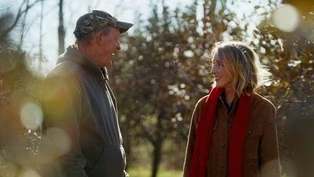
Preview: Relish Presents - Cooking with Community
Video has Closed Captions
A preview of Relish Presents: Cooking with Community (30s)
Providing Support for PBS.org
Learn Moreabout PBS online sponsorship
- Food
Christopher Kimball’s Milk Street Television
Transform home cooking with the editors of Christopher Kimball’s Milk Street Magazine.


Support for PBS provided by:
Relish Presents is a local public television program presented by Minnesota PBS