
Ornie Alness, Rustic Designs Flower Farm, Dave Roth
Season 17 Episode 2 | 28m 45sVideo has Closed Captions
WWII US Navy Veteran Ornie Alness, a flower farm & veteran Dave Roth talks music and family history
Ornie Alness reminisces on his WWII US Navy tour and life as a farmer in Clarkfield, Rustic Designs Flower Farm in Belgrade grows pick-your-own flowers, and in Madison, veteran Dave Roth shares his music and family history with the Madison Bottling Company.
Problems playing video? | Closed Captioning Feedback
Problems playing video? | Closed Captioning Feedback
Postcards is a local public television program presented by Pioneer PBS
Production sponsorship is provided by contributions from the voters of Minnesota through a legislative appropriation from the Arts and Cultural Heritage Fund, Explore Alexandria Tourism, Shalom Hill Farm, West Central...
Support provided by:


Ornie Alness, Rustic Designs Flower Farm, Dave Roth
Season 17 Episode 2 | 28m 45sVideo has Closed Captions
Ornie Alness reminisces on his WWII US Navy tour and life as a farmer in Clarkfield, Rustic Designs Flower Farm in Belgrade grows pick-your-own flowers, and in Madison, veteran Dave Roth shares his music and family history with the Madison Bottling Company.
Problems playing video? | Closed Captioning Feedback
How to Watch Postcards
Postcards is available to stream on pbs.org and the free PBS App, available on iPhone, Apple TV, Android TV, Android smartphones, Amazon Fire TV, Amazon Fire Tablet, Roku, Samsung Smart TV, and Vizio.
Providing Support for PBS.org
Learn Moreabout PBS online sponsorshipMore from This Collection
Postcards is dedicated to telling the stories of veterans.
 New
NewFoxhole Brewhouse, Smilin’ D Arena, Streets of Honor
Video has Closed Captions
Foxhole Brewhouse's award-winning brews, Smilin’ D Arena is big time rodeo, fallen veteran art. (28m 45s)
Korma Aguh-Stuckmayer, Katie Bell, MN Veterans Home
Video has Closed Captions
Dance company Afrocontigbo; breakaway roper Katie Bell; and Montevideo MN's Minnesota Veterans Home (28m 45s)
Video has Closed Captions
Vietnam War photographer Gary Bipes, artist Nicole Brenny and activist of Mary Beth McCarthy. (28m 45s)
Vietnam Memorial History Center
Video has Closed Captions
Vietnam War veterans Royal and Charlie Hettling’s Vietnam Memorial and History Center. (28m 45s)
Bible Camp History, Norwegian Log Church, Memorial
Video has Closed Captions
Bible Camp History, Norwegian Log Church, Ray Fagen Memorial Airshow (28m 45s)
Bluenose Gopher House, 40 Thieves on Saipan
Video has Closed Captions
The Bluenose Gopher Public House and a platoon known as the 40 Thieves of Saipan (28m 45s)
Vietnam Survival Story with Eugene Murphy and Lyle Bowes
Video has Closed Captions
Vietnam veterans Gene Murphy and Lyle Bowes of Sioux Falls tell their story. (28m 45s)
Kirk Williams and Don McPherson
Video has Closed Captions
Kirk Williams shares his art and WWII Navy Ace Don McPherson shares his story. (28m 45s)
Postcards: Dave Hansen, Vietnam Veteran
Video has Closed Captions
Learn about the Vietnam War from Dave Hanson and the ongoing struggle with PTSD. (28m 45s)
Craig Tschetter, Vietnam War Vet
Video has Closed Captions
Learn about the the book Fifteen Minutes Ago: A Vietnam War Memoir by Craig Tschetter. (29m 8s)
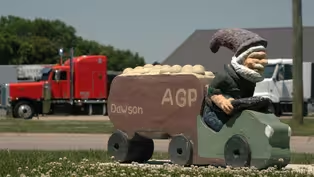
Dawson Gnomes, WWII Story, The Dawson Bank Museum
Video has Closed Captions
The famous Dawson Gnomes, hear a WWII story and get a tour of The Bank Museum. (28m 45s)
Artist John Sterner, Inventor Don Husby, Painter Paul Peters
Video has Closed Captions
Artist John Sterner, inventor Don Husby and painter Paul Peterson. (28m 45s)
Providing Support for PBS.org
Learn Moreabout PBS online sponsorship(gentle music) - [Announcer] On this episode of "Postcards".
(gentle music) - I'm happy I could serve my country.
I'm proud of that, of the time I spent in there.
- I definitely feel that designing is something that you are born with.
I mean, sure, you can definitely learn the techniques, but I think you need to also have that in your blood too as well.
- I'm not in it for the money.
You know, I'm not in it for the business.
It's just self, it's self enjoyment.
(energetic music) (gentle music) - [Announcer] "Postcards" is made possible by the Minnesota Arts and Cultural Heritage Fund and The Citizens of Minnesota.
Additional support provided by Margaret A. Cargill Philanthropies, Mark and Margaret Yackel-Juleen on behalf of Shalom Hill Farms, a retreat and conference center in a prairie setting near Wyndham, Minnesota, on the web at shalomhillfarm.org.
Alexandria, Minnesota, a year-round destination with hundreds of lakes, trails and attractions for memorable vacations and events.
More information at explorealex.com.
A better future starts now.
West Central Initiative empowers communities with resources, funding and support for a thriving region.
More at wcif.org.
(gentle music) (bright music) - Well, my name is Ornie Alness, and I've lived here on this place all my life, with the exception of the time I spent in World War II in the US Navy.
And then I came out of the service and I went back into farming.
I farmed the rest of my life.
I'm still called that actual farmer.
I still got 101 tractor, although I don't do anything like my full farming.
I rent out most of my land.
(bright music) I got married in 1954, I think it was, and we had five children.
I had over about 50 years of nice wonderful life.
Wonderful life and family.
So I had a real wonderful life, actually, a long one and a good one.
(bright music) Well, I was on the troop and supply ship, 535 feet long.
It was actually a passenger liner when it was built because we made some pretty long trips across the ocean.
I went to board ship as a disciplined seaman deck force and I didn't stay there too long until I started working up.
From then on, I was on that ship for 26 months.
I didn't, that was my home and that was underwater back and forth in the Pacific.
We went to the Aleutian Islands, Dutch Harbor, Kodiak four times, hauling sailors up.
After four different trips we went to Alaska.
The first trip I was on was the worst and the stormiest.
We had ended up with 50 foot swells.
That's what they said it was.
It was kind of a little bit scary.
A lot of times when the old nose would go down in the water and you were wondering if you were coming up again or not.
You know, the bow of the ship, not the main stripper structure, but the bow would go into, down into the water.
And when that did come up, my water was just flying tons of it off the top.
(bright music) After we left Aleutian, so then we started going south to the southern islands, south of equator.
I was in on two different take backs or whatever you want to call it, when we took the islands back from the Japanese that they'd take it from us.
You know, I was in the marshals when we took them back, and then Guam was the next one that we, I helped take back.
That was a big one and a tough one.
They were both tough enough, but that was another big fight.
(bright music) It was wartime so you just, that's what you had to live by.
You had to be ready for it 'cause you never knew.
We'd have to stand and watch four hours on and four off and watch for any air raid or airplanes coming in for bombing or anything like that.
We were on the alert on our guns all the time.
We were retaking the Guam Islands.
We had an awful lot of wounded Marines and army guys.
We flew the white flag, so we were supposed to be neutral, but anyway, they didn't pay no attention to that.
Oh, I got into several hair racing experiences, I guess.
So Guam, one time there, the Japanese were on the other side of the mountains, they weren't that close yet at that time.
And they lobbed a bomb over the mountain and come down and land at about 150 feet away from the ship.
(tank firing) War... War is hell.
Nothing else.
But you get in and you do what you have to do, whatever happens.
(bright music) When we were done, we'd taken the Guam Islands.
I was already far enough along in my duty, so I put in for a transfer 'cause I've been on there 26 months.
So if I could get, if they'd transfer me off, I'd take duty to some other place for a while, which I did.
I ended up down San Diego down at the welding school down there, went through more training on that, then I, they transferred me right from the welding school to the repair base there in San Diego.
So I worked on the ships that come in and were shot up.
I was at the repair base there then in San Diego.
So then after the war was over, I stayed there until my turn come up to get discharged and I got, made it home in December, middle of December, right before Christmas.
So then I come back then to peace time, I come back here, got discharged to the Minneapolis.
I got my discharge shapers here at the airport or old gym room.
Got my discharge and I come back here and here I am.
(vehicle engine roaring) - Was it difficult to adjust much when got back from the war?
'Cause you said you served for, how many months did you say?
- Oh it takes, it took a while to kind of, you know, get back in it, but then you got back into your groove.
You got your work to do and you know, it just smooth it off.
But I don't know.
You went right back into the rhythm you had back here instead of in the military.
(gentle music) That is such a change from the time that before the war when I was growing up till now, that you can hardly comprehend what it goes on, you know.
(bright music) Your transportation, your electrically.
We didn't have electric lights out here or nothing.
We didn't, we got them in '40 something, 1940, '41.
(tractor's engine roaring) Your farm equipment is from by stars.
From then till now, you know, there's no comparison there.
And then 100 years, quite a change.
That's for sure.
I don't know, it's hard to comprehend now on what did, everything is so different, you know.
(bright music) - So how often do you think about your time in World War II, like today?
Did it come to your mind fairly often or do you not think about it too much or?
- Oh, I think about it once in a while, but I am happy I could serve my country.
I'm proud of that, by the time I spent in there.
So that's about it.
I probably went and done my little bit and that's about what it amounted to like everybody else did, I think.
(tractor engine roaring) You've done your job there just like any other place and you... And you ended up serving and being thankful that you could.
(bright music) - So Rustic Designs Flower Farm is where we grow two acres of specially cut flowers.
Actually it's a little bit over two acres of cut flowers that we grow out in the field.
We sell wholesale to flower shops in Central Minnesota, and we also do a subscription deliveries where we deliver flowers to people's homes, and we have you pick hours where you can come out to the farm and pick flowers early in the morning.
We also have flower ranging classes out here as well as classes year round.
So we have like the spruce top classes in the winter time.
We have succulent planter classes in the summertime.
Oh, and also a lot of wedding work.
I forgot to talk about that.
We do full design and setup, so that does take up most of our weekends with that type of thing.
So we use an assortment.
We have just a fun assortment of succulents and fun assortment of containers too that you get to pick from for that class.
So it's super fun.
(bright music) I grew up on a farm not very far from here.
We had a huge garden and lots of flowers, and both my grandmas have flowers.
I was really surrounded by flowers as a child.
I was in forage, so I exhibited at the county fair and of course I exhibited flowers as well as in the open division.
Belgrade also had a flower club, a really big flower club back in the day where they actually had their own little fair, and it was pretty large.
And I exhibited there as a child and I even competed in the adult divisions.
So, and there was also another lady at my church that taught me a lot of skills as far as design work.
And so I feel as a child that I really grew up with it.
So I always say it's in my blood.
I just really love flowers.
I have a passion for it.
(bright music) So with the you pick hours, you just come out to the farm and we have a bucket and clippers, you can cut your own flowers.
We suggest to cut nice lawn stems and then you just pay the stem price.
So stem prices are anywhere from $0.50 to $5.
Once you're done, then we'll bundle them up for you to take home.
And we would certainly put them in a bucket too.
If you brought your own bucket, we'll put 'em in your bucket for you to take home too.
So that's kind of how that works.
So it's very important that the cutting hours are only in the mornings from 8:00 until 10:00 a.m.
We do have some that'll come after 10:00 a.m., and unfortunately we don't allow picking after 10:00 a.m.
just because it gets too hot out in the field and it really is stressful on the flowers to pick in the heat of the day.
So that's why we have morning picking hours.
(bright music) - Okay.
It's a pretty shot.
(participant chuckles) - I'll do it.
(bright music) - I definitely feel that designing is something that you are born with.
I mean, sure, you can definitely learn the techniques and the mechanics behind it, but I think you need to be, also have that in your blood too as well.
(bright music) I started the flower farm in 2011, so this is year number 14.
Now, granted, when I started back then I had just a little space.
It was definitely under an acre and I just grew it over the years, every year expanding a little bit more, tilling up a little bit more grass, taking down some sheds.
Even last year we took down 120 trees to expand out in the backyard and put up a high tunnel.
And when I started out in 2011, I was just doing the farmer's markets in Wilmer, and that's kind of how I grew my business and my clientele.
And we no longer do the farmer's markets.
We built this building, the shed here in 2018, and that was kind of a game changer.
People really wanna come out and experience the farm kind of behind the scenes.
And so we quit doing the farmer's market at that point and we just invite everybody to come out to the farm to experience what the flower farm life is like.
We're actually gonna be taking them completely out of the crate.
- Yeah.
- Throwing everything but keeping the lilies itself and then just the lilies will go into the shed just to dry.
And I wanna save them for the Harvest Fest and give them away as a. Flowers make people happy and colorful, lots of color, especially like in the springtime when you are so sick and tired of the winter and the snow and no leaves on the trees, and the first flowers in the spring is just everybody, it brings a smile to everyone's face.
Flowers are happy.
(bright music) I find that growing flowers is therapeutic.
It just is soothing to the soul.
It's happiness.
The satisfaction after weeding an area is great too 'cause you see a really weedy area and you just wanna clean it up and it's just that good feeling after you got a clean space or once you have tied up flowers.
We do tie up our flowers out in the field.
Certain ones need a little bit more support.
So after you've gone through the area, just the neatness.
(bright music) My favorite flower changes every week.
I'm definitely drawn to flowers that have scents.
So I definitely like the lilac, the peonies, the garden flags are probably my top favorite ones, I guess.
But other than that, I don't really have a favorite.
It changes week to week.
(bright music) No, we have no air fresheners.
You know, that's a funny thing is everyone comes in here like, oh it smells so good in here.
I honestly am so used to it, I don't even notice it.
I have to be gone for like a whole entire week to even know that it's, it's like a different scent in here.
And I think it's also a lot to do with the dried flowers that we have on this ceiling.
We have so many dries up there that I think it also creates a scent in the, the shop here, but everyone loves the, the scent when they walk in and I just don't even smell it, it is so sad.
(participant laughs) (bright music) I have a degree in horticulture and floral design.
So I had worked in the floral industry and small flower shops.
I knew that I didn't wanna own a flower shop on Main Street.
I wanted to do something a little bit different.
I love being outside, I love getting a tan and I love growing flowers, so I thought, you know, let's just try this.
Let's just grow some flowers, see how it goes and see if I can make a go of it.
So I think this is probably like year eight or so where this is my full-time job.
This is all that I do.
Now, granted, I can't do this all by myself.
I have six girls that help me here at the farm.
So it's definitely a teamwork farm.
(bright music) 5:00 this morning, I was working on wedding work because it's gonna get really hot today.
So usually I am out here right away at 5:00, either working out in the field on stuff or prepping the list of things that need to be done for the day or like Thursdays and Fridays I'm working on wedding work.
There's been even times where I'm out here at 3:00 or 4:00 in the morning working on wedding work 'cause wedding work takes a lot of design hours.
So it just depends upon how many weddings I have for the weekend and what needs to be done.
My early mornings are early, but I get my best work done.
I think I'm the most creative person in the morning, so.
It's less distractions too.
(participants laugh) (bright music) I am gonna do this until I'm like 70 ish.
(participant laughs) I am... I love what I do, so yeah, I definitely, I'd say that I'm definitely gonna be in my 70s before I quit doing this, but I've recently been thinking a little bit more about that and what does retirement look like, and I wanna keep doing this.
(bright music) Yeah, I really love this.
Yeah, this is a passion.
(bright music) (participant playing guitar) ♪ Wanna go home ♪ ♪ Seem like another life and time ♪ ♪ Gotta be strong ♪ ♪ Sometimes you realize ♪ ♪ Through the cold ♪ ♪ All that you know ♪ ♪ Wanna go home ♪ - In an early age, my mom was the choir director at the church and they, my dad was a, he had a beautiful tenor voice and she had a soprano voice and they sang for people's weddings and then they did the cantatas.
You know, so it was always, there was music in our home.
Then my cousin Randy and my cousin Tim and my brother Charlie, you know, they used to have little hoot nannies, you know, and like sing alongs and stuff.
And it was just, as early on I was always infatuated with, you know, and loved it.
(participant plays guitar) A year or so ago, you know, I met David and Hannah, and it kind of opened me up a little bit.
We started really working on different things and we put projects together to perform, and that's been really good for me.
It kind of got me, it reenergized me, and I just said, you know, now now I'm hooked.
(participant laughs) Let's not be embarrassed to tell we're embarrassed.
(bright music) - Well, I joined the National Guard March 2nd of 1982.
I did 20 years in Bravo Battery right here in Madison.
Started out with as a 13 Bravo, and that's a cannon crewman.
And then I moved into food service, and then I retired.
And that was in 2002.
And then in 2008, I reenlisted in the National Guard, and then we went to Iraq.
I guess after Iraq, you know, we got back and, you know, 'cause I did 20 years first and then when I reenlisted, I did another nine years and which a wonderful experience, and I accomplished to retire as a E-8 with 29 years of service.
So very proud of what we did.
Some of the greatest people that I've met my whole life is associated with Minnesota National Guard.
Something to hang on the wall now.
(participant laughs) (bright music) Back in 1917, my grandfather started the Madison Bottling Company, and my dad, his brother Malin and his brother Roland joined the partnership.
And they bottled Sun-Drop right here in this building.
And during the prohibition, I think they sold select beer.
And then as Prohibition lifted, they started selling Schmidt beer.
They would take a model A truck to St.
Paul to the Schmidt Brewing Company and they'd pick up a load of beer and bring it back.
But back in those days when they did that, it wasn't a very good road all the way to Minneapolis and back, but they did that.
My dad retired out of the modeling company in 1982, and then he took over this building, and my uncle and my cousin went out where they're located outside of town on Highway 40 where they are today.
(bright music) And if you can really see it, but 1918, my grandfather Henry W. Roth.
And this was done by my sister Rachel.
And they made a... There's a Henry Roth family.
And the old, his is where we were.
That was at... That's where my garage is.
And then see that little building there, that's where we were... That's where we were sitting in.
(bright music) That is my dad in 1931 drinking a bottle of pop out on the front steps.
I just like that picture 'cause that's an old trike there, you know, rolls up on a trike and drinks pop.
(bright music) Yeah, a lot of things through the years here.
This is my uncle Malin and my uncle Milton.
And that's that truck that they'd... That model a truck 'cause that's when they'd go and they'd get loads of Schmidt beer down in St.
Paul.
(bright music) Back in the '50s, my grandfather went to a bottling convention and he came home and he said, "Boys, I bought this franchise from the Sun-Drop."
And he says, "This is the future of Madison Bottling Company."
And they started bottling Sun-Drop, and it was very successful.
My dad pretty much made all the Sun-Drop that everybody got addicted to around this area.
And everybody was like, well, they, Madison, you know, the Sun-Drop was invented in Madison, Minnesota.
Well, I don't think they told anybody that it is actually from I think South or North Carolina (chuckles) you know, and they bought into the franchise to do it.
But, you know, so there's still today, still today people think, some people think that we invented Sun-Drop.
(participant laughs) You know, so yeah, it's just a funny story, but it's cool bottles.
(bright music) Yeah, I was the youngest of my family, and I was waiting my turn to get a chance to work for the Madison Bottling Company, and the rule was that you had to be 10 years old to work for the Madison Bottling Company.
And I was nine and I was in the house and my brothers were out working, and I heard my dad coming up the stairs and he said, "You want a job?
I'll pay you $0.25 an hour."
And as soon as he said that, I had my boots on and I was down the stairs.
He could have said, I'm not gonna pay you anything, I'll just try you out, and that would've been fine with me too.
I mean, it was just a, you know, and that was just the thing we did, you know.
We worked, worked, worked all day for $2 (laughs) and loved it.
(bright music) Being in the National Guard, being Camp Ripley, you know, I'd bring my guitar, you know.
I'm a harmonica player and I, you know, we'd do stuff that, you know, we'd play for the guys.
That's been fun.
And as far as the opportunity to play like, at, with the church services and just to be part of that, maybe to give a little bit of enjoyment to people.
You know, I guess that's, any musicians, I guess that's where their euphoria comes in, I guess, you know, to be able to get some response, you know, from somebody that enjoys listening to you.
I guess that's what we go for.
Try to spread some joy and get some good feedback.
(bright music) I'm not in it for the money.
You know, I'm not in it for the business.
It's just self, it's self enjoyment.
And that's all I really want.
I don't, you know, I have no dreams of... You know, I think it's a little late to be a rock star.
(participant laughs) You know.
(bright music) (energetic music) - [Announcer] "Postcards" is made possible by the Minnesota Arts and Cultural Heritage Fund and The Citizens of Minnesota.
Additional support provided by Margaret A. Cargill Philanthropies, Mark and Margaret Yackel-Juleen on behalf of Shalom Hill Farms, a retreat and conference center in a prairie setting near Wyndham, Minnesota, on the web at shalomhillfarm.org.
(bright music) Alexandria, Minnesota, a year-round destination with hundreds of lakes, trails and attractions for memorable vacations and events.
More information at explorealex.com.
A better future starts now.
West Central Initiative empowers communities with resources, funding and support for a thriving region.
More at wcif.org.
(bright music)
Video has Closed Captions
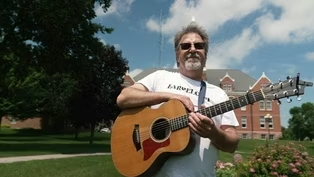
Clip: S17 Ep2 | 9m 43s | Veteran Dave Roth shares his music and family history with the Madison Bottling Company. (9m 43s)
Video has Closed Captions
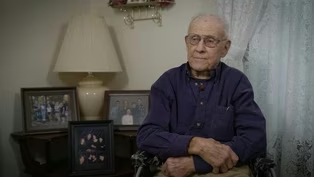
Clip: S17 Ep2 | 10m 53s | Ornie Alness reminisces on his WWII US Navy tour and life as a farmer in Clarkfield, MN. (10m 53s)

Ornie Alness, Rustic Designs Flower Farm, Dave Roth
Preview: S17 Ep2 | 40s | WWII US Navy Veteran Ornie Alness, a flower farm & veteran Dave Roth talks music and family history (40s)
Video has Closed Captions
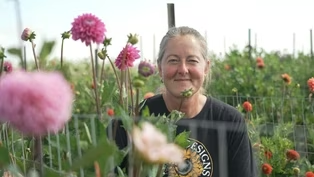
Clip: S17 Ep2 | 8m 48s | In Belgrade, Mary Solbreken has always, even from a young age, had a passion for flowers. (8m 48s)
Providing Support for PBS.org
Learn Moreabout PBS online sponsorship

- Arts and Music
The Best of the Joy of Painting with Bob Ross
A pop icon, Bob Ross offers soothing words of wisdom as he paints captivating landscapes.










Support for PBS provided by:
Postcards is a local public television program presented by Pioneer PBS
Production sponsorship is provided by contributions from the voters of Minnesota through a legislative appropriation from the Arts and Cultural Heritage Fund, Explore Alexandria Tourism, Shalom Hill Farm, West Central...