
Grant's Farm, Hour 2
Season 30 Episode 14 | 52m 24sVideo has Closed Captions
ANTIQUES ROADSHOW harvests hidden treasures at historic Grant’s Farm in St. Louis, Missouri. One fin
ROADSHOW harvests hidden treasures at Grant’s Farm, including a 1960 Ansel Adams Portfolio III: Yosemite Valley, a Persian Qashqai Gabbeh rug, ca. 1935, and 1959 JFK’s boxer shorts with signed photo. One find reaches $40,000-$60,000!
Problems playing video? | Closed Captioning Feedback
Problems playing video? | Closed Captioning Feedback
Funding for ANTIQUES ROADSHOW is provided by American Cruise Lines and Ancestry. Additional funding is provided by public television viewers.
Support provided by:


Grant's Farm, Hour 2
Season 30 Episode 14 | 52m 24sVideo has Closed Captions
ROADSHOW harvests hidden treasures at Grant’s Farm, including a 1960 Ansel Adams Portfolio III: Yosemite Valley, a Persian Qashqai Gabbeh rug, ca. 1935, and 1959 JFK’s boxer shorts with signed photo. One find reaches $40,000-$60,000!
Problems playing video? | Closed Captioning Feedback
Where to Watch Antiques Roadshow
Antiques Roadshow is available to stream on pbs.org and the PBS app.
Buy Now

ANTIQUES ROADSHOW's 2026 Production Tour
Enter now for a chance to win a pair of free tickets to one of the three stops on ANTIQUES ROADSHOW's 2026 Tour. Sweepstakes entry deadline is April 6.Providing Support for PBS.org
Learn Moreabout PBS online sponsorship♪ ♪ CORAL PEÑA: Not to brag, but "Antiques Roadshow" is prouder than this guy to be showing off treasures at Grant's Farm.
You're telling me you bought this painting for $40.
I loved her braids and her glasses and her bangs.
(laughing) I can see the resemblance.
♪ ♪ PEÑA: Grant's Farm is a special blend of wildlife park mixed with the history of St.
Louis beer-making.
August Anheuser Busch, Sr., former president and C.E.O.
of the Anheuser-Busch Brewing Association, bought this property in 1903 from the family of President Ulysses S. Grant.
Grant's Farm opened to the public in 1954, and today entertains hundreds of thousands of visitors every year.
What treasures are pouring into "Roadshow" at Grant's Farm?
Wow, what you got here?
I don't know.
(chuckles) That's why she's here, she doesn't know.
(laughs) GUEST: It was in my grandma's basement.
During Prohibition, Anheuser-Busch sold other products besides beer.
And this one in particular was used for egg products.
So, they sold egg whites during Prohibition.
GUEST: It's my grandfather's train.
He used to run it around under the Christmas tree every year, so I know that at one point it worked.
And it's been in the family for probably 100 years.
APPRAISER: So, this is a German-made train.
Actually, if we turn it over and look on the underside, right at the top here... Oh.
...it's marked "Made in Germany."
Now, normally, there would also be the company logo, which is an M and a C, from Märklin.
Uh, Märklin is the maker of the train, circa about 1906, 1907.
Okay.
Märklin was a producer of children's toys, uh, at the turn of last century, and they really made the top, top-quality toys.
Trains was sort of the rise to the top.
They're actually still a company today.
England, France, and the United States were the three markets for exporting their trains.
Oh.
And they designed the trains specifically for those export markets.
Okay.
So in this instance, it's an American beer car.
"Schlitz, the beer that made Milwaukee famous."
Schlitz started around the mid-1800s.
In fact, it's actually still a brewery today, owned by Pabst Blue Ribbon.
There's three different variations of the beer cars that Märklin made.
There's a Pabst Blue Ribbon and there's also a Budweiser.
They're all very desirable.
The Schlitz car, in this size-- which is a gauge 1 train car size-- in the past 20 years, there's only been a dozen or so that have come up.
So, quite a rare piece.
Oh, okay.
What's also very interesting about these toys, they're tinplate, and they're all hand-painted with an enamel paint, which does hold up really well.
And that's why it's still so well-preserved here for being over 100 years old.
Uh, it has opening doors on the sides, with a little hinge, and you can even open the hinge roof to get access to the interior load.
Mm-hmm.
This would be a refrigerator car, so this one would be refrigerating Schlitz beer.
Oh.
As is often the case for all of these toys, condition is king.
Mm-hmm.
This is in really nice condition.
(gasps) Oh, good.
It is.
It's very sharp, colors are great, all the way around.
There's some wear.
Your grandfather obviously did play with it, but the paint is really well-kept.
It can actually be cleaned up a little bit to really brighten up the color even more.
Mm-hmm.
Now, in valuing the train car, it's a select market.
Uh-huh.
This is an American-focused marketplace.
Mm-hmm.
Do you have any idea what the value is on a train like this?
No, no.
You might want to pour a nice cold glass of beer after I tell you this, but this train car should easily fetch $10,000 to $20,000.
Dollars?!
Wow.
That's amazing.
That's wonderful.
Now, with that said, there have been examples of this car that have sold for $30,000 or even $40,000.
(chuckling): Oh, good-- I'm... S... I'm almost speechless.
And you know-- if you know me, that's... (both laugh) I got this at a thrift store about a month ago.
I paid 70 bucks for it, and I want to know more about it.
I know it's a Windsor.
It's creaky, but that's how I know it's old.
This is a 1970s Bell & Howell radio.
My grandpa worked for Bell & Howell for about 35, 40 years, so I think this was probably, like, a, a gift that they gave at Christmas or something.
I rescued it from the garage, like, five years ago and got it cleaned up.
And now it, now it lives in my office.
And it also has a cassette tape player in the back... Yeah.
It gets really... ...that you can take off.
It gets really, really loud, it's... I have a couple Grateful Dead, uh, cassette tapes that I still play... (laughing): Yeah, yeah.
...uh, much to her chagrin, in there.
(laughing) Yeah.
GUEST: I brought a bracelet, a pin, and a pair of earrings that I first saw 50 years ago, after my grandmother died.
All of the jewelry that was hers was laid out on a large meeting room table at the trust company, and my sister and I were agog at all the wonderful things.
The diamonds, the, the... Everything.
But it was up to my father to choose.
And he chose these.
At 20 years old, I was really disappointed.
(both laugh) I wanted the diamonds, but these are so beautiful.
What you have here are micromosaics.
Some of the most beautiful examples that I've ever seen, actually, in my career.
And it's not just one piece, it's three pieces that go together: a brooch, earrings, and a bracelet, which together form what you might call a parure.
So, we started to look at it more carefully, and realized that not only was it a great example of micromosaic work, it had hallmarks on it that indicated that it was from Rome.
It had the Papal State marks, with the St.
Peter's crossed keys.
Oh, cool!
Um, which place it around 1840, 1850.
What you have in that era is a confluence of a number of things going on.
This was before Italy was consolidated.
Rome was an independent state.
It was the era of the Grand Tour, when Europeans and English and Americans would make the big tour of Europe.
Italy was already known for great micromosaics, but there was a great output in that era in order to feed the souvenir market.
They came in all levels of quality.
But these are among the best pieces of jewelry of that type that I have seen.
Micromosaics... Mm-hmm.
...are made of tiny little pieces of glass.
Exactly.
There's a lot of very detailed handiwork... Absolutely.
...involved in creating these.
You've got really beautiful floral designs here.
You've got two doves mounted in 18-karat gold.
We had a lively discussion among the appraisers, because e, everyone was im, impressed by these pieces.
We're thinking that a retail price for these could be $28,000, $32,000, in that range.
Holy cow.
Wow.
Increase my insurance, yes?
(both laugh) That's wonderful.
Maybe I'll wear 'em now.
(both laugh) PEÑA: The Busch family's mansion, affectionately called the Big House, has a one-of-a-kind seven-paneled Tiffany stained-glass window.
BEATRICE BUSCH VON GONTARD: Tiffany exhibited at the World's Fair in 1904 here in St.
Louis.
And that's when my grandfather met him and commissioned Louis Comfort Tiffany to manufacture these pieces just for his house.
And the stained-glass window is reminiscent of a stag in the Black Forest of Germany, so it reminded my grandfather of his homeland.
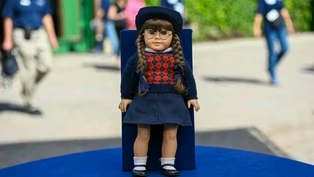
I brought my American Girl Molly doll.
I actually got her from the warehouse sale at the Pleasant Company in Middleton, Wisconsin, probably 25, 30 years ago.
So you don't remember the exact date when you got her?
I don't-- I just know I was in elementary school.
I know that she was made by the Pleasant Company before the Mattel buyout.
Me and my mom and my best friend and her mom went together for a fun girls' weekend.
It was kind of a crazy event.
Lots of people in line, rushing for dolls, and I just had to have Molly.
I loved her braids and her glasses and her bangs.
(laughs) I can see the resemblance.
Do you know what you paid for her?
$50.
Molly was produced by Pleasant Rowland.
Um, Pleasant was a child's textbook author, so she was very aware of history.
In 1984, she went to Williamsburg, Virginia, and she loved the historical aspect.
And then at Christmastime, she was shopping for some nieces, and there was only Cabbage Patch and Barbies.
And she thought about Colonial Williamsburg and about creating a doll line to bring historical events to young girls, eight to 14 or so, that she felt were very underserved in textbooks in history.
So she came up with these three girls, Samantha, Felicity, and Molly.
She made them historically significant.
She got girls reading, six-book series, teaching girls about whatever went on during that period.
Molly's dad went off to war in World War II.
So it was all about the things they were going through with rationing and what it was like to miss your dad.
And Samantha becomes an orphan, and kids related to that, because they were orphans.
Yeah, mm-hmm.
So, bravo to her for creating this and, and seeing and filling that need, because it was needed.
Pleasant had the dolls made in Germany, by Götz.
And Götz produced them for about 1986 to about 1990-ish.
At that point, Pleasant sold the company to Mattel, and Mattel changed the name into American Girl Dolls.
So this particular Molly is one of the first Mollies.
And we know that because she has a white body.
We're going to be modest here, we're going to try and protect her modesty.
You know, she is from the '40s.
(laughs) So, on her back here is a green sticker and an X. That says to me that she came from one of your factory sales.
Later on, they changed these bodies to be more flesh-colored, matching whatever skin tone that doll had.
She has her original clothing on, and on here, we have "Made in West Germany," which again, indicates the Götz.
Her glasses have real glass in them, and a real knitted sweater.
Those were all made in Germany.
So, yours being an early 1986, one of the first ones coming from Germany, makes her a little more significant.
You took great care of her.
Yeah, I never took out her braids.
(laughs) Which is great, 'cause so many kids, they come in with crazy hair... (laughing): Yeah.
...and they played with them and that kind of stuff.
I would estimate her value at about $1,200 to $1,500.
(laughing): Oh, my gosh, that's amazing.
I'm so glad that I never took her hair out and played with her.
(laughs) And thanks, Mom, for taking me to the warehouse sale.
(laughs) Absolutely-- thanks, Mom.
Yeah.
For sure.
It's always been in our house.
Uh-huh.
It was our mother's.
In the 1950s, she went to a used store.
She saw this and asked the lady, you know, "How much?"
And she said, "Well, five or ten dollars."
It is Grueby and a beautiful example.
Grueby's almost always green, 95% of the time.
But almost always only green.
Ah.
So to have a second color is very good.
This is also larger than most pieces of Grueby.
Well-marked.
This dates to about 1904 to 1905.
Oh, okay, great.
When I see this kind of a mark-- you see that little green thing?
Mm-hmm.
When that's on the bottom of a piece of Grueby, it's meant to be a lamp base.
The fittings themselves, it looks like it's Tiffany to me.
Oh, wow.
And Grueby worked with Tiffany.
On a bad day, at auction, it's between $6,000 to $9,000.
Wow.
And it could bring $10,000 or more.
Wow.
At auction.
What a treasure for us, yeah.
Yeah, it's a really, it's a really good one.
Makes me cry.
(laughs) In 2019, I was in San Antonio, and there was an auction house I used to go to.
I, I love rugs, I have several rugs at home.
This one came up for sale, and I really enjoyed the motion in it.
It was wool and, I believe, goat hair.
Mm-hmm.
So I just really liked the colors.
I think I paid about $100.
Wonderful-- do you have any idea what type of rug it was or where it came from?
No, and I do have, uh, a gentleman here in St.
Louis that I do take rugs to, and he had no idea... Okay.
...of its history or background.
All right.
This rug was woven by the Qashqai tribe in the Zagros Mountains in Southern Persia.
So technically, it's a tribal rug.
It's referred to as a gabbeh, and "gabbeh" in Persian translates to raw, uncut, and natural.
It's raw because they're using natural wool for the majority of the wool.
It's not heavily dyed.
Uncut would refer to the pile.
It kind of has a shaggy, long pile to it.
And that's also related to the weave quality, it's rather coarse.
This rug is maybe about 50 knots per square inch, or less.
So it would make it one of the coarser Persian rugs that are woven.
As this rug is a tribal rug, they didn't have a large supply of wool when they were weaving it, so they used different dye lots of wool.
And as you can see, there's a line over here of demarcation where the brown color is slightly lighter and slightly darker.
This is a term that's referred to as abrash-- it's natural.
Especially in nomadic pieces, you tend to see that occurring.
The value of these rugs really is in their pattern.
These abstract geometric designs are very bold and graphic, and they're very popular-- they always have been.
This one was woven around 1940, and with the resurgence of contemporary design, they became very popular in the late '90s up until the current day.
Most of these were small in size.
Naturally, there's a demand to get this aesthetic in room-sized pieces.
So, they started making modern reproductions of them in Iran, India, and Pakistan.
So this really is what set the whole wheel rolling in the first place.
Do you have any idea what this rug is worth?
$100?
(both laugh) I, uh... No, I have-- I have no, no idea.
Okay.
It's really in fine condition, and, uh, this rug would retail for between $3,500 and $4,500.
Oh, I did good.
So, it's really wonderful.
Thank you so much.
They're my father-in-law's comics.
Uh, I didn't quite get where he acquired them, but he's had 'em in his basement for quite a while now.
(both laugh) Yep.
And, uh, he's got, he's... Oh, no!
(both laugh) Not quite the best condition, but he's got some notable ones.
I bought it from a lady-- I was redoing her kitchen.
I hope she's not listening, but I think I paid $30 for it.
But I've had it for 50 years, maybe.
I've been told that this is a commercial butter churn from England.
I guess you could use it to do your laundry in, too, but you might want to clean it first.
I don't think I've ever seen another one.
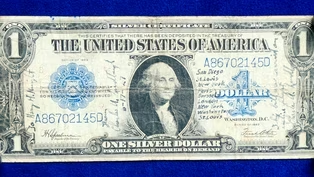
My father was very interested in Charles Lindbergh, so we have this dollar bill that Charles Lindbergh carried on the Spirit of St.
Louis from New York to Paris in 1927.
He heard that this bill was going to be sold at an auction in Kirkwood, Missouri.
So he went to the auction, and ended up buying it in a fierce battle, I understand, for $225.
And what year was that?
1972.
There's some writing on it.
On the top here, it says, "To Harry H. Knight from Charles Lindbergh, June 17, 1927."
Now, Harry H. Knight and his brother were both part of the nine investors that backed the transatlantic flight.
And Harry is credited as being the one who got everyone else interested.
And June 17 is the day the Spirit of St.
Louis arrived back in St.
Louis after that transatlantic flight.
We know that he carried this on the plane.
He actually has written on here-- it says, "This bill was carried on entire flight.
Charles A.
Lindbergh."
He signed it again.
We can't find any other examples of Lindbergh signing, inscribing dollar bills to anyone.
So it is both unique, and it's this, uh, fantastic... I think of these things as a witness to history.
And on the right side here, he's listed all the cities that the Spirit of St.
Louis flew to.
Silver certificates were, at the time-- this one dates from 1923-- you could exchange it for a silver dollar.
They are a little bit larger than a normal bit of American currency.
The flight was on May 20, when it left New York.
It arrived in Paris the, late the following night, on the 21st, and sometime at the beginning of June, both the plane and Charles Lindbergh came back to the States.
What he did was amazing.
No one had done this, he did it on his own.
He flew straight-- he had no bathroom breaks, no going to the back of the plane, no sleeping.
I think for you and I, Charles Lindbergh was Jimmy Stewart in "The Spirit of St.
Louis."
I remember watching that film at school on a projector in the gym, and that's who I thought he was-- he was a hero.
In 2025, people look at him a little differently.
They talk about during World War II and before the war, his sympathies with the German government at the time, the Nazi Party.
He was against the U.S.
going into the war.
He had a secret family in Germany.
Is there anything else-- do you remember what your father thought about it?
Clearly he fought for it.
Oh, he did fight for it, and he treasured it.
I mean, this is something that he was very proud of.
He didn't get to the age where all the things about Lindbergh became clear.
Right.
So for him, Lindbergh was a hero.
And because he was an amateur pilot, he really looked at this as something that drew them together.
Right-- would you be surprised if I told you that at auction, we would estimate that at $20,000 to $30,000?
(chuckling): Very much so, yes, I would.
But I wouldn't want to sell it.
(laughing) No, it-- nor would I. Without the writing, without the inscription, that silver certificate's worth about $20.
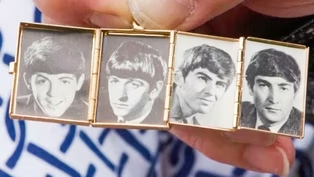
Really cool, what you brought in at the jewelry table.
It's not gold... No.
...but I find it very interesting.
I know.
Where'd you get it?
Kresge's-- dime store.
(chuckling) I think this one came from Woolworth's.
And back in the day, when you were a kid.
1964.
Aha, and that's when these were made.
The Beatles had a ton of promotional stuff being licensed out.
Did you ever wear this?
Oh, yeah.
(chuckles): Yeah.
On a chain?
Oh, yeah.
So it's amazing that it survived.
I know.
And then it's a little book, but when you open it... Ooh, there they are.
Yeah.
A lot of these are around, but a lot of 'em don't survive in this condition.
So, believe it or not, these bring about $100 today.
Oh, wow.
I probably paid five.
Five.
If that much.
Yeah.
Now, you have another one there.
This one, while it has the same theme outside, with the fonts and everything, probably not as much money.
Probably'd be around $75.
It's more than I thought.
(laughs) I appreciate it, thank you.
It's one of the best paintings I've seen of Harold Newton, the leader of the group of Highwaymen painters.
They were in Fort Pierce area, and I grew up in Indialantic, across the river, and they would drive up to the family business and walk, knock on the door, and say, "Come on out and see today's paintings, and you can buy 'em for 25 bucks."
When did you get this painting and how?
I got it, uh, about 13 years ago.
13 years ago.
At an estate sale in St.
Louis.
And being in St.
Louis, there's not many people that knew about the Highwaymen painters.
And so when I got down to the basements of this house, I saw some sort of wetland painting, and I said, "That could be Florida."
And then when I saw the frame, I said, "That's a Highwaymen painting."
Ah.
It's that distinct.
So I wanted to go closer, and my heart beating... (imitates) And I looked at, at the, and the signature... Saw the signature.
And I said, "This is the best one, and I'm going to get it for..." $40.
So, wait a second, you're telling me you bought this painting for $40 13 years ago.
Unbelievable.
That's an incredible, incredible story.
(both laughing) Harold Newton was a founding member of the Florida Highwaymen, a bunch of African American artists who, out of necessity, in the mid-'50s, established the group.
During a time of segregation and discrimination, they had difficulties showing their work... Right.
...getting training-- all the opportunities that were available to other artists were not available to them.
And so they formed this group as a way to support one another and develop their skills.
And as you pointed out, they were selling the works by knocking on people's doors, selling it out of the trunks of their cars next to the highway.
That's where the "Highwaymen" name came from.
Banks, gas stations, restaurants.
Yes.
They would just go in wherever they could.
Exactly.
(chuckles) And so this particular painting, though, it's just a striking image.
Wow.
It demonstrates his skill as an artist.
Shortly after this was painted, he'd probably sell this for maybe 50 or 60 bucks.
Typically he ranged, like, $25 to maybe $50.
Wow.
It's an oil on fiberboard.
He was born in 1934 and he died in 1994.
So it'd be, like, a circa 1970s, I would say.
That's a guess.
'Cause the painting is not dated, but it is signed "H.
Newton."
It's in very good shape.
The paint looks great.
I think if it were to come up to auction, I would put an estimate of between $10,000 and $15,000.
Wow!
That is nice.
Yes.
Thank you very much.
PEÑA: There's quite an assortment of animals at Grant's Farm's Deer Park: deer from Europe, Asia, and North America, as well as alpacas and llamas, and this big-horned bovine.
CRAIG THOMAS: Uh, Watusi cattle are from Africa, and they are distinctive for, they're very large-horned.
It's about that big around, and it kind of curls up.
We currently have nine, but we do have a successful breeding program with Watusi, so hopefully this season will be even more beneficial than last season, which was very successful.
My father was a, uh, World War II veteran and also an amateur photographer.
So he took his camera to Europe and took pictures all along on their march.
These pictures here are from Buchenwald in Germany.
He was there when the, uh, concentration camp was liberated.
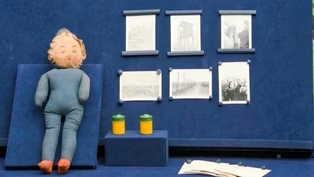
And what relation does this doll have?
Well, the pictures that he took, he couldn't just develop and send back.
So, he bought this doll in France and opened the head on the back and stuffed in film canisters, which had these pictures on them.
He shipped it back to my aunt, who was one year old then, and left a note saying, "Please do not let Darlene play with the doll."
And my aunt never played with the doll.
So... And do we know what unit he served in?
He was in, uh, Patton's Third Army.
Your dad was involved in two fairly significant liberations.
He was at Ohrdruf, and that's April 4 of 1945, and then a week later, at Buchenwald.
Ohrdruf was a satellite camp of Buchenwald.
And Eisenhower came in to visit that camp.
And when he saw that, that really redirected the focus and opened the eyes about what was going on inside the camps.
Mm-hmm.
The stark reality of it was just jaw-dropping.
Yeah, yes.
And when you brought these photos in, even to open those envelopes and look and see the images, they have a profound effect on you as a human being.
For sure.
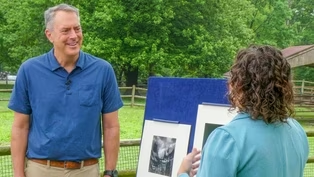
You had a number of pictures of the atrocity.
We're not going to display those... Right.
...out of respect to those that lost their lives.
For sure.
But these photographs out front here, face down, represent that.
They are shocking and disturbing on a deep level.
Harsh, right.
These places existed within a mere kilometer or two... Right.
...of occupied towns.
Of a town, sure.
There were plenty of people who knew.
There were plenty of people who thought that they were doing the right thing.
That's the scary thing.
Yes, right.
Once you start seeing other people as something other than human beings, that's when truly terrible things can happen.
Yes, sir.
One of the first things that happened was, General Eisenhower ordered that the local German civilians be brought in to see what had been happening.
Yes.
Here, we see them digging graves... Mm-hmm.
...for executed prisoners.
And then, your dad has some annotations on the back that explain what the ones on the far side here indicate.
You've got a woman coming out just in complete tears.
Because she's either in disbelief or shock or horror or whatever.
She's had that real reaction... Mm-hmm.
...that any true human being will have.
And the woman to her right is laughing and making fun of her.
Yeah.
According to your father's notation.
Right.
Which, she hasn't gone through yet.
The other woman's coming out.
You hope for her soul that she had a change of heart... Right, right.
...once she was in there.
These are other photographs of the German civilians being forced to witness these atrocities.
Right.
Your dad was so compelled that he felt the need to actually break all the rules and smuggle those images home to make sure that they were seen.
One of the most disturbing things about the history of the Holocaust is that there were non-believers at the time.
Right.
And one of the truly most disturbing things is that there are non-believers today.
Today.
Historians' best estimates at this point are that over six million Jews perished in the Holocaust and another six million or so others died, as well.
Right.
They enslaved the entirety of the continent.
They shot Slavs, uh, homosexuals, Jehovah's Witnesses, uh, petty criminals.
It's hard to put a value on something like this, because we're talking about cultural value and historical value.
Mm-hmm.
But let's say, for example, you wanted to have this insured.
We are comfortable with an insurance value on this set at $10,000.
Oh, my God.
That's amazing.
Breaks our heart.
I know it broke my heart looking at these images.
Yeah.
They're powerful.
I brought this piece of art.
I don't really know much about it.
About a year ago in our office, uh, they were demoing out all of our cubes.
Uh, this was hanging on the cube wall in our office.
Uh, they ended up putting it in the dumpster.
And then, uh, at that time, I had a new office with, like, nothing on the walls.
So I decided to grab it out of the dumpster and hang it on the wall 'cause I liked the, the color of it.
And then about, you know, a year later, here we are today.
This is a Victor Vasarely three-dimensional limited-edition bas-relief sculpture.
All right.
Uh, the piece is from, uh, 1972.
1972.
He was a painter and printmaker.
Uh, less this kind of three-dimensional stuff, but he, he did some of these kinds of things.
Op art was his specialty.
It's basically made of a plastic on a metal base.
And the frame is part of the whole piece.
It's not like it was then framed.
Okay.
It has an odd title.
It is "CTA-102 Pos.
Gold."
It's in a very small edition.
It's an edition of four.
He's in major museums.
He also was sold in commercial galleries and malls in the '70s and '80s.
Okay.
So he was very popular for many years.
It's a signed piece.
He did paintings.
Right.
He did a lot of silk screens and lithographs.
Yeah.
The prints are mostly in the $400-$500 range into the real low thousands.
Yeah.
There's lots of that kind of thing.
And I saw the square prints, like, on a, painted, for, like, $1,000 or $2,000, like that... Yeah, that... I couldn't find this when I looked online.
It'd be hard, with an edition of four.
Do you want to guess on a number?
Maybe, like, $5,000, $6,000?
You're, you're getting there.
Okay.
It's, uh, the most recent auction price was right around $10,000, so... $10,000, wow.
So I would say an $8,000 to $10,000... Holy cow.
...uh, auction estimate on it.
Retail price maybe even more, but... Wow.
But, I mean, it actually brought in that $8,000 to $10,000 range... Okay.
...within the last few years.
Okay, then recently-- that's awesome.
So, and I... I appreciate you pulling it out of the dumpster.
Yeah.
Because it was, it was going to be an edition of three if you hadn't done that.
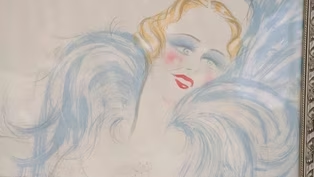
(laughs) GUEST: I believe we have a burlesque poster.
My, uh, best friend gave it to me about six years ago.
She's had it for 30 years.
It was given to her when she lived in L.A., and she had it framed then, and it hung in her house for years, and it's been hanging in my house.
APPRAISER: When do you think it's from?
GUEST: I think, by her outfit, probably 1920s-- I don't know.
You're close.
Really?
I would say it's early 1930s.
Okay.
Circa 1931.
And it's not exactly cabaret.
Oh, okay.
It's more like French music hall.
GUEST: Ah, okay.
APPRAISER: She was a performer, and an elegant performer.
You can see by her feathers and especially, the jewelry on her arm... GUEST: Jewelry, yes.
APPRAISER: ...is so elegant, it's great.
And I can see why a performer would like it.
I could see why a jewelry person would like it.
You're just smiling 'cause you just like it.
(guests laughing) You just, "Whatever, I, I l..." She's pretty!
She's pretty!
At auction, I would expect this to sell for between $600 and $900.
Okay, all right-- good to know.
Thank you.
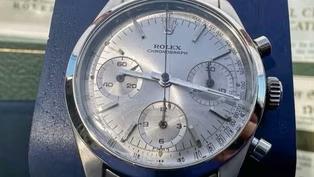
I was flying over in Thailand-- flying out of Bangkok, actually, the north part-- and I went to the BX with a couple of my friends, and they wanted the GMT, and that's what I wanted, but my friend bought the last one.
So when this one came out, the, uh, lady said, "Well, you might like this one better."
And actually, I did, so I was... Okay.
Was real happy-- 1969.
You were a pilot?
Yes.
We were developing drone technology.
I was flying with the UNIVAC Corporation under contract to the Air Force, and our drone would fly orbits over the Ho Chi Minh Trail in Laos.
We would fly the aircraft either remotely controlled or with a pilot in it.
We had the complete-- just like flying in the airplane, like a simulator.
Oh!
I could actually control the aircraft, and so, uh, I wanted the watch to help in my job.
Did it help in your job?
It did.
The engine quit one day on a mission, and, uh, I pushed the button for the sweep-second hand to tell me how fast the ground speed was.
I was steering the aircraft.
I had to tell the helicopter where I was gonna crash the airplane.
Ah.
And tell the pilot when to jump out of the airplane, so we could bring the helicopter rescue squad in to pick up the pilot without much time on the ground wasted.
And this was in enemy territory?
Yes, over in Laos.
The enemy was all in the jungle, and he didn't want to be on the ground very long.
(chuckling): Yeah, right.
I had to blow the wings off the airplane.
'Cause it had to be destroyed-- it was all top secret.
I said, "You have to jump within ten seconds.
And I'm counting now, ten, nine..." And so at ten seconds, I blew the wings off.
(breathlessly): Oh, my God.
And, and I hoped he was out.
Oh, my... (laughing): Which he was.
The helicopter was able to retrieve him?
They were right there at him, and within five minutes, he was in the helicopter heading back to our base.
And so the watch actually saved somebody's life.
It did-- the major that was flying it was, uh, very grateful for that.
Wow, that's, that's amazing.
It was.
(both laugh) I see on the warranty papers, it says 1966.
It was first purchased by a Navy pilot in Saigon in 1966.
And the story I got from the Navy Exchange was that he was either killed in action or was captured.
And, uh, they sent the watch, uh, to Bangkok, to the Navy Exchange there.
(sighs) So they let me buy it in 1969.
I paid $500 for it.
Did you wear the watch after the war?
I've worn it every day since 1969.
'69, wow, that's amazing.
Until I had it serviced in 2012.
I took it off, I've not worn it since.
The watch is a Rolex 6238.
Okay.
It's what's dubbed the Pre-Daytona.
It was a transition between the earlier chronographs and the 6239, which was the later model of the new versions of the Daytonas.
Mm-hmm.
It has a plain bezel, and it's just a very elegant watch.
It's function-- it's all stainless steel and it has a registry.
So it's a push-button chronograph in which you can do one minute, 30 minutes, up to 12 hours.
The dial on yours happens to be, considering the age, in incredibly fine shape.
Out of a one to ten, it's probably a nine.
Wow.
So the dial is really, really nice.
Production year of your watch is very late 1964- very early 1965.
The total production in the five- or six-year run is probably somewhere, they estimate between 2,500 and 3,000 units.
Okay.
Notoriously, other than a pilot or a race car driver, these were not particularly popular watches.
(chuckles) A lot of 'em ended up overseas because they didn't sell particularly well in the stores.
Yeah.
Um... It was perfect for what I needed, though.
Perfect.
Right, right.
So you've managed to keep all these years... Many.
(laughing) ...the original box that came with it.
Yeah.
And here you've got the original warranty paper.
Mm-hmm.
So it's pretty complete.
The only thing that's missing are a couple hang tags.
Okay.
You know, they would have come with... I might have those.
(laughs): Okay.
I'll have to look-- I think I might have them.
Everybody's looking for one-owner, complete pieces.
And you've got the whole ball of wax here.
(exhales) Today, to a collector in the retail market, this watch would probably trade in around the $45,000 price range.
So... (chuckling): 40?
Oh, my.
And, um, and what's in... I had no idea.
(both laughing) And what's interesting is, if you would have gotten the GMT, which would have been the model 1675, the Pepsi... Yeah?
...that watch would probably be worth today probably in the $17,000 to $20,000 range.
Okay.
(chuckles) So by having your two friends in front of you get the 60, 1675 GMTs, you came out well all these years later.
(chuckling) Oh!
And if you were insuring it, we would probably easily put an insurance appraisal of $55,000 on the watch.
(sighs) Wow.
Oh, my.
GUEST: I found it in a coffee can that I bought at an auction.
Ten bucks, something like that-- it wasn't very much.
Opened it up when I got home and this was inside.
It's a land grant signed by President Buchanan.
This is a Robert Indiana print from his series "Decade: Autoprints."
I found it in a local auction.
I think it was only about $300 plus shipping.
I love it-- it's above the fireplace.
Yeah.
Yeah.
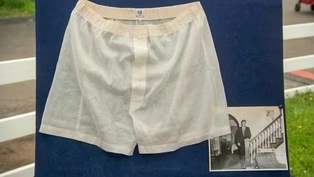
(chuckles) GUEST: I brought some silk boxer shorts that John F. Kennedy left in our house.
My father was a prominent politician in Indiana.
He got very involved in JFK's presidential campaign.
In October of '59, Kennedy came through our hometown in Southern Indiana, and my dad created a big fundraiser for him.
Kennedy needed a place to stay for the day, and so he stayed in our house.
He was battling a very sore back, apparently.
So he bathed in our upstairs bathroom.
After the whole event was finished and he left town, my mom found these boxer shorts on the bathroom floor.
Apparently, he forgot them.
In 1959, Kennedy was the junior senator out of Massachusetts, and he wouldn't declare his official candidacy for the presidency, even though it was expected, until January of 1960.
Right.
But as you said, in the fall, he would have been traveling around America, continuing to lay the groundwork for his candidacy, getting ready for the primaries, and meeting important Democratic supporters and fundraisers, of which your father was one.
Right.
I had a chance to take a look, and on October 4, 1959, in your hometown of Huntingburg, Indiana... Right!
...it was a hot fall day.
It made it to 88 degrees.
I did not know that.
He had events to go to, a lot of standing.
He then retired to your family's home.
So, your father was sort of his host.
Mm-hmm.
And where he could cool off.
And who hasn't left things behind as a guest?
Right.
This is a pair of silk or synthetic undershorts.
There's a store label from Lewis and Thomas Saltz and Company from D.C., and they were a very prominent haberdashery, menswear, in Washington, D.C., serving all the politicians and businessmen.
On the inside front of the waistband is also some block letters in a permanent ink that say "K-E-N-N."
Mm-hmm.
I imagine that's from the junior senator having his clothes sent out to a laundry.
And you've also bought a photo of Kennedy.
In your family home?
It is our family home, he's standing on the stairwell, and he signed it to my parents.
The best kind of provenance is when the individual who's a historic person has given it to a trusted confidant or if it's from the family of the historic person.
And we don't have that-- we don't have... We don't have a picture of JFK giving these to your mom.
What we do have is a meticulously documented history.
And also it's documented in two books.
One book was written about my father.
In it, the story is described just as I told you.
Mm-hmm.
Then there's another book, the history of Huntingburg itself, and the same story is described there.
So apparently, in that book, it said that my father wrote him a humorous letter saying, "Well, if you're accustomed "to leaving your boxer shorts around the country, maybe you need another pair," so he sent him a new pair.
That is utterly charming.
And that's my dad's sense of humor.
Kennedy's special.
Yes, he is.
The idealism, the charisma, and the social impact of the president and his family.
For auction purposes, we'd put an estimate of $3,000 to $5,000.
Yeah, that's nice.
(both chuckle) This is probably about $500 itself, but it is helping to verify, uh, the story.
Mm-hmm.
And so these kind of need to be kept together.
For insurance value, I would have $10,000... Mm.
...on these.
The, the collection, yeah.
Okay.
STEVE BYRD: This carriage behind me is one of our oldest in our collection.
It was built in 1878 in Concord, New Hampshire.
It's a 12-passenger coach.
It has leather strap suspension, which gives it a very soft ride.
It was restored back in 1976 and '77, in New Hampshire, as well.
All of the carriages in the Busch family collection have been used by the Busch family over the years, including the one behind me.
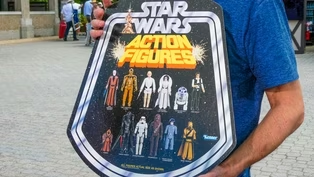
I brought a store display of the original "Star Wars" characters that came out of my father's toy store.
I just happened to keep this instead of collecting any of the toys themselves.
I didn't want the characters, but I liked the sign.
"Star Wars," right?
Little to no introduction needed for the film.
Came out May 25, 1977.
Became an overnight international sensation.
What you've brought today is a 1978 Kenner "Star Wars" store display.
This is referred to as the bell hanger style.
They used this styles over multiple iterations of the "Star Wars" toy line, but this is not just any, it's the absolute first.
What it depicts here are the 12 original figures that were first made available as part of the "Star Wars" toy line.
And when it comes to display pieces like this, condition is so critical-- crucial to the value.
Overall, I'd say it's rather phenomenal, compared to the ones you mostly see out there.
There's some edge wear, minor staining here, a little surface stain.
But the big part is, there's no surface tears.
There's no actual losses to the cardboard.
There's no major creasing, there's no wrinkles.
Overall, it presents exceptionally well.
If I were to give it a numerical grade, in toy speaking terms, to be conservative, I would say it's about a 75-plus to maybe an 80.
As far as displays go, this is a pretty prime example that collectors watching this are going to be drooling over.
At auction today, if this were in a well-advertised toy and pop culture sale, I would place a pre-auction estimate of $5,000 to $8,000 for the display.
Really?
Wow.
That's shocking.
Perfect, premium examples that receive 85-plus grades have sold upwards of $20,000 on the market.
Wow.
This is A-plus material when it comes to "Star Wars."
This was our grandfather's, who had a business downtown in St.
Louis called Lammert's Furniture, and he was on a board called Downtown St.
Louis when they were building the arch.
And this was presented to him.
It's a maquette of an arch-- of the arch.
I think it's a hood ornament.
I don't know who made it.
I found it in my aunt's house.
But if we turn it around... Okay.
...you can see it actually is signed.
Oh.
It's hard to see in the glare... Okay, okay.
...but it says "Sabino, France."
What you have here is a Sabino... Mm-hmm, mm-hmm.
...Art Deco car hood ornament from the 1920s.
And you have this wonderful frosted glass.
And it is a Saint Christopher, the patron saint of travelers.
Right.
Yeah.
So that makes a lot of sense to have on a car.
It makes a lot of sense.
Conservatively, at auction, I would say between $400 and $600.
Oh, okay, great.
(both laugh) Well, that's really neat.
Thanks for pointing that signature out.
Yeah.
I just wasn't looking in the right place for it.
Yes.
My wife and her mother and father, before she was my wife, in 1963, went to Gallup, New Mexico, to the Indian International Tribal Council show and bought that first picture from Jerome Tiger.
This one?
Directly from him at the show.
It actually won first prize in the show that year.
The second picture, over here, my wife's aunt bought it at the Philbrook in 1963.
The history of Jerome Tiger's life and his career is meteoric.
He died in '67 in a gunshot situation in Eufaula.
Yeah, 26 years old.
26 years old, and a tremendous loss.
His impact, uh, in the art world was fairly significant.
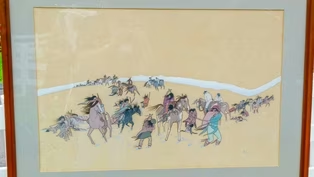
The title of that picture next to you is called "The Defeated Ones."
He really brought that depth of feeling about what happened to Native Americans really to the forefront.
Jerome Tiger was born in 1941 in Tahlequah, and I expect the reason he was born in Tahlequah, Oklahoma, is, that's where the big Indian hospital is.
But he's Muscogee Creek, and Tahlequah's the Cherokee capital.
Both of these paintings Jerome painted in 1963, which was very early in his career.
This is a family that suffered a lot of pain.
They've had a lot of tragedy.
And the way Jerome got through this, as have his relatives and descendants, like his daughter, is by creating great beauty, and the beauty depicts the pain of their history, as well.
President Andrew Jackson, after a war with the Creek tribe, which involved Sam Houston and David Crockett, where the Creeks were brutally put down, signed the Indian Removal Act of 1830 to clear out the Southeast.
The first tribe was the Muscogee Creeks.
The second the Seminole, Chickasaw, Choctaw, and then his supposed allies in the Creek war, the Cherokee, that Sam Houston was married into.
They would ride into one of the towns and say, "We're moving you this week.
Pack your things, we're done."
The worst of it was in the middle of winter, and everyone suffered.
About 3,000 to 5,000 Muscogee people died on the Trail of Tears going to Eastern Oklahoma, which at that time was Indian Territory.
That's what these depict.
I've never seen one this big with this many figures in it.
These are military officers on horseback that are part of the removal team.
More people dead in the snow.
This did not just set the standard for Native American politics in the 1830s.
It set the, the tone for Native American politics with the United States government till today.
It just changed their world permanently.
And it was a very painful change.
They're painted on matboard and they're painted with temper paint and watercolors.
He changed the approach to Native American painting, in my thinking.
He didn't do just outlined color blocks, which was very popular at that time and before.
You see more things in diagonal, as opposed to profile.
You see things like this man laying face down in the snow.
Do you know what these paintings cost?
We have the receipt for the one next to you, for $65.
On the back of this one, on the tag from the Philbrook, it's $85.
They used to never come on the market.
He was such an agent of change in the short time he was alive.
These paintings, in a retail situation, would sell each $20,000 to $25,000.
So $40,000 to $50,000 for the pair.
Wow.
They're wonderful paintings, and they certainly depict a huge tragedy in American history.
I don't know much about it.
I bought it for five bucks at Goodwill.
Uh, my sister and I like to go there a lot.
My brother-in-law likes bright-colored stuff for my niece's bedroom.
So we thought it was cool and took it home.
I brought an original sculpture from the late artist Bob Cassilly.
He's world-renowned, built the City Museum here in St.
Louis.
This is a hippo prototype for Cementland, which was a shuttered playscape up in North City.
GUEST: I brought a portfolio of prints by Ansel Adams.
A good friend of mine knew that I was a backcountry hiker.
My wife and I would go to national parks.
I'd bring him pictures to show of the trips.
And he said one day he had something to show me, and this was in his possession.
And later in his life, he called me back to see it again, and he said he wanted me to have this.
Wow, that's incredible.
Mm.
I mean, even today, pulling them out to look at them... Mm.
...and seeing them here like this, these gave me goosebumps.
It's awe-inspiring.
Yeah.
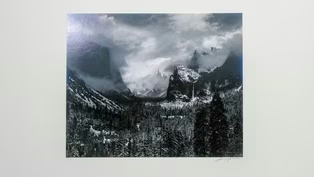
So this is portfolio number three, the third portfolio that Ansel Adams published.
It was published in 1960 by the Sierra Club.
And the images inside were made starting in either circa 1926, which is how this image is dated in the portfolio colophon-- sometimes it's dated 1927, very early-- all the way up to 1959, but they were printed in 1960 for the set, for the portfolio.
And they're each signed by Ansel Adams.
They really represent the qualities that people love about Ansel Adams.
He's one of the most collected, one of the most well-known photographers, still, in the world.
That precise focus, the clarity of vision, the contrast, the detail, and of course, as we've already discussed, the emotion that is conveyed through the images is really powerful.
This picture is called "Monolith, the Face of Half Dome."
It's one of his most famous pictures.
He had a sense of being able to see the finished print in his mind, and then use what he knew about the camera to create the right conditions in order to be able to make that print.
So the dark sky.
The sky, of course, was not dark when he made this image.
He used a red filter in his camera to create the visual effect.
Hm.
His legacy is also as a teacher of these skills.
The photograph closer to you is called "Winter Storm."
And that image is really what Ansel Adams is most well-known for, which is these sort of sublime landscapes that capture the big vision of the place.
There's a sense of drama, there's a sense of beauty, majesty.
The contrast between the light and the clouds, the snow in the landscape, and even captures the details of all the trees so perfectly.
This really represents Adams at his most skilled.
There were originally 16 photographs in this portfolio and there are three that are no longer part of the set.
Do you know what happened to those prints?
I really don't-- we think they were given away as gifts to other people.
Okay.
So as is, at auction, my estimate for the set would be $40,000 to $60,000.
It's a lot of money.
If it was complete, an estimate might be $50,000 to $75,000.
Mm-hmm.
So the good news is that the prints that are missing from your set you own are not among the most desirable or the most valuable in the group.
Mm-hmm-- cool.
The two that I've pulled out here are... Mm-hmm.
...the two most valuable and desirable, because they're the most well-known.
At auction, individually, this print would be estimated between $7,000 and $10,000.
(blows out) The "Winter Storm" would be estimated between $8,000 and $12,000.
Wow-- that's my favorite one.
Good.
(both chuckle) You mentioned that you have taken your own photographs in Yosemite.
Yes.
Oh, yeah.
(chuckles) Um, how do you think they... (laughs) Would you call yourself a photographer?
No.
(laughs) I own a camera.
Okay.
(both laugh) PEÑA: "Antiques Roadshow" filmed this episode PEÑA: And now it's time for the "Roadshow" Feedback Booth.
The last time we were here at Grant's Farm was for his senior prom in 2010.
And we're back here today.
I found out this block print I have, which I purchased for two dollars, is worth $500.
(chuckles) So today is a lot better than prom was.
No offense, babe.
The family lore said that my great-uncle brought this doll back from Paris in the 1940s, after the war.
And what actually happened is, she's from the 1960s, from America, and she's not worth a lot.
(laughs) But we had a great time.
We had this painting that, uh, we found inside the walls of my brother's house when we were finishing his basement.
And it was really creepy.
And, uh, found out that it's not worth anything 'cause it's fake.
And so we're probably gonna burn it.
(laughs) This lovely Bristol glass vase was purchased by my father, um, and given to me.
My mom was with him when he bought it, and she thought he was crazy for the amount he paid.
Turns out Mom was right.
(all laugh) And I have my grandfather's watch.
It's, was supposed to be gold, but it's made out of brass.
I brought this statue from 1858.
It's not going to keep me from going to work tomorrow... (laughs) ...but it's worth about $200.
This replica Civil War reconnaissance map barely made the cut of the things that came with me today to "Antiques Roadshow," but I'm sure glad I brought it, because it's real, from 1862, and it's worth $1,000.
Thanks, "A.R."
By the time this show airs, this'll be sold, and we'll be living in Bora Bora, baby.
He's lying.
(both laugh) PEÑA: Thanks for watching.
See you next time on "Antiques Roadshow."
Appraisal: 1927 Spirit of St. Louis-flown & Inscribed $1 Silver Certificate
Video has Closed Captions
Clip: S30 Ep14 | 3m 11s | Appraisal: 1927 Spirit of St. Louis-flown & Inscribed $1 Silver Certificate (3m 11s)
Appraisal: 1959 JFK’s Boxer Shorts with Signed Photo
Video has Closed Captions
Clip: S30 Ep14 | 3m 30s | Appraisal: 1959 JFK’s Boxer Shorts with Signed Photo (3m 30s)
Appraisal: 1960 Ansel Adams Portfolio III: Yosemite Valley
Video has Closed Captions
Clip: S30 Ep14 | 3m 42s | Appraisal: 1960 Ansel Adams Portfolio III: Yosemite Valley (3m 42s)
Appraisal: 1963 Jerome Tiger "Trail of Tears" Paintings
Video has Closed Captions
Clip: S30 Ep14 | 4m 1s | Appraisal: 1963 Jerome Tiger "Trail of Tears" Paintings (4m 1s)
Appraisal: 1964 Gold-filled Medal Beatles Lockets
Video has Closed Captions
Clip: S30 Ep14 | 1m 3s | Appraisal: 1964 Gold-filled Medal Beatles Lockets (1m 3s)

Appraisal: 1972 Victor Vasarely Bas-relief
Video has Closed Captions
Clip: S30 Ep14 | 2m 2s | Appraisal: 1972 Victor Vasarely Bas-relief (2m 2s)
Appraisal: 1978 Kenner Star Wars Bell Store Display Sign
Video has Closed Captions
Clip: S30 Ep14 | 1m 52s | Appraisal: 1978 Kenner Star Wars Bell Store Display Sign (1m 52s)
Appraisal: 1986 Pleasant Co. Molly Doll in Original Clothes
Video has Closed Captions
Clip: S30 Ep14 | 3m 30s | Appraisal: 1986 Pleasant Co. Molly Doll in Original Clothes (3m 30s)
Appraisal: French Art Deco Music Hall Poster, ca. 1931
Video has Closed Captions
Clip: S30 Ep14 | 1m 5s | Appraisal: French Art Deco Music Hall Poster, ca. 1931 (1m 5s)
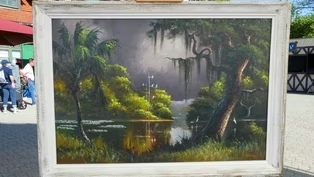
Appraisal: Harold Newton Oil on Fiberboard, ca. 1975
Video has Closed Captions
Clip: S30 Ep14 | 2m 26s | Appraisal: Harold Newton Oil on Fiberboard, ca. 1975 (2m 26s)
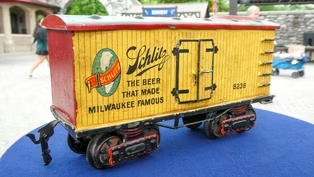
Appraisal: Märklin Schlitz Beer Train Car, ca. 1906
Video has Closed Captions
Clip: S30 Ep14 | 2m 53s | Appraisal: Märklin Schlitz Beer Train Car, ca. 1906 (2m 53s)
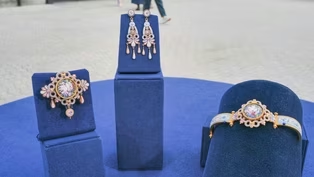
Appraisal: Papal States Micromosaic Jewelry, ca. 1845
Video has Closed Captions
Clip: S30 Ep14 | 2m 31s | Appraisal: Papal States Micromosaic Jewelry, ca. 1845 (2m 31s)
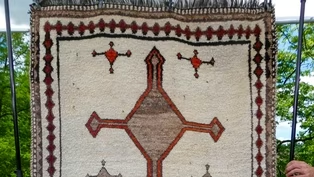
Appraisal: Persian Qashqai Gabbeh Rug, ca. 1935
Video has Closed Captions
Clip: S30 Ep14 | 2m 47s | Appraisal: Persian Qashqai Gabbeh Rug, ca. 1935 (2m 47s)
Appraisal: Rolex “Pre-Daytona” with Box & Papers, ca. 1965
Video has Closed Captions
Clip: S30 Ep14 | 4m 48s | Appraisal: Rolex “Pre-Daytona” with Box & Papers, ca. 1965 (4m 48s)
Appraisal: Southeast Asian Hardwood Trunk, ca. 1975
Video has Closed Captions
Clip: S30 Ep14 | 1m 4s | Appraisal: Southeast Asian Hardwood Trunk, ca. 1975 (1m 4s)
Appraisal: WWII Concentration Camp Liberation Archive
Video has Closed Captions
Clip: S30 Ep14 | 4m 23s | Appraisal: WWII Concentration Camp Liberation Archive (4m 23s)
Video has Closed Captions
Preview: S30 Ep14 | 30s | Preview: Grant's Farm, Hour 2 (30s)
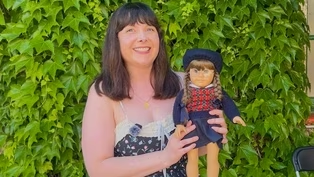
Owner Interview: 1986 Pleasant Co. Molly Doll in Original Clothes
Video has Closed Captions
Clip: S30 Ep14 | 1m 30s | Owner Interview: 1986 Pleasant Co. Molly Doll in Original Clothes (1m 30s)
Providing Support for PBS.org
Learn Moreabout PBS online sponsorship New Season
- Home and How To

Hit the road in a classic car for a tour through Great Britain with two antiques experts.
 New Episode
 New Episode
 New Episode





 New Episode



Support for PBS provided by:
Funding for ANTIQUES ROADSHOW is provided by American Cruise Lines and Ancestry. Additional funding is provided by public television viewers.