
Summer of ‘76
Special | 57m 47sVideo has Closed Captions
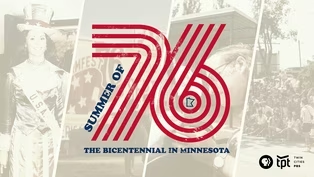
Summer of ‘76 is a video time capsule about the Bicentennial in Minnesota.
What happened in Minnesota during the United States Bicentennial? Summer of ‘76 is a video time capsule about this lost moment in Minnesota history when the nation and the state came together to celebrate and ruminate on the meaning of America at 200. Interviews with organizers and found footage unseen in 50 years fill this kaleidoscope of stories from the Bicentennial in the North Star State.
Problems playing video? | Closed Captioning Feedback
Problems playing video? | Closed Captioning Feedback
Summer of ‘76 is a local public television program presented by Minnesota PBS
Summer of ‘76
Special | 57m 47sVideo has Closed Captions
What happened in Minnesota during the United States Bicentennial? Summer of ‘76 is a video time capsule about this lost moment in Minnesota history when the nation and the state came together to celebrate and ruminate on the meaning of America at 200. Interviews with organizers and found footage unseen in 50 years fill this kaleidoscope of stories from the Bicentennial in the North Star State.
Problems playing video? | Closed Captioning Feedback
Where to Watch Summer of ‘76
Summer of ‘76 is available to stream on pbs.org and the PBS app.
- [Announcer] Join the new Spirit of '76 America's new cause needs you.
- [Barbara] In 1976, there was a real coming together as a nation.
- [Announcer] It's more than fireworks, parades, and speeches.
It's Bicentennial USA.
- [Seitu] This 200th anniversary of the birth of America.
(upbeat music) - [Lori] There was certainly a goal on the part of the people who designed the celebrations to try to bring people together.
- [Dave] This impression of community.
- [Announcer] Bicentennial is a once in our lifetime opportunity.
(smooth music) - [Lori] But there was a heavy overlay that year of continued wounds from what we had been through and kind of exhaustion.
- It was a period when the army was in great distress coming out of Vietnam.
(energetic music) - [Jeremiah] Freedom Fest was dubbed Minnesota's gift to the Bicentennial.
- [Katrina] I should not be surprised by the complete and utter erasure of Native people.
- [Richard Thompson] There was a lot going on.
All those things were certainly real and had some impact.
(drums beating) - [Dave] Remember when you're seeing those fuzzy images, everybody smiling and waving, having a good time.
That was real, but it was also only part of the story.
(fireworks booming) - [Dave] When I think about mid-1970s in Minnesota, it had only been a couple years before our governor appeared on the cover of Time Magazine, declaring that we had the good life.
(upbeat music) - [Thomas] And this is all at the same time that we have a lot of other issues in our society.
Vietnam War, rising inflation, political turmoil.
(upbeat music continues) - [Richard Neumeister] The country had a gut punch.
Watergate, issues of privacy, secrecy, FBI.
J. Edgar Hoover looking under the bed for Reds.
(upbeat music continues) - [Lori] The Watergate scandal was unlike the kind that people had seen before.
They felt really betrayed in a deeper way than I think today people would react to such a thing.
It drove down voter turnout in Minnesota in 1974.
Something like 200,000 Republican voters didn't show up at the polls.
That's how Governor Wendell Anderson won reelection, by carrying all 87 counties.
The success of Jimmy Carter speaks to a desire on the part of a lot of Americans for a return to morality in the White House.
And the fact that he chose Walter Mondale from Minnesota as his running mate, second time in the 20th century that a Minnesotan was chosen for the ticket.
(upbeat music) - [Richard Neumeister] Where do we go next?
For some people, they decided, "I'm just gonna go back to regular life."
Some people said, "Hey, we gotta start repairing."
"Let's heal a little bit."
- [Narrator] A 200th birthday party might help with this healing.
So to get Minnesotans excited about the Bicentennial, charismatic Governor Wendell Anderson literally dressed the part.
- [Dave] That photo was an invitation to all other Minnesotans to get on board.
This is coming.
This big birthday party we're gonna have for the United States, and get ready for something big that's gonna happen, and it's gonna be fun.
(mellow music) - [Narrator] Before the Bicentennial fun could commence it had to be organized.
The United States had been planning for its two-century celebration, the Bicentennial, since the late '60s, but with slow progress in Washington, the buck got passed to the states for a more local approach And in Minnesota, one woman took on the monumental task of leading the state's planning and execution.
- [Lois] I was having coffee with a neighborhood group of women, and each one was kind of going around the table complaining about their husbands and kids.
I thought, "I don't need this.
I'm going to go to work.
I've got something to offer."
- [Narrator] In 1975, Governor Anderson appointed Lois Pollari to be the Executive Director of the Minnesota American Revolution Bicentennial Commission, or MARBC.
- [Lois] I said, "Well, the Bicentennial is not going to be about stuffy museums.
This is really a people's celebration.
It's got to have grassroots."
- [Narrator] Lois Pollari was everywhere.
She crisscrossed the state, traveling more than 80,000 miles to attend meetings, ceremonies, and banquets, to preside over events, ride in parades, speak to communities, and encourage participation in the Bicentennial.
- [Lois] As long as we had the staff and telephones and a mileage budget, we could make it work.
- [Narrator] Joining Lois in this work was Oglala Sioux Band member Ed McGaa, a decorated Vietnam veteran, lawyer, and author who brought his keen intelligence and personal experience with indigenous culture to his leadership role on Minnesota's Bicentennial commission.
- [Kyle] He was a Marine, and he became an F-4 Phantom Pilot in Vietnam.
- [Mary] When he left the military in the late '60s, he moved to South Dakota and got his law degree, and then moved to Minnesota in 1970.
Ed was very much an advocate for environmental issues and taking care of Mother Earth because it was such a sacred part of Native people's beliefs.
It was a real honor for him to be the Bicentennial Chairman and to be appointed by Governor Wendy Anderson.
He was uniquely positioned to represent the people from Indian country.
With his unique perspective as a veteran, he could represent the average American as well.
He was thrilled.
He was energized by being a part of it.
He embraced it and did a really good job.
(guitar music fades) (upbeat music) - [Narrator] This groovy animation of American iconography was part of the U.S.
Information Agency's Young Filmmakers Bicentennial Grant Project.
(upbeat music fades) Another very different Bicentennial student film featured a Native American woman presenting her family's winter count, a traditional tool for recording and preserving tribal experience and history.
- [Lydia] My name is Lydia Fire Thunder Bluebird.
I am an Oglala Sioux.
- [Narrator] The film was created by Minneapolis College of Art and Design student and future Hollywood editor, Stephen Rivkin, brother of Bobby Z, the drummer for Prince's "The Revolution."
This ahead of its time student film allowed the world to sit at the feet of a Lakota elder.
- [Lydia] Each one of these pictures stands for one year.
We did not use numbers.
Instead, each year had a symbol.
(lively music) - [Announcer] Produced by the American Revolution Bicentennial Administration.
- [Puppet] Tell us, ARBA, where can our viewers go to see America's 200th anniversary celebration?
- Well, Gordon... - [Narrator] ARBA, or the American Revolution Bicentennial Administration, created several films and other media to warm Americans up to the approaching celebration.
- [Narrator] These educational shorts range from the interesting to the odd.
♪ Happy Birthday Uncle Sam ♪ - [Narrator] And like a lot of the artifacts of America's 200th birthday, most have been forgotten.
- [Announcer] Each person must find his or her own Bicentennial.
Must find a way to relate today to yesterday, to find tomorrow in today.
That's Bicentennial USA.
- [Narrator] But there is one meaningful media production from the Bicentennial that many Americans even those born long after 1976, do know and can probably sing along to.
♪ I'm just a Bill yes ♪ I'm only a Bill ♪ - [Kid] 'Cause knowledge is power.
- [Dave] "Schoolhouse Rock" was short animated educational films that ran between cartoons on Saturday mornings, and they were really well done.
They had great original music.
♪ Conjunction junction ♪ what's your function?
♪ - [Narrator] The iconic "I'm Just a Bill" animated civics lesson is still echoing through pop culture.
Composed by St.
Paul native Dave Frishberg, this short was part of Schoolhouse Rock's "America Rock" season.
- ♪ Yeah, I'm one of the ♪ lucky ones ♪ ♪ Most bills never even ♪ get this far ♪ - [Narrator] These spots were roughly animated but cleverly conceived and driven by earworm jingles that hold up fairly well across the half century since their first broadcast.
♪ Today I am still just a Bill ♪ - And most of them were about U.S.
history or U.S.
government.
- [Narrator] There was a winsome about the United States being a nation of immigrants.
♪ Our heritage mixed ♪ ♪ So any kid could be ♪ the president ♪ - [Narrator] And a battle by battle account of the Revolutionary War, and, of course, Bill who provided a slightly confusing but certainly charming overview of the nation's messy legislative process.
But some of the "America Rock" spots didn't age well... at all.
♪ Elbow Room ♪ ♪ Elbow Room ♪ - [Tane] Right from the beginning, they're like, "Oh, this was super easy, the Louisiana purchase."
It's like, no, it wasn't.
♪ How'd you like to sell ♪ a mile or two?
♪ - [Tane] Like, Napoleon was at war with all of Europe, and even in the United States where it was like, "Oh, we're gonna go and spend $15 million to buy all of this land."
That means that we are now absorbing all kinds of people into this country.
What is America now?
♪ But it took the early folks ♪ ♪ To open up the way.
♪ - Of course, most people watch it and they'll just be like, "Ooh, Manifest Destiny.
That makes- that makes my skin sort of uncomfortable."
♪ Elbow Room ♪ - [Katrina] Unfortunately, I think this is a good example of the revisionist history that we're fed as kids.
You know, it's not showing us that the reason Napoleon sells the Louisiana territory is because there's a rebellion by enslaved people in Haiti.
It's not showing us that the Louisiana territory and all of the lands beyond that were already home to thousands of Native nations.
(guitar strumming) We have to take a look at the wider sphere of what North America looks like in the mid to late 1700s.
Native peoples have been contending with and contesting European incursions for centuries.
You see this really long and incredible history of Native resistance to colonial impositions on their lands, on their cultures, and on their ways of life.
Then there's the verse about Manifest Destiny.
♪ There were plenty of fights ♪ to win land rights ♪ ♪ But the West was meant to be ♪ ♪ It was a manifest destiny ♪ - [Katrina] I should not be surprised by the complete and utter erasure of Native people in this video, but it is really... hard to watch it and to see how much of our history is just completely ignored in favor of this celebratory narrative of- of expansion.
But now I am super conflicted because of how much little kid Katie adored "Schoolhouse Rock."
- [Narrator] But 50 years on, some of the refrains of Schoolhouse Rock still ring relevant to many Americans.
- [Man] ♪ We're gonna elect ♪ a president ♪ ♪ [Chorus] No more kings ♪ - [Woman] ♪ He's gonna ♪ do what the people want ♪ ♪ [Chorus] No more kings ♪ - [Man] ♪ We're gonna run things ♪ ♪ [Chorus] No more kings ♪ ♪ [Woman] Nobody is going to ♪ tell us what to do ♪ (song fades) (bright music) - [Narrator] Another Bicentennial experience that was as popular then as it might be seen as insensitive now was the reverse wagon train.
Instead of traveling west, as in the 19th century, make believe pioneers hitched horse to wagon and rolled east toward Valley Forge.
In Minnesota, these travelers were celebrated with a sendoff at the state fairgrounds.
(bright music continues) - [Narrator] Organizers encouraged citizens to sign Rededication Scrolls, which included over 22 million signatures, with the final signature from President Ford.
Unfortunately, the scrolls were somehow misplaced, and like much of the Bicentennial, are now mere memories for those who were there.
(bright music fades) (spirited music) [Narrator] There was one primetime public service announcement campaign that penetrated the consciousness of the nation.
- I'm Zubin Mehta.
- [Dave] For those of us who were addicted to television back in 1975, 1976, one of the most memorable things that happened were these things called Bicentennial Minutes.
They were these short, historical segments that came on every night, and they would be introduced by a different narrator.
- This is Jessica Tandy.
200 years ago today, British work gangs were stripping Boston bare of wood.
- 200 years ago today, a red coat... - [Dave] And they would always end with... - And that's the way it was.
- That's the way it was.
- As if they were Walter Cronkite ending his newscast.
- That's the way it is Friday July 31... - So this happened every single night.
- [Narrator] In an era where there were only three commercial TV networks to choose from, these spots would've eventually been seen by most American television viewers, for better or worse.
- I guess I can't speak for everybody, but I got really sick of them.
- Do you realize, Marie, that the Bicentennial Minutes won't go into reruns for another 100 years?
(crowd laughing) - Oh good.
For a minute there, I thought my dream was having a Bicentennial Minute - They became so easy to make fun of.
- Walter, I asked you for one good reason, not a Bicentennial Minute!
(crowd laughing) - [Dave] They were basically became the butt of lots of jokes.
But they were ubiquitous.
By the time they were done, I was ready for them to go.
And I'm not sure I could tell you one thing that I learned from them, but they were a big part of everybody's Bicentennial experience.
- Now the rebels knew why.
- [Dave] For Minnesotans... there was one example where we sort of intersected with the Bicentennial Minute.
And weirdly enough, it had to do with "All in the Family."
(loud singing) [Dave] Its most famous character was Archie Bunker, this white, New York bigot.
- [Archie] That ain't the American way, buddy.
- [Dave] Archie Bunker learns that his son-in-law, Mike, was up for a job.
- [Mike] We may not even be going to Minnesota.
There's somebody else up for the job, and he happens to be Black.
- [Dave] This created all sorts of opportunities to reveal his ignorance about the state of Minnesota.
- [Archie] It was up to me.
I sent every colored guy in New York to Minnesota.
(crowd laughing) - [Mike] That, I believe.
- He uses this to launch into this unhinged rethinking of the meaning of the Statue of Liberty.
- [Archie] You are the one that needs an American history lesson.
You don't know nothing about Lady Liberty.
Standing there in a harbor with a torch on high, screaming out to all the nations of the world.
"Send me your poor, your deadbeats, your filthy."
(crowd laughing) And they're all free to live in their own separate sections.
(crowd laughing) Where they feel safe, and they bust your head if you go in there.
(crowd laughing) 'Cause that's what makes America great, buddy.
(crowd laughing) (crowd applauding) - [Mike] I think we just heard Archie Bunker's Bicentennial Minute.
(crowd laughing) - [Dave] That great monologue was set up by the fact that he got to show his ignorance about what the state was, and that was, in a way, our Bicentennial Minute claim to fame here in Minnesota.
(lively music fades) (cheerful music) - [Narrator] Local broadcaster, KSTP, picked up on the idea of the Bicentennial Minute.
- [Man] Okay, cast out the line.
- [Narrator] And produce some of their own ambitious shorts to celebrate Minnesota history.
- [Announcer] And the race to tell the news to St.
Paul would become just another Minnesota Memory.
- [Narrator] One of these shorts introduced Minnesotans to the man who was most likely the first person of African descent born in what would become Minnesota.
- [Seitu] It began with George Bonga who's from this family of Black, French fur trappers.
- [Narrator] KSTP needed Black talent to bring Bonga to life and called upon two artists who were traveling the state collecting oral history interviews about the African-American experience in Minnesota.
- [Seitu] We took the detour to hook up with these folks at an old restored fort.
Malik as George Bonga and me as his right-hand person.
And so we're running through this prairie.
One of the stories about George Bonga is he was so big, so strong that he was able to carry, like, 700 pounds on his back.
And really, it was us wanting to tell our story and emphasizing that we didn't wanna depend on other folks to tell that story.
(groovy music) - [Narrator] Twin Cities PBS produced a weekly talk show listing Bicentennial events and updates.
No copies from these programs seem to exist, which might not be so bad as they didn't sound like riveting television for a Saturday night.
But local news stations had crews out and about, documenting a wide range of events leading up to and during the summer of '76.
- [Dave] So these were stories created by the field crews and turned into packages that would air.
- [Reporter] Wally Pickle likes a good joke.
That may explain other parts of He says, "Gimmicks are just smart showbiz."
(horns playing) - [Narrator] In addition to the evening news broadcast, local daytime TV also fed viewers a steady diet of Bicentennial boosterism.
This included taking Minnesotans on a tour of Revolutionary War-era historic sites out East.
- [Man] Right now, we're talking to the people of Minneapolis again, you know?
That's my favorite part of America.
- [Narrator] And a half-hour special at the Great Minnesota Get Together to cap off the summer of '76 called "The Fair of a Lifetime."
♪ You wanna say you were there ♪ ♪ The time of your life ♪ ♪ Bicentennial Fair ♪ - [Announcer] At an expanded heritage square, a sense of early America has been enhanced this year in a new area with a family living in an authentic log cabin (upbeat music) - [Narrator] And in an only in the '70s touch, the special was sponsored by... - McDonald's.
- And.
- [Narrator] Weight Watchers.
- [Announcer] It's great to be alive and slim.
- [Narrator] This special featured grandstand shows with acts as wide-ranging as Bill Carlson's super wide '70s collars, including the Osmonds.
(guitar screeching) (lively music) Charlie Pride.
♪ Is a woman and a man in love ♪ Neil Sedaka, and other national that took the grandstand stage that summer.
♪ To get a little action ♪ on the side ♪ - [Announcer] But the real passion is automobile racing.
(spirited rock music) (rock music fades) ♪ Get into America ♪ - [Puppet] ARBA, there are so many Bicentennial activities all over the nation, it's just fascinating.
- Yes, Jessie Lou, with folk festivals restorations.
- Music, films, ecology projects... - [Thomas] Each state could put forth a town and a city to be officially recognized as National Model Bicentennial communities.
And in Minnesota, Duluth was the city, and Fertile in Polk County was our National Bicentennial town.
(bright music) Preserved in the state archives is a program from the day, and you can really see the pride that this town of Fertile took in the visit by the Lieutenant Governor and being named a Bicentennial Community.
- [Roberta] We were really happy that Fertile is chosen for that honor, and there was no doubt in our mind that we deserved it.
- [Thomas] I had the great pleasure of visiting Fertile a few years ago to conduct some interviews about their experiences during the Bicentennial years.
[Thomas] How did you become involved with the Fertile Bicentennial Committee?
- [Roberta] The newspaper editor of a small town is involved in everything.
When the uh- Bicentennial came about, it was a logical step forward for me not to just report it, but to also become active on the committee and in the activities.
- [Narrator] Funded projects needed to fit into three Bicentennial themes: heritage, festivals, and horizons.
- [Thomas] Civic leaders and particularly the mayor engaged with this concept and really thought hard about what they could do in heritage, festival, and horizon, these three areas.
They made a lasting impact, and you can see some of those lasting impacts eh- in and around Fertile even today.
- [Roberta] It was gonna be historic for Fertile, but it was going to carry into the future as well.
Things that were happening during this observation would impact future generations.
- [Thomas] They also used some Bicentennial matching grant funds to buy some land outside of town The Sand Hill Recreation Area, which is on the map today, is another of these enduring legacies of Fertile's engagement with the Bicentennial.
- [Roberta] I thought it was a- a pretty ambitious plan because it was just woods out there.
Duane and some of the other people that had been natives here realized the value of it.
And of course the Nature Conservancy had been keeping an eye on the areas around Fertile and around Minnesota to preserve these historic and special places.
- [Thomas] Fertile is the "Flower City".
And if you approach the city from the south, on the west side of the road, you'll see the name Fertile, F-E-R-T-I-L-E spelled out in eight-foot tall flowers that bloom every year.
And nearly 50 years later, that display is still there.
- [Roberta] It brought their families in and brought other people that were on different committees.
They offered to the community what their talents were.
That was one of the big events for Fertile's history.
(guitar music ends) (introspective music) - [Narrator] When Duluth was named the State's Bicentennial City, the Duluth Bicentennial Committee ensured it would be a year-long event that no one would forget.
And the Bicentennial City title couldn't have come at a better time.
- [Hailey] The late '60s and the early '70s was not a super financially stable time for Duluth or cities in the United States that were industrialized.
Manufacturing is moving overseas and the economy in Duluth, it kind of falls out from underneath us.
This is happening the same time that passenger service railroads in the United States are also collapsing.
Instead of investing in the revitalization of those buildings in that space, it ends up, that a lot of them fall to the wrecking ball as part of like urban renewal in the '60s and '70s.
There was a passenger station a block and a half from here that did ultimately come down.
The Depot very narrowly avoided the- the wrecking ball, and we were only saved because of community involvement.
In old newspaper ads, talking about the Bicentennial projects that are going on, and if you wanna get involved, it's "come to the Bicentennial offices at The Depot."
So a lot of the cultural movers and shakers of the mid-'70s were involved in this Depot project and we were kind of like a hub in the same way that we had been a rail station connecting the communities of Northern Minnesota.
- [Narrator] In addition to historic preservation, there were several ethnic celebrations highlighting different cultures sprinkled across 1976.
(introspective music continues) - [Hailey] Tall ships, that's still a thing that's pretty associated with Duluth, and it comes about during the '76 celebration to have the big Norwegian sailing vessels make their way here into our harbor.
- [Captain] These lakes are so great that they are more or less a mini ocean.
- There was also a Voyager party A bunch of Duluthians out in canoes recreated the voyage of Daniel Greysolon uh Sieur du Lhut from Montréal to Park Point here in Duluth.
- [Narrator] This civic engagement, cultural enrichment, historic preservation and redevelopment from the Bicentennial boosted the struggling city into the world-class tourist attraction Duluth is today.
(introspective music fades) [Narrator] Along with parks, nature preserves, and countless planted trees, the Bicentennial Commission was on a mission to beautify Minnesota.
(calm music) - [Thomas] We should remember that 1970 was the first Earth Day.
So, here, we have this kind of greater consciousness and awareness of the fact that environment matters In Minnesota, one of the Bicentennial activities was called the Esthetic Environment Program.
They spelled the word aesthetic starting with an E, so it was EEP.
EEP was really put into motion to work on cleaning up our environment, and so we could take a kind of greater pride in outdoors.
There were tens of thousands of abandoned automobiles across Minnesota.
They're either safety hazards or they're at least eyesores, and possibly environmental hazards.
What's leaking out of these cars?
So, the Esthetic Environment Program took upon itself, really, with some funding to collect these abandoned automobiles, and they collected thousands of these cars.
So, I think this is one of the lasting impacts of the Esthetic Environment Program.
Something that EEP with director Lois Pollari can be really proud of.
- [David] It wasn't so much the landscape changed, it was we saw the landscape differently.
There was, of course, the big move to tear down Downtown St.
Paul as part of that post-war modern movement.
The federal government had decided it was going to basically give away buildings that they thought were obsolete, and there sat the old Federal Courts building, Landmark Center.
It was not in a ruin exactly, but sort of semi-ruined.
So the city purchased the building from the federal government for a dollar, and then sold it to the county for a dollar.
With the opening of the Bicentennial movement and historic preservation, it became a Bicentennial project.
(bright music) Well, there's also a notion that preservation should be expanded to the non-elite population.
Everyday people.
All kinds of places should be preserved because they represent America and what's good about America.
(calm music) So the federal government create these historic tax credits that you could apply for if you were in a designated area or if you had a designated building.
And the community here was very aggressive, I guess, I'll say, about declaring buildings significant.
So, there was money available, but there was also a will to put things in a positive light.
Instead of being a problem to tear down, it became a resource to build up (calm music fades) (spirited music) - [Narrator] From school plays about the Declaration of Independence to operas and everything in between, performing arts was, for many, a way to celebrate the nation's 200th anniversary.
- [Philip] I've been in music my whole life.
And in 1976, for the Bicentennial, Minnesota Opera, commissioned Dominick Argento, and he did an opera called "The Voyage of Edgar Allen Poe."
And it was a huge opera.
Big cast, orchestra, chorus.
It's a piece that I'm very fond of.
♪ Dear friends ♪ ♪ Here on this day... ♪ [Philip] During the Bicentennial the people who did the commissioning probably were thinking that they're going to give us something that's really yay, rah, rah, America.
There were pieces that did that, but other composers felt that they had free reign.
(opera vocalizing) Dominick Argento writing "Edgar Allen Poe," well, yes, he was an American figure, but was that what people thought it was going to be?
Because if you're gonna ask a composer to compose something, you have to give that composer some freedom if you expect anything to be inspiring.
In 1969, when I began Plymouth Music Series, I knew that if you wanted to get attention, you needed to do something that create a bang.
I picked up the phone and called Aaron Copland and said, "I would like you to come to Minneapolis and conduct your choral music."
And he said, "Young man, no one has ever asked me to do that."
So, Aaron came.
And we became good friends.
In 1976, when he came and conducted, he was the same charming, enthusiastic man that I knew.
- [Announcer] Recorded July 4th, 1976.
- [Aaron Copland] Good evening, ladies and gentlemen.
It's a real pleasure to celebrate the 4th here in Minneapolis.
Here are four movements from the ballet, "Rodeo."
Some people say "ro-day-o".
I asked in the West how they say it.
They say, "You say it the way you like."
(crowd laughing) (orchestra playing) (playing continues) - [Richard Thompson] Having studied ballet and contemporary dance and many other forms that were very Western, there was this desire to find things that were more relatable.
So, myself and some other young people (jazz music) studied some African dance.
I really believed in sharing this dance, this culture.
We were a highlight of the Minnesota Renaissance Festival for many, many years.
Someone from the Bicentennial Commission called us (music ends) and we were contracted to go to a county fair, and the grandstand sat in the middle of a race track.
The wood on the stage was very weathered and splintered.
For what we do, because we dance in bare feet, we cannot dance on that.
"Well, okay, here's what we can do.
We can put you off in this corner of our grounds and you can perform there."
We said, "Okay, great."
And so we started our performance, and, basically, no one watched us.
Yeah, it was like some sort of weird dress rehearsal or something.
It was very odd and peculiar.
It wasn't very welcoming, wasn't warm.
Certainly there was no encouragement from the fair to bring people there to us.
About halfway through the performance, the musicians just said, "We're not doing this."
And I convinced them, "No, let's just keep going.
Let's just finish, let's finish."
There was one individual who did stop and watch.
This individual was a foreign exchange student from somewheres in Africa who was studying agriculture.
And for him, I mean during the entire performance, he just beamed, he smiled.
After the performance, he came up to us and spoke with us, Um talking about how it reminded him of home.
A few days after that, received a call saying that the remaining performances had been canceled.
Um- it left a bitter taste in one's mouth.
We just wanted to share folk dances.
That's what we were about.
- [Narrator] Richard Thompson would wipe his feet of the racetrack mess and go on to have a notable theater career.
Minnesota's multicultural performing arts offerings did find a receptive audience in the nation's capitol.
Each state hosted a Bicentennial show at the Kennedy Center.
After some of the musical groups from Minnesota performed in the Bicentennial celebration of Philadelphia, they took a bus to the nation's capital where they continued their Minnesota Day performances.
- [Narrator] Minneapolis' Zion Baptist Choir and the University of Minnesota's Symphony (orchestral music) received a standing ovation at what organizers said was "one of the better attended of the concerts."
Bicentennial energy and funding also offered a canvas for visual arts, video and film projects.
The grassroots film and video production movement was on the move in Minnesota, made more affordable and accessible by new gear and training through groundbreaking organizations like Film in the Cities and University Community Video.
(upbeat music) - [Mark] It wasn't just film or video, but it was the content that you were trying to express, trying to find meaning and share that with a broader audience.
Between University Community Video, Film in the Cities, The Film Society, and also the Walker Arts Center, I had tremendous resources to study and learn and follow the practices of other filmmakers.
- [Narrator] University Community Video, UCV, which would later become Intermedia Arts, offered alternative news and expressions about America and Minnesota in the '70s.
(lively music) To reach a wider audience, UCV videos were aired on Twin Cities PBS in a series called "Changing Channels," and then "Everybody's TV Time."
One of these films documented a young Al Franken and his comedy partner, Tom Davis, who were on the rise as part of a new sketch comedy show called... Saturday Night Live.
They were back in the Twin Cities producing a Bicentennial stage show for Dudley Riggs' Brave New Workshop.
- [Man] Okay!
[Narrator] But most of the Portapak-produced documentaries that aired on public TV didn't feature local celebrities.
The content often centered progressive politics, liberation movements, and diverse voices.
In the '70s, in a real way, the revolution was televised.
- [Sheryl] Well, we're talking about 1976, and that was an era that was, it was often called the second wave of the feminist movement.
(guitar music) In the 1970s, women still didn't have equity in all areas.
- [Mark] There is one thing that was very clearly different about UC Video.
They made an effort to include women in the filmmaking process.
(music continues) Women's interest in filmmaking came together under an organization called Twin Cities Women's Film Collective.
Women that wanted to express specifically the subject matter and the point of view that they had through the medium of filmmaking - [Narrator] The Collective was of the many Minnesota arts group to receive Bicentennial funding to create local history and humanities projects.
The group's film would become one of the most notable and lasting Minnesota Bicentennial outputs.
- [Mark] And it was called "My People Are My Home."
And it featured Meridel LeSueur, a mentor and inspiring figure for the women doing the film, and they put her writings together with very lyrical and poetic images.
- [Meridel] I had my child at the General hospital.
It was crowded.
Beds in the hallways, pregnant women turned away.
The doctor said that these women were peasant women.
"They felt nothing," he said, "and were valuable for experimentation."
I knew then what to write and who for.
(guitar music fades) - [Seitu] I was a part of what people are describing as the Black Arts Movement, which was the cultural component to the Civil Rights movement and the Black Power Movement.
Within the African American community, there were these different attempts to establish these cultural institutions.
Getting caught up in this rich mix of culture and politics The Way in North Minneapolis on Plymouth Avenue.
The African American Cultural Center where I worked in South Minneapolis, Inner City Youth League in St.
Paul on Selby Avenue.
During that time, Lou Bellamy started Penumbra Theater.
The Sounds of Blackness began a few years earlier.
The Minneapolis Sound, the seeds were planted for that.
You know, we started to hear about the Bicentennial.
We applied for and received this and the outcome was this exhibit at the African American Cultural Center that focused on Blacks in Minnesota.
My great-grandfather was born in slavery in the 1840s, freed himself to join the Union Army.
He ended up in Red Wing, Minnesota in the 1870s.
This is a story that is my story but it's also the story of so many folks.
- [Narrator] The Bicentennial provided a homecoming opportunity for one Minnesota artist who had gone on to international fame.
Leroy Neiman of St.
Paul (whimsical music) had made a name for himself with his stylistic and vividly colorful sports-themed paintings in the '60s and '70s.
He returned to his home state in 1976 to paint the quadriga atop the state capitol.
- [Narrator] The painting became the official Minnesota Bicentennial poster, but his attention-grabbing painting process itself was quite a performance.
(whimsical music fades) - [Narrator] In the mid-'70s, women were redefining modern womanhood, including a scholar and beauty pageant participant from Minnesota.
- [Announcer] 1976, a year of celebration.
From coast to coast, America is celebrating its 200th birthday.
(crowd cheering) - Like so many TV programs in 1976, the Star Spangled theme was center stage for the Miss USA program as TV host Bob Barker announced the finalists for the Bicentennial year.
(clapping) - [Announcer] Next, Miss Minnesota!
(crowd cheering) - [Narrator] Miss Minnesota, Barbara Peterson from Edina, represented the state at the popular Made for TV pageant.
- [Announcer] Down to earth and right on.
She's so generous that she often neglects herself in order to devote all her energies to help- - [Barbara] Well, it had a very strong freedom theme.
(mellow music) It was based on all the states coming together, and that reflected the Bicentennial coming up.
Well, I'm hoping to get into law - [Interviewer] What uh- what does your father do?
- My father's on the Supreme Court of Minnesota.
- If you don't win, you can always appeal, can't you (crowd laughing) - It was totally unplanned.
I mean, I had my life planned out after I graduated from high school.
I was going to go and get my liberal arts degree and then finish law school, and I would take the bar and I would become a lawyer.
I was a freshman at St.
Olaf College, and I was asked if I would participate in the Svenskarnas Dag Festival, of which they have a Midsommer Queen, which is part of the mythology of the solstice.
And my family, Swedish as I am.. - Now, Peterson is a Scandinavian name.
- Oh, it definitely is.
It's Swedish.
And... I won.
From there, I was automatically entered into the Minneapolis Aquatennial (cheerful music) And I won.
And then I was entered into Miss Minnesota.
And I won.
- Will both of you please step down here?
- [Barbara] And then I went on to Miss USA.
- [Interviewer] One of you is about to become Miss USA.
I won again.
- [Interviewer] You are Miss USA, Miss Minnesota!
Barbara Peterson is Miss USA.
(cheerful music continues) - [Barbara] It was an extraordinary year, but it was even more because of the Bicentennial and the opportunities that were out there to participate in.
- [Narrator] And this memorable moment with a Minnesota connection.
- [Barbara] I was invited to come to the White House by President Ford.
And the day I went was the beginning of the Lebanon crisis.
I can remember thinking walking into the Oval Office, "What can I possibly say as a 20-something to the leader of the free world?
I remembered that they had gotten a Golden Retriever and the dog's name was Liberty, and Liberty came from Minnesota.
So I was asking him about Liberty.
And he said, "Well, you know, there was a really good story," because they didn't want the dog breeder to know that this dog is going to go to the White House.
So the breeder had all these questions.
"Would it go to a nice family, will it have a nice home, and does the father have a steady job?"
And he turned and he said, "Well, two out of three is not bad."
(upbeat music) (upbeat music stops) (bright music) - [Thomas] Farm Fest.
Billed as America's Bicentennial salute to agriculture, it had a lot going for it as far as the concept and the ideas.
Right outside of Lake Crystal, Minnesota, and this is Blue Earth County, a very large area on a couple of farms.
- [Reporter] From this hill, it's all seeded in alfalfa right now, that's gonna be the grandstand area.
- [Thomas] It was set up with exhibits around agriculture, a farm machinery.
There was even a Museum of American Agriculture.
They had a number of big name performers.
Everybody from Loretta Lynn to Glen Campbell.
This was a period in American society when we were in the middle of a rapid transformation from an agricultural society to one that's more urban and post-industrial.
At the same time, agriculture was still a significant pillar of America's economy.
- [Narrator] This was a time when Minnesota's farmers were experiencing high anxiety with one of the worst droughts in the state's history leading to devastating losses.
And just a year earlier, President Ford vetoed a farm bill that would've significantly helped farmers.
Farm Fest was meant to boost morale in rural areas while elevating the importance of farmers in the national conversation.
As this was also an election year, Jimmy Carter and his running mate, Walter Mondale, campaigned at Farm Fest.
- [Jimmy Carter] It's not right farmers are going bankrupt, growing food that the consumers cannot afford to buy.
- [Thomas] If it had been something of less significance, they would not have shown up.
But they did.
- [Narrator] While organizers had high hopes to attract over a million people to Farm Fest, torrential rains and muddy conditions kept attendance to a still impressive 300,000.
- [Thomas] We look back now and think it was a large disappointment.
However, still an awful lot of people found their way to Blue Earth County, Minnesota.
Political candidates showed up because agriculture and rural voters and small town voters were still a very important part of getting elected and getting elected in Minnesota.
(bright music fades) - [Narrator] Nostalgia and a longing for better days was at a premium during the Bicentennial, along with the patriotic notion that we needed to commemorate this moment in time.
- [Thomas] So when it came to commemoratives, we had Bicentennial coins.
- [Man] This design, it has been by the Bicentennial Commission.
- [Thomas] And the postal service also issued Bicentennial stamps.
At a time when many more Americans used the post office and postage stamps and had coins in their pocket, those were real tangible ways that Americans could see and feel the Bicentennial on a regular basis.
- [Narrator] Also, like a Bicentennial fever dream, the pounding pulse of American advertising leading up to Independence Day encouraged the nation to put the B-U-Y, "Buy" in Bicentennial.
- [Thomas] The Bicentennial itself had its own merchandise, and this took two forms.
There was official American Bicentennial merchandise.
Now, this featured the official American Bicentennial symbol, a red, white, and blue five-pointed star.
And this official logo could be licensed and put on uh- a wide range of products.
And you had to pay royalties.
So the use of that logo actually raised money that was paid to the federal government.
It was extremely specific.
"Yes, you can do this."
"No, you can't do that."
"Here's the shape."
"Here's how it has to be placed on a particular item."
- [Narrator] And then there was the... unofficial merchandise.
(lively music ramps up) - [Reporter] Consumers will be buying a lot of Bicentennial junk.
The corporations are to blame.
- [Reporter] Bicentennial soap, Bicentennial playing cards, Bicentennial cake pans, Bicentennial burger coupons, Bicentennial bingo cards.
- [Reporter] There are two versions of the Bicentennial rug the one for $25 and the $85 model.
(lively music stops) Not everybody wanted to celebrate the Bicentennial.
I, like many other Black folks, have this love-hate relationship with America.
- [Katrina] A lot of historically marginalized and historically excluded folks have a hard time looking back and think that, "Yes, this is a moment that I wanna celebrate."
"Maybe the country's not as great as we think it is, and we're going to poke at that in different ways."
Healthy skepticism or just skepticism at all.
And with the upcoming Bicentenni a group called the People's Bicentennial Commission says... That whenever any form of government becomes destructive of these ends... It is the right of the people to alter or abolish it.
- [Announcer] As important now as it was 200 years ago, the Declaration of Independence.
- [Reporter] The group went on to say, "American people should celebrate the Bicentennial with a greater emphasis on people and not on things."
(flute music fades) (bright music) - [Narrator] Downpours on June 26th, 1976 did not stop thousands of people from waiting around for an unprecedented event that would've been unheard of just a decade before.
(upbeat music) - [Dick Van Dyke] Hi, I am Dick, and I am an alcoholic.
(crowd cheering and applauding) And I am free.
(crowd applauding) - [Jeremiah] One of the most unique Bicentennial events in Minnesota was this event called Freedom Fest '76.
- This is the wettest bunch of dries I have ever seen.
(crowd cheering and applauding) - This was billed as a sobriety-themed celebration, and it drew 20 to 30,000 people to Bloomington Met Stadium.
(lively music continues) - [Jeremiah] It just wasn't normal to get people together uh- to celebrate recovery.
This is uh- something that had lived kind of in the shadows for most of our history.
And Minnesota became a real leader in addiction treatment and mainstreaming recovery.
♪ We are free ♪ ♪ Let's gather 'round and ♪ have a fest of freedom ♪ - [Narrator] Freedom Fest was organized by business and civic leader, Wheelock Whitney, who brought together thousands of volunteers.
This was an opportunity to challenge the deeply held social stigma surrounding addiction and recovery.
- [Jeremiah] There were about 60 prominent people who were on the stage that day.
The emcee was Dick Van Dyke, kind of at the height of his entertainment fame.
(upbeat music) So there was a program in the middle of the stadium, and there was a recovery fair in the parking lot and then the adjacent Met Center which is where the North Stars used to play hockey.
- [Thomas] So, to celebrate this or to have people of note come out and talk about this publicly was a really, really big deal.
- This has been an evening that will be remembered as a very special birthday present for our Bicentennial.
- [Jeremiah] For most of our history, hopelessness has been a hallmark of addiction.
This was a bit of a turning point in America's history and starting to see instead of hopelessness, hope and the fact that it help is available.
- [All] Yeah.
- [Thomas] The significance of this, I think, is really enormous.
The freedom part of it, the Freedom Fest, I mean, freedom was a word that was used uh a lot during the Bicentennial years.
Are we talking about the Declaration of Independence as freedom?
It's a concept that is part of the American conversation and was during the Bicentennial years as well, people will more easily and openly talk about their own struggles.
"I have the freedom to talk about this."
"I have the freedom to share my own experiences, and to be with other people who may have the same challenges."
(upbeat music fades) (spirited music) - [Douglas] I enlisted in the Army in 1968.
I was 18 years old and uh- was assigned to the 82nd Airborne Division and went to special forces and went to Vietnam.
(mellow music) - [Douglas] The '70s were a period when the army was in great distress coming out of Vietnam.
They were looking for things that could assist in recruiting and building a spirit of patriotism and army heritage.
I came home, and some friends called me up and they said, "Well, come and join this reserve unit."
So, I did, and it was essentially an Army advertising agency devoted to doing propaganda.
In 1975, the unit was tasked to build a Bicentennial exhibit for the Army Reserves at Fort Snelling.
And so I was made the officer in charge of building that.
We had it for the Bicentennial.
And for a year or two, we would be tasked to drive it around and uh- set it up various places around the state.
(mellow music) - [Randal] You know, this experiment isn't done yet.
We're trying to always perfect this union.
And so this is an ongoing process.
(gunshot) - [Narrator] America's military and stories of service were often centered during Bicentennial events.
In Minnesota, veterans and historians used the Bicentennial to boost efforts, to honor military history and service that still echo today.
- [Douglas] After the Bicentennial had quieted down, the exhibit went into storage somewhere at Fort Snelling.
And then a few years after that, I found out that it had been transferred up to Camp Ripley to the National Guard, and they were building a military museum up there.
And so it became the nucleus of that military museum.
- [Randal] The Minnesota Military and Veterans Museum really traces its origins back to the 1976 era.
- [Narrator] Like the military and veterans history, other history organizations that were supported by the Bicentennial boost continue to provide the state's communities with history, humanities, and educational experiences.
- In 1976, Dakota County Commissioners were looking for a way to build a museum as a community resource to recognize the Bicentennial.
So, our Lawshe museum in South St.
Paul was a direct outcome of that Bicentennial.
- [Randal] Our job is to be the best possible stewards and storytellers for the benefit of others.
- Not everything in the last 250 years is worth celebrating, working with these communities to try and figure out how can we recognize and not shy away from some of that history.
- [Randal] 50 years removed from that origin story of our museum, the summer of 2026 we're opening this brand new 40,000 square foot facility dedicated to Minnesota veterans from all service branches and statewide.
- [Matthew] Our goal is they'll find something that we've been doing today that they can look back and say, "Oh, Dakota County Historical Society did this."
(calm music fades) (bright music) - [Narrator] A half century after the Bicentennial, the nation is once again considering our history, our democracy, and how we move forward beyond our 250th birthday.
- We're in another period of great division in the country, and it distresses me greatly.
- [David] You know, we are a diverse population, and finding those things that we all agree on is important.
And the centennial, bicentennial, sesquicentennial give us the opportunity to think hard about that.
- [Narrator] The search for the meaning behind these milestones still echoes throughout Minnesota.
- [Katrina] Civic engagement has really shifted.
Our ideas of patriotism have changed as well.
People are calling for change.
- [Lori] We have an opportunity now to cling to that constitutional order, that ability to keep power close to the people.
Capture that, cling to that, renew it, refresh it, and make it work again for the 21st century.
(bright music continues) - [Richard Neumeister] I try, as one individual, to make a difference and to live that kind of spirit of 1776 as I envision it.
- We don't spend enough time talking about love, guiding how we should look at the 250th birthday party.
- If we're gonna celebrate something, well, what are we celebrating?
Minnesota's Bicentennial projects made a lasting impact.
(bright music fades) (uplifting music) - The biggest difference between the Bicentennial and the Semiquincentennial is just the number of syllables.
You add syllables, it just makes it harder for people to get excited.
Like, how are you gonna put a Semiquincentennial up on a banner?
I-I don't know.
It's hard.
We should have come up with a better word.
(uplifting music continues)
Summer of ‘76 is a video time capsule about the Bicentennial in Minnesota. (30s)
Providing Support for PBS.org
Learn Moreabout PBS online sponsorship










Support for PBS provided by:
Summer of ‘76 is a local public television program presented by Minnesota PBS