Prairie Yard & Garden
Plants Beautiful
Season 39 Episode 3 | 28m 45sVideo has Closed Captions
Host Mary Holm travels to Plants Beautiful Nursery near Parkers Prairie to meet owner Lowell Dittber
The distinct, sculptural trees that define classic Japanese gardens may seem exotic, but they can be grown right in Minnesota. Host Mary Holm visits Plants Beautiful Nursery near Parkers Prairie, where owner Lowell Dittberner reveals the meticulous process his nursery uses to grow them and other premium trees for commercial and residential markets. Plus, learn tips for maintaining them at home.
Problems playing video? | Closed Captioning Feedback
Problems playing video? | Closed Captioning Feedback
Prairie Yard & Garden is a local public television program presented by Pioneer PBS
Production sponsorship is provided by Shalom Hill Farm, Heartland Motor Company, North Dakota State University, Friends of Prairie Yard & Garden, and viewers like you.
Support provided by:


Prairie Yard & Garden
Plants Beautiful
Season 39 Episode 3 | 28m 45sVideo has Closed Captions
The distinct, sculptural trees that define classic Japanese gardens may seem exotic, but they can be grown right in Minnesota. Host Mary Holm visits Plants Beautiful Nursery near Parkers Prairie, where owner Lowell Dittberner reveals the meticulous process his nursery uses to grow them and other premium trees for commercial and residential markets. Plus, learn tips for maintaining them at home.
Problems playing video? | Closed Captioning Feedback
How to Watch Prairie Yard & Garden
Prairie Yard & Garden is available to stream on pbs.org and the free PBS App, available on iPhone, Apple TV, Android TV, Android smartphones, Amazon Fire TV, Amazon Fire Tablet, Roku, Samsung Smart TV, and Vizio.

Visit the Prairie Yard & Garden Website
Do you love gardening? Consider becoming a friend of Prairie Yard & Garden to support this show and receive gifts with your contribution. Visit the link below to do so or visit pioneer.org/donate.Providing Support for PBS.org
Learn Moreabout PBS online sponsorship(gentle music) - When we go to visit the Minnesota Landscape Arboretum, one of my favorite spots is the Japanese garden.
We also did a show several years ago at the awesome Terrace Park Japanese Garden in Sioux Falls.
There is something about both those gardens that is peaceful and beautiful, the rocks, statuary, and plants call me, and I really admire the topiary shapes.
Let's go see where lots of trees and some of those special topiaries are produced.
- [Announcer] Funding for "Prairie Yard & Garden" is provided by Heartland Motor Company, providing service to Minnesota and the Dakotas for over 30 years in the heart of truck country.
Heartland Motor Company, we have your best interest at heart.
North Dakota State University through its Field to Fork educational program, providing research-based information on growing, preparing, and preserving fruits and vegetables.
Mark and Margaret Yeakel Jolene in honor of Shalom Hill Farm, a non-profit rural education retreat center in a beautiful prairie setting near Windom, Minnesota.
And by Friends of Prairie Yard & Garden, a community of supporters like you who engage in the long-term growth of the series.
To become a friend of "Prairie Yard & Garden," visit pioneer.org/pyg.
(bright music) (bright music continues) - When we hit our garden center, Tom did lots of landscaping.
One job he did incorporated a topiary tree into the planting.
It looked so nice, but the topiaries were expensive and hard to get.
Imagine my surprise in learning there's a nursery right here in Minnesota that grows and produces topiaries and lots of other trees too.
I call Lowell from Plants Beautiful Nursery, and he said we could come and see what they have and how they do it.
Thanks, Lowell, for letting us come.
- Well, thank you, Mary, for coming.
- Now, tell me how did Plants Beautiful Nursery get started?
- My dad started it in 1967, so we've been growing and planting trees since 1967, and I started working with my father.
I was in junior high at the time.
And planting trees and the rest is history from there, I guess, you could say.
The nursery we have is about 150 acres, and we have another farm, which is Christmas trees.
We have a choose-and-cut Christmas tree farm, so that could be another story, Mary, for another time.
- So, what makes this a good location for growing trees?
- This location is, we're out on the prairie here.
We have more of a heavier type of soil, prairie loam soil with a little bit of clay in it, and then it's lighter down below.
We'll get to sand eventually down.
So, we have good soil drainage for water.
Water's not gonna sit around for very long.
And it allows us to ball and burlap trees very well.
That's the key thing.
Whereas the other farm where we have the Christmas trees is lighter soil, a little bit sandier, not as good for balling and burlapping trees, so that's why we grow Christmas trees over there.
- So, what are the different parts of your nursery?
- [Lowell] Well, we have evergreen trees, we have shade trees, we have the topiary trees.
The evergreens trees in our nursery make up about 70% of our sales, the shade trees is about 20% to 25%, and then about 1% at most is topiary trees.
That's more of a unique customer that likes to have a decorative tree in their yard.
- [Mary] How many different kinds of trees do you grow?
- [Lowell] We have about 60 different kinds of trees that we're growing between all of the evergreens, about 25 to 30 different evergreens, and it's about 35 different shade trees, flowering trees, and that kind of thing.
- [Mary] How many trees do you plant each year?
- We plant between four and 5,000 trees a year so that we have a good number of trees.
They aren't all gonna make, you know, a number one, you know, perfect tree, so there's gonna be some, you know, that will not fill in.
Maybe even like this one next to you, Mary, here.
Right now, doesn't look as full as this guy, but five years from now, that guy will be 10 feet tall and look just as full as this guy, so.
(chuckles) - When you plant, do you plant in between where you have already harvested or do you start a new area each time?
- We start a new field every time.
So, we're finishing off a field.
That field right over there is one example.
It'll be planted either this summer or next spring.
Okay, that's got alfalfa in it right over there that we planted last summer into that.
It was worked up for at least one year or more to work it up.
So, everything came out of there tree-wise that was left.
And then we work it up with disc the field several times throughout the summer.
Then we plant alfalfa in there, and that by the way, is part our cover crop.
So, we're getting fertilizer out of the alfalfa, even though we fertilize this field.
We don't have to do that continuously every year, but the University of North Carolina did research on this for Christmas tree growers a number of years ago, and we were already doing that.
That if you mow alfalfa four mowings a year in the tree field like this, it's actually like you're getting 70 pounds of actual nitrogen to the acre, or that's like putting on 200 and some pounds of ammonium sulfate to the acre that you're getting out of the alfalfa.
Some people do use Roundup in the rows, but we prefer to mow it.
And the trees have good organic compound being mowed in there that are supplying the trees.
- [Mary] When do you plant the trees?
- Most of the trees, the evergreen trees, we plant mid to latter part of May, sometimes it's almost June, so we have to dig the trees in the spring prior to the new growth coming on.
So, our planting is a little bit later than what most people would think of in the spring.
The other thing we've seen, like this spring, it went hot, went cold, went hot and cold, and it was really cold to start with in April.
That wouldn't have been good.
We found the trees will sit there in the field, and some of 'em might even die because they're not actively doing anything.
So, we're planting from a two-gallon pot to three-gallon pot, sometimes a five-gallon pot.
Tree's about two foot tall that we're planting into the field.
And we're auger-planting these holes in a pattern here.
There's three rows of trees being augered at one time.
And then we plant sideways across the field, depending upon what soil we have to work with.
So, the Meyer's spruce right here will handle a little bit lighter soil, so will that medora juniper behind you over here tolerate a little bit lighter soil.
We usually try and put the fir trees or the white pine or arborvitaes in a low spot in the field.
- If mother nature doesn't cooperate, how do you water?
- We use drip irrigation.
We came up with that almost 20 years ago as a way to irrigate the trees.
So, 100% of what we're growing, even the bigger trees, we have drip irrigation available to supply water.
So, if it was like '21, we had a major drought here, we were irrigating.
This field of trees here got irrigated at least twice a week for about 12 hours down this drip line.
And it's supplying in that 12 hours about a three quarter-inch equivalent of rain in a band about this wide.
So, the water down out of the emitters, and waters that strip, which keeps the trees alive.
- [Mary] Would you be willing to show us how you actually grow and prune these trees?
- [Lowell] How to prune 'em?
Okay, sure, I could do that.
(gentle country music) - When we talk about adding more color to our plate, we're not talking about colorful frosting or sprinkles, we're talking about adding more colorful fruits and vegetables.
We all need about four and a half cups to five cups of colorful fruits and vegetables every day to meet current recommendations.
Fruits and vegetables provide a lot of vitamins, minerals, and also plant compounds that are linked to reducing our risk for different types of chronic diseases.
So, let's take a look at some of the vegetables.
I have some tomatoes, which are sometimes considered a fruit.
They are high in lycopenes, as are watermelon.
I have berries.
Berries are rich in anthocyanins, and anthocyanins are linked to reducing our risk for heart disease and other chronic conditions.
I also have a squash, and the flesh of winter squash is rich in beta-carotenes.
Beta-carotene is converted to vitamin A in our body, and that keeps our skin and our eyes and our mucus membranes healthy.
So, four and a half cups of fruits and vegetables seems like a lot.
Do a little planning.
Have some fruit for breakfast, have a vegetable for lunch, have some vegetable soup or a salad for an afternoon snack or dinner.
In anything that you do, if you can add more fruits and vegetables to your diet, you're doing your body a favor.
I am Dr.
Julie, taking you Field to Fork.
Until next time.
(gentle country music) - Hey, Mary, this is a Meyer's spruce tree here, and I'm gonna show you how we prune a spruce tree.
And this is one of the clippers.
It's like a two-phase process.
This is a clipper.
Very lightweight, very easy to use.
And what we do, Mary, is I'm gonna prune these growth over here on the sides so they aren't competing with this top over here.
So, they're about half the length of the top, and then I'm gonna prune that top up there just a little bit, so that'll make this tree more dense is what that will do, Mary.
And the second phase, we use these machetes here.
16-inch blade, very sharp, so I'm wearing goggles, you know, and I'm gonna be going like this.
You see?
(Mary laughs) Pruning a little bit of that new growth right there.
And I don't wanna hit you.
Go 'round the tree.
Just nipping that edge a little bit, and that makes the tree denser.
That's it.
- [Mary] This is a spruce.
How do you prune a pine tree?
- Well, I'll go show you, Mary.
And Mary, this is a white pine.
We did the spruce before.
So, the white pine is done very similar to the spruce but a little bit different.
You notice how this one is, like, trying to grow a lot of tops up there, right?
So, it's very similar, but I'm gonna cut those back up there with this clipper like that so they're about half the length.
And then I've got my clipper marked, I want that about a 15 inch leader up there, so that I get at least 15 inches of new growth up there each year on this tree.
It gets me up higher.
You can see this white pine is quite a bit taller than that spruce too.
So, the white pine grow faster than the spruce.
Same age, but they grow faster.
So, then again, you might wanna step back a little bit, Mary.
So, I'm gonna take this clipper, this machete here, and go like that to this tree, and just lightly dense it up just a little bit so it's more thick for the homeowner or for wherever it's going.
If you didn't do this to the tree, you would look right through it, 'cause these trees grow about two feet a year.
So, white pine grows pretty fast.
You can see in here, that's how much we let it grow the year before, and we let it grow the year before and there that much.
So, if you didn't do that, this would've probably grown to here, and then that would've grown to here, and we'd already be up there at nine feet tall right now.
- Do you have to worry about winter burn at all on the trees?
- A little bit.
On white pine, it has to do with seed source.
You know, as far as the hardiness coming from Minnesota, Wisconsin, or Michigan seed source versus Tennessee or Georgia or someplace like that where white pine naturally grows there too.
So, there's a difference there.
And then like, oh, maybe show you these Siberian fir that we have behind you, Mary, that Minnesota's kinda like Siberia, (chuckles) you know, sometimes.
That is one of our heartiest trees.
Foolproof, no matter what winter comes along.
- [Mary] (chuckles) This is great, but can we see how you do a topiary tree?
- Yeah, I can show you that, Mary.
We've done this spruce.
I've showed you how to prune the pine.
Now I'll show you how to prune your favorite tree, the topiary tree, how's that sound?
- Sounds great.
- So, every year before the 4th of July, you have to prune this tree, otherwise it won't look like that.
Right now, you're seeing it with the new growth on, so what I'm gonna do (clippers snipping) is start cutting this new growth, and it looks like I'm cutting almost all of it off, right?
And I almost am.
I'm allowing about a half inch to one inch of new growth on this tree here on this pad of foliage.
Okay, and these are drooping.
You don't want droopers, so we're cutting those off down there.
These branches that are pointing down underneath.
You want a nice level line here.
That's how topiary trees in the Japanese style, like a bonsai tree, would be designed.
So, they want a nice fine line on the bottom, everything's tight, everything's together like that.
And go here, go here.
(clippers continue snipping) I would need a ladder to probably go up higher.
But all this growth that you're seeing here would get clipped off and be pruned back.
This is probably the 20th year that this tree has been pruned, okay?
To look like what you're seeing here.
So, the tree did not look like this even 10 years ago.
It takes a long time to develop this big a pad of foliage on the tree.
- [Mary] How old are the trees when you start to shape them?
(clippers continue snipping) - This tree was probably about 15 years old when we started doing this to it.
- Huh, how do you get the branches to go out so nicely?
- We cut all that stuff off.
So, this was like a Scotch buying Christmas tree at one point in time, and this is what we turned it into.
(clippers snipping) - How long does it take you to prune one tree?
- This tree will probably take a person 20 minutes.
Somebody that's really moving this fast, (Mary laughs) (clippers snipping rapidly) you know, could do it quicker, you know what I'm saying?
And you can't do it with motorized.
You can't make all this with a hedge trimmer.
You gotta have a clipper like this.
- What happens if you prune back too far?
- That doesn't hurt the tree.
I mean, I could shave this down more and make it tighter.
You see what I'm doing right there?
I just made it tighter.
Now, what happens if you don't prune it, right?
Big question.
You got a weird-looking bush in a couple of years.
(Lowell chuckles) (clippers snipping) If you don't prune it, you got one or two years of missing pruning 'cause look at how much this growth is up here right now.
What I'm pruning here is this year's growth.
Imagine what this would look like two years from now Would look like ugh.
(Mary laughs) So, topiary tree is, of all style that we're doing, is like a bonsai tree, only way bigger.
Topiary trees is the term for man-manipulated tree.
- Well, I wanna find out more as to how you harvest the trees and ship them.
- Okay, I'll show you.
(lively music) - I have a question.
I was thinking about trying to grow blueberries, but I've heard they're difficult to grow.
Do you have any recommendations?
- Blueberries can be a really rewarding crop to grow, but they're also pretty tricky.
The top two reasons why your blueberries might die are, the soil is not acidic enough or they're not getting enough water, and the two can definitely interact as well.
So, before you plant your blueberries, and I mean a year before you plant your blueberries, measure the pH of your soil, just five pH strips at your garden center.
Measure that soil and make sure that your pH is between 4.5 to 5.5.
That's pretty acidic, but that's what blueberries need.
That's what they're adapted to.
All right, so you do that by adding sulfur to your soil.
That sulfur takes a while to break down and acidify your soil, usually about a year, so then the next spring, you can plant your blueberry plant.
Make sure you get a variety that was bred here in Minnesota by the University of Minnesota because those are the ones that were bred and adapted for our region, and we know they're gonna do really well here.
All right, so the second thing was about water, right?
So, I made the mistake once of planting my blueberries way in the back of my yard.
It was really far from the spigot, and I never watered 'em.
And they did really poorly.
Blueberry roots are super shallow.
They're right up at the surface of the soil, and they're very fine, tiny little roots.
So, we have to water 'em pretty often.
You never want the top of that soil to dry out with blueberries, or your plants are not gonna grow very well.
And if you get a dry winter, they might even die over the winter 'cause those roots are too dried out.
So, make sure you're prepping your soil to acidify it about a year before you plant.
And make sure once you do plant, they're in a spot where they're gonna get lots of water.
- Mary, these are them Siberian fir I was telling you about.
Like Minnesota's kinda like Siberia, this is our heartiest tree.
They're very soft, and smell them needles there.
- Oh.
- It's a fir smell along with citrus smell.
And Siberian fir, when you see fir essential oil on a bottle or something, they make it out of Siberian fir because of that citrus peel smell.
They don't have to add citrus oil to that bottle also.
So, everybody loves this tree.
They're hard to get ahold of.
There was some American blockades back a number of years ago with Russia 'cause that's where the seed's coming from obviously.
That we have got some.
We do have some over 35-year-old trees that are like 30 and 40 feet tall.
We had a guy up there, Terry picked up 30 feet up in there, picking cones off 'em this year.
Some of the growers I'm getting from, they are able to get Siberian fir seed.
I told 'em when that blockade was going on, "Why don't you buy it from a guy in Europe and then he can sell it to you in the United States if you can't buy direct here, you know, from Russia type of thing?"
But not only here, but I've had two rows of these going down a Fraser for a Christmas tree field, and every one of the Siberian fir are gone 'cause everybody loves this beautiful green color.
- [Mary] About how long does it take to get from your two or three-gallon plant that you plant until it gets to a saleable size?
- [Lowell] That spruce tree that I pruned, okay, which was about six-foot tall, was planted about seven or eight years ago from that two-gallon pot.
So, it's about a seven year, sometimes six years.
Meyer's spruce is a little bit denser, slower growing tree.
The white pine that I showed you grows faster, and we're digging that sometimes in five years.
- How do you get your trees from the field to the customers?
- That's a good question.
So, before we dig the tree, Mary, we come with some twine wrapped around our hand, and we tie all these branches up.
Then we dig the tree, ball and burlap, wire basket burlap bag.
Then once they're on a truck, they're tipped, laid down on the truck, and a tarp goes over the top.
It either went one with a tarp or a Conestoga, which is a truck that has sides that you can slide the side, put the trees in, tip 'em down, then slide the side back on so they're protected from the wind going down the road.
So, the bigger trees, like say 10, 12 footers and bigger, it's easier to put a tarp over the top of them, and it's a mesh tarp, not like a lumber tarp that doesn't let any air through.
It lets some air go through it so the tree doesn't cook in the hot sun.
- [Mary] How do you ship a topiary?
Because it's got the branches in each direction.
- [Lowell] That takes the process of tying up.
We take three-ply rope and carefully tie up all those pads of foliage that you saw on those trees so that they're up as much as we dare move it.
And then we tip it very carefully on the truck.
- [Mary] When people buy the trees, do you sell wholesale or retail or both?
- [Lowell] Both.
- [Mary] Is there a certain time that people can buy from you or throughout the season?
- [Lowell] They can buy any time, but like right now, I can't actively dig this tree with the new growth on, 'cause this'll wilt today in the hot sun.
- [Mary] And then where do you keep them from the time that they get dug here in the field until you put 'em on a truck to ship them?
- [Lowell] We have a holding area that we put 'em in.
It's under a a lot of bur oak trees.
So, bur oak is a very hardy tree, and loaders can run around there pretty well and store 'em there.
- [Mary] When people buy trees from you, how should they take care of 'em or how do they know how to take care of 'em?
- Well, they're balled and burlapped in a wire basket with a burlap bag, and we've tied the ropes across the top to hold the tree secure in that transporting process.
They just plant that whole thing in the ground, wire burlap and roping all.
Don't untie it.
That helps hold the tree from rocking around in the wind once they've planted it so hopefully they might not have to stake the tree depending upon how windy a site they have.
And it helps survive the tree better.
The roots will grow right through that burlap.
The roots will go right through that wire.
They're not affected by the wire basket whatsoever.
And the tree will survive better if you don't mess with the wire and the rope.
You've got the tree there.
You build a dike around that tree, take a garden hose with the water running, and push it in the ground about a foot with the water going, and wash all the air pockets out from where the dirt.
'Cause if you have an air pocket in there, Mary, about like this, someplace down about here, the roots aren't ever gonna go through that spot.
So, you have to wash all that air pockets out for that tree so that, you know, the roots, they're gonna go through or penetrate through.
So, you do that after you've done that a couple of times.
Do that and you go, "Whoa, where's all the dirt going?"
You know, just disappear.
Then after that, you untie the branches 'cause you can't see down there on an evergreen tree with all them branches in your way.
So, once you've done that, you untie that, and you're ready to go.
- [Mary] How do you know how deep to plant it?
- You plant it flush with the grade, the ball of the tree flush with the grade, unless you're in really heavy soil or clay, then you want the ball sticking up about three or four inches out of the ground and mount some dirt up onto it.
It's like a cup-and-saucer effect.
All the water's gonna go to that hole where you planted that tree, and it can't go away.
So, depending upon how wet a year it is, the water's gonna sit there, and the tree could potentially drown in that spot, so you want the tree to be a little bit elevated.
Different species are different ways.
The fir can tolerate a little bit wetter.
The white pine can, the arborvitae can, but the spruce not, the maple's not.
That type of tree there would wanna definitely be planted high if you have extremely heavy clay type of soil.
- [Mary] Do you send instructions along with the trees like- - [Lowell] It's on our website.
So, at the bottom page of any page on our website, it's planting instructions there, all printed out for you right there, and we made a video about 10 years ago of everything I just told you, Mary.
(chuckles) - Well, this has been so interesting, and I appreciate you letting us come out and see your beautiful trees.
- Well, thank you.
Thank you for coming.
(gentle music) - [Announcer] Funding for "Prairie Yard & Garden" is provided by Heartland Motor Company, providing service to Minnesota and the Dakotas for over 30 years in the heart of truck country.
Heartland Motor Company, we have your best interest at heart.
North Dakota State University through its Field to Fork educational program, providing research-based information on growing, preparing, and preserving fruits and vegetables.
Mark and Margaret Yeakel Jolene in honor of Shalom Hill Farm, a non-profit rural education retreat center in a beautiful prairie setting near Windom, Minnesota.
And by Friends of Prairie Yard & Garden, a community of supporters like you who engage in the long-term growth of the series.
To become a friend of "Prairie Yard & Garden," visit pioneer.org/pyg.
(bright music)
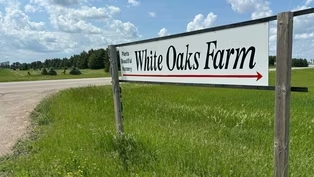
Preview: S39 Ep3 | 30s | Host Mary Holm travels to Plants Beautiful Nursery near Parkers Prairie to meet owner Lowell Dittber (30s)
Providing Support for PBS.org
Learn Moreabout PBS online sponsorship

- Home and How To

Hit the road in a classic car for a tour through Great Britain with two antiques experts.













Support for PBS provided by:
Prairie Yard & Garden is a local public television program presented by Pioneer PBS
Production sponsorship is provided by Shalom Hill Farm, Heartland Motor Company, North Dakota State University, Friends of Prairie Yard & Garden, and viewers like you.