

July 10, 2026 - PBS News Hour full episode
7/10/2026 | 57m 46sVideo has Closed Captions
July 10, 2026 - PBS News Hour full episode
July 10, 2026 - PBS News Hour full episode
Problems playing video? | Closed Captioning Feedback
Problems playing video? | Closed Captioning Feedback
Major corporate funding for the PBS News Hour is provided by BDO, BNSF, Consumer Cellular, American Cruise Lines, and Raymond James. Funding for the PBS NewsHour Weekend is provided by...
July 10, 2026 - PBS News Hour full episode
7/10/2026 | 57m 46sVideo has Closed Captions
July 10, 2026 - PBS News Hour full episode
Problems playing video? | Closed Captioning Feedback
Where to Watch PBS News Hour
PBS News Hour is available to stream on pbs.org and the PBS app.
Providing Support for PBS.org
Learn Moreabout PBS online sponsorshipGEOFF BENNETT: Good evening.
I'm Geoff Bennett.
Amna Nawaz is away.
On the "NewsHour" tonight: A housing affordability bill is on track to become law, but without President Trump's signature.
Why he's denying his own party the chance to celebrate their legislative victory.
The president fires members of a key election commission in his latest effort to assert control over the voting process.
And an ongoing drought compounds problems for farmers already suffering from a shrinking Colorado River.
REID FISHERING, Colorado Farmer: This almost feels like this hopefully is not the last nail in the coffin, but it has the looks of it, for sure.
(BREAK) GEOFF BENNETT: Welcome to the "News Hour."
Just hours from now, a sweeping new housing bill is set to become law.
The measure passed Congress with bipartisan support, but President Trump said today he will not sign it, protesting the GOP Senate's failure to approve his election legislation known as the SAVE America Act.
Now, barring a last-minute veto, the bill will usher in new housing regulations and incentives at midnight.
Lisa Desjardins is here with more on what's set to change.
Good to see you, Lisa.
So this is a housing affordability - - it's a complex problem.
This is a complex bill.
What are some of the most impactful aspects of this legislation?
LISA DESJARDINS: I'm so excited to talk about actual policy.
As you said, this is a complex subject, but this bill has quite a lot to it.
It is not a show bill.
It does have some serious impact and effect.
So let's look at them right now.
First of all, the biggest ones,this would redefine manufactured housing in this country, removing a 1970s era requirement.
It also would speed up loans and support for modular housing.
So, together, those two provisions really could create a big boom in one form of housing being more available.
At the same time, it also would limit corporations or institutional investors from buying more than 350 homes, and they would get a million dollar penalty if they do that.
Now, this bill essentially attacks the housing problem by increasing supply.
That is just one part of the problem, and it would take time.
One of the experts I spoke to said the full rollout of this could mean three to five years in -- in affecting the market directly.
What could happen most quickly?
Those manufactured and modular housing pieces.
So, for years, what happened was, manufactured housing had a requirement in this country that had a steel chassis underneath it.
That is an outdated requirement, but it's been in place for 50 years.
This bill removes that.
That could revolutionize how manufactured housing is built and also make it cheaper.
Those chassis cost $10,000 each.
I spoke to a representative from the Manufactured Housing Institute today.
They said this is a game changer, and it's what they see as the future of housing.
GEOFF BENNETT: So, as you said, this is a big bill.
What are some of the more overlooked provisions here?
LISA DESJARDINS: Right.
It's difficult to choose just three, but I did.
So these are three that are overlooked that I want to talk about.
First of all, rural America would benefit from this.
This would protect subsidies for almost half-a-million renters in rural America.
It also would expand home repair subsidies for low-income Americans.
And listen to this.
It would encourage more community banks, give them more flexibility.
Why is that important?
I spoke to one of the main negotiators of this bill, Republican French Hill.
He said that community banks are actually one of the largest sources of loans for development around the country of housing.
So he wanted to make sure that there could be more of them, when in fact he's seen it go the other way.
There have been fewer.
Now, as I said, this is about supply, but a lot of advocates say this misses a big piece of the puzzle of affordability.
Let's look at where we are right now.
The problem is vast.
Home prices are up at an all-time high, as I know you've been talking about.
Forty-three million Americans spend more than 30 percent of their income.
That's sort of the mark people look at on housing.
But how about this?
Some 12 million American renters are spending more than half of their income on housing.
So this is why advocates say there is still a lot more to do.
I spoke with Libby O'Neill of the National Low Income Housing Coalition.
She said they find hope in the fact that this bill was passed in a bipartisan way.
LIBBY O'NEILL, National Low Income Housing Coalition: So that's a really big deal.
We have been encouraged to hear many of the congressional leaders say that this is a first step.
We really need sustained investments in programs like rental assistance, public housing, programs to help people experiencing homelessness, to really make an impact for that population.
LISA DESJARDINS: Politically, there's some irony here.
This is Congress doing something.
The president has said nothing but good things about this bill, and yet here we are.
The president is not planning to sign it.
GEOFF BENNETT: There's another issue that you are tracking Lisa.
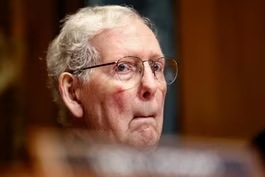
So this has to do with the health of the former Senate leader, Republican Senate Leader Mitch McConnell.
What more do you know?
LISA DESJARDINS: OK.
Yes, let's get into this.
I know a lot of our viewers are paying attention to this.
McConnell was admitted to the hospital three weeks ago.
But beyond that, we don't know very much from his office.
His office has not said why he was admitted.
They only issued this statement.
This was his most recent statement from a spokesperson.
"The senator continues to improve and is working closely with his staff in Kentucky and Senate matters" -- oh, sorry, -- "on Kentucky and Senate matters while the Senate is out of session."
Now, at the same time, we know there is ems audiotape from a dispatch on the date that he was admitted to the hospital, June 14, indicating someone from his home was given CPR for cardiac arrest.
We haven't been able to verify that that was McConnell himself, but a lot of people believe -- what are the chances that someone else in McConnell's home who was admitted in the hospital at day had a cardiac arrest?
There have been vast conspiracies about this.
Some of our viewers have heard them probably, but I have spoken to McConnell contacts who say they have texted back and forth with him.
Others have publicly said they have had long conversations with him.
So this brings up the question, why do we not know?
Why is he not saying what happened to him?
McConnell's 84 years old.
He is the person who served the longest as a party leader in the Senate.
And one thing you and I both know from covering him, there's no one more disciplined and perhaps more private about his health concerns.
This is not his first health concern.
He froze up twice before in press conferences before he left leadership.
So I believe we probably won't know what has happened to him until he wants to tell us.
But there is a real issue of disclosure.
Especially, we're hearing that from people in his state.
GEOFF BENNETT: Lisa Desjardins, thanks, as always.
LISA DESJARDINS: You're welcome.
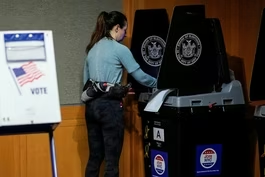
GEOFF BENNETT: With planning for the midterm elections well under way, President Trump has ousted the remaining members of a bipartisan federal agency that helps state and local officials run smooth elections and certify voting equipment.
Our White House correspondent, Liz Landers, is here to explain what happened at the Election Assistance Commission and the impact it could have in November.
So, Liz, who was pushed out and how is the White House explaining this move?
LIZ LANDERS: The three remaining commissioners there at the EAC were pushed out yesterday.
Thomas Hicks, who was the chairman, he is a Democrat, also Benjamin Hovland, he was also a Democrat appointed to the commission, and then one Republican who apparently resigned under pressure, Christy McCormick, have all left.
The fourth commissioner had already left at that point.
So there is no one on the EAC right now that is a confirmed commissioner.
Votebeat reports that last night these commissioners, the two who were dismissed, received an e-mail telling them that they were being pushed out, and it was signed by someone from the White House.
We have not heard directly from the president on this, but I did e-mail the White House yesterday asking for comment about this.
A White House official told me in a statement that the president has the authority to fire people that -- quote -- "may not be totally aligned with the important task of securing America's elections and ensuring every legal vote is counted."
And, interestingly, Geoff, the White House pointed to a recent Supreme Court decision, the Slaughter decision, which tests the limits of the president's ability to fire independent agency heads.
He was allowed to fire this FTC commissioner, Rebecca Slaughter, but Lisa Cook, a member of the Federal Reserve Board, does remain in her job.
So if one of these terminated members of this board were to sue, we might be in uncharted legal territory.
GEOFF BENNETT: So, the EAC, the Election Assistance Commission, I think it's fair to say most people did not know it existed until the White House fired the remaining commissioners.
What exactly does it do?
LIZ LANDERS: This commission does not have any of these confirmed commissioners at this point, so they can't act.
But I spoke with David Becker earlier today.
He's the executive director of the Center for Election Innovation and Research, and he said that the EAC doesn't really have much control over anything.
They have kind of three main areas and tasks that they do.
They create alongside election officials a voluntary voting system's guideline to certify voting equipment.
But, again, that's voluntary.
Not all states participate.
They give grant money when appropriated by Congress, and then they administer a election voting administration survey every two years.
GEOFF BENNETT: How concerned are state election officials about all of these changes?
LIZ LANDERS: One Republican that I spoke to was not very concerned.
This person pointed out that because the EAC does not have any governing authority, they were not that worried about this decision.
I also spoke, though, with Tobias Read.
He's the Democratic secretary of state of Oregon.
He called these firings irresponsible and reckless.
And I asked how this change will affect the midterm elections in his state.
TOBIAS READ (D), Oregon Secretary of State: I think it remains to be seen.
As I said, we're we are prepared to step into that gap.
But I think it also really underscores how important it is for the president to -- if he wanted to really make a difference in elections, he would he would go to a whole range of other things that would be much more effective.
The president could restore the funding to the agency that is responsible for protecting our elections from foreign interference and cyber intrusions.
He hasn't chosen to do that.
He could make it easier for more people to have the access that Oregonians do to paper mail-in ballots.
So, if the president were serious about this, he'd be focused on that, instead of this kind of manufactured controversy and exceeding his authority.
GEOFF BENNETT: And these firings aren't happening in a vacuum, as you well know.
President Trump has been laser-focused on trying to change how elections at the state level are administered in this country.
LIZ LANDERS: He's put pressure on various parts of the government and also used presidential power and authority, which the courts, I would add, have pushed back on throughout the last year or so.
I think our audience will remember that the director of national intelligence went to Fulton County to investigate the election there from 2020 that still has no proof of substantial voter fraud there.
The Department of Justice keeps losing challenges to their requests for personal data and voter rolls.
There are executive orders about mail-in ballots that the president has signed, and courts keep telling him that he does not have authority over election administration in this country, and then he has also put pressure on Congress recently on that SAVE America Act, a sweeping voting piece of legislation.
So, for years now that he's been elected, he's been talking about election fraud, which is incredibly rare in this country, Geoff.
This is a solution without a problem.
GEOFF BENNETT: Liz Landers, thanks so much for this reporting.
We appreciate it.
LIZ LANDERS: Of course.
GEOFF BENNETT: Today's other headlines start with the deadly ICE shooting in Houston this week of a Mexican man who had been living in the U.S.
for decades.
The Department of Homeland Security says Lorenzo Salgado Araujo was not the intended focus of an immigration enforcement operation when the shooting occurred.
A DHS official tells the "News Hour" that - - quote -- "Officers were almost at the target's address when they observed a white van with an individual who resembled the target."
Federal officials claim an officer then fired in self-defense after Salgado Araujo -- quote -- "weaponized his vehicle," but have provided no evidence to support that claim.
A lawyer for three men who were also in the car is demanding an independent investigation.
HUGO BALDERAS-IBARRA, Attorney For Detained Men: His only crime was that he fit the description of another man that they were looking for.
The agency's versions of the killings have varied.
My clients' versions of the events are extremely different from what ICE agents are saying or what the agency is saying.
GEOFF BENNETT: Federal officials have not yet released the name of the officer who opened fire.
The case has reignited public concerns about the Trump administration's aggressive immigration crackdown and the tactics of ICE officers.
The family of the teenager whose body was found off the coast of Mississippi is calling for a thorough investigation into their son's death; 18-year-old Nolan Wells had gone on a boat trip to a nearby island with friends during the July 4 weekend, but did not return with them.
He was the only Black teenager among a group of white friends.
The Jackson County Sheriff's Office says no foul play is suspected, but is calling for any witnesses to come forward.
At a press conference today, civil rights attorney Ben Crump said the facts of the case are not adding up, as the mother of Nolan Wells asked for answers.
BENJAMIN CRUMP, Attorney For Family of Nolan Wells: We are going to make sure that we get to the truth, the whole truth, and nothing but the truth, because Nolan deserves it.
CHRISTINE WELLS-WONSLEY, Mother of Nolan Wells: We just want to know what happened.and why our baby didn't come home.
GEOFF BENNETT: An official autopsy has been conducted, though it could be weeks before results are released.
Police say the friends who were on the island with Wells are cooperating with the investigation.
The CDC says an intestinal parasite called cyclosporiasis has now reached more than 30 states.
The agency has confirmed more than 800 cases of the parasite, which can cause weeks of gastrointestinal illness.
At least 86 people have been hospitalized.
Some states are reporting much higher numbers, with more than 1,500 in Michigan alone.
Several other states have also recorded at least 100 cases.
No deaths have been reported, and the source has not been identified, but it typically stems from contaminated irrigation water.
Experts say to thoroughly wash fruits and vegetables or cook them before eating.
A wildfire in Southern Spain has killed at least a dozen people, making it one of the country's deadliest fires on record.
Authorities say that many of the victims died while trying to escape after ignoring shelter-in-place orders.
More than 20 people remain missing.
Hundreds of firefighters and soldiers are still working to contain the blaze.
It broke out yesterday, and, as of this afternoon, had burned nearly 8,000 acres.
Locals say the devastation is overwhelming.
JOSE ANTONIO FLORES, Spain Resident (through translator): A disaster, not just for the woodland, but for the people who have already died and everything that has happened.
The house right there up above has burned completely.
GEOFF BENNETT: Spain has experienced a series of heat waves this summer, and local officials say those have contributed to the fire's intensity.
The Bayeux Tapestry is back in the U.K.
for the first time in nearly 1,000 years.
Trucks carrying the 11th-century artwork arrived overnight at the British museum after a secret high-security journey from France.
The tapestry spans more than 220 feet and depicts the Norman invasion in 1066, a pivotal moment in British history.
French President Emmanuel Macron called the loan a tangible expression of the longstanding friendship between the U.K.
and France.
It will go on view in September, and museum officials say 100,000 tickets have already been sold.
In World Cup news today, Spain advanced to the semifinals after beating Belgium 2-1 this afternoon.
Things were looking promising for Belgium after they tied the match one-all with this header in the first half.
It was the first time Spain had conceded a goal all tournament.
But they then pulled ahead with a goal in the closing minutes and will take on France on Tuesday.
And, late today, Apple sued OpenAI, accusing the company of stealing trade secrets tied to products still in development.
It's a dramatic reversal for the two companies, which entered into a high-profile partnership in 2024 to integrate ChatGPT into the iPhone's operating system.
Meantime, on Wall Street, stocks ended the week with modest gains.
The Dow Jones industrial average added about 150 points.
The Nasdaq rose roughly 75 points.
The S&P 500 closed out its fourth winning week out of the past five.
Still to come on the "News Hour": after recent court defeats where trans advocates are focusing their efforts next; David Brooks and Jonathan cape hart give their analysis on the week's headlines; and we speak with the man in a poignant image that laid bare the country's stark divides on its 250th anniversary.
The U.S.
Supreme Court wrapped up a consequential term for LGBTQ rights last week.
In one of its major end-of-term decisions, the justices upheld state bans on transgender athletes competing in girls and women's sports.
But the ruling left key legal questions unresolved, and new challenges are already taking shape.
Liz Landers is back and brings us a conversation she recorded earlier this week on the ongoing legal battles.
LIZ LANDERS: For decades, LGBTQ rights groups have turned to the courts to fight back against laws they view as discriminatory.
And while they have notched victories in the past, advocates are now facing challenges in that legal movement.
In the past two years, the Supreme Court's conservative majority has sided with Republican-led states on issues involving transgender people.
Those rulings include bans on gender-affirming care for minors, and, just last week, upholding bans on transgender women and girls from playing on sports teams that match their gender identity.
For more on where the legal movement goes next, I'm joined now by Chase Strangio, co-director of the ACLU's LGBTQ and HIV Project, and the first openly transgender attorney to argue before the U.S.
Supreme Court.
Chase, thank you for joining "News Hour."
CHASE STRANGIO, American Civil Liberties Union: Thanks so much for having me.
LIZ LANDERS: How are you and the ACLU responding to last week's Supreme Court decision?
CHASE STRANGIO: You know, we're going to do what we always do, which is assess the court's decision and prepare to mobilize whatever strategic next steps we need to take both in and out of the courtroom.
Whether we win or lose at the Supreme Court, there is always more work to be done, and that is how we are positioning ourselves for the coming months and years.
LIZ LANDERS: I want to ask you about the Bostock v. Clayton County decision.
That was from 2020 from the Supreme Court that protects employees against discrimination on the basis of sexual orientation or gender identity.
It was a major win for you all just a few years ago.
But public sentiment has shifted since then.
How much of that change comes down to politics?
CHASE STRANGIO: I think that the reality is that the Supreme Court's decision in Bostock in 2020 coincided with a change in the federal administration and was in the middle of the pandemic.
And in the aftermath of those three things all together, we saw a pretty significant backlash targeting LGBT people.
And it was part of the political changes that were happening, but it was also part of a very significant conservative investment in narratives targeting particularly transgender people and hundreds of millions of dollars that were paid in the four or five years between 2021 and 2025 to demonize trans people in particular.
And that, of course, changes public sentiment when they're internalizing incessant narratives about our community that situate us as a threat, despite the fact that we represent less than 1 percent of the population.
LIZ LANDERS: You are dealing with a Supreme Court with a conservative majority of justices that clearly don't share your vision.
How big of an obstacle is that?
CHASE STRANGIO: I think, right now, we are facing in all rights movements, all civil rights movements a serious set of obstacles, both from the federal executive and from the judiciary in terms of a desire to really narrow civil rights.
And now, as trans people are facing this uphill battle with attacks from the Trump administration and significant constraints on our rights from the Supreme Court, obviously, we need to think about ways to protect people without just relying on the federal government.
And so we're turning to state courts, we're turning to state legislatures, but we can't abandon advocacy in the federal courts.
And we and we won't, because that is a important part of fighting back against the type of attacks that we're seeing from the Trump administration.
And even though we are facing these obstacles from the Supreme Court, we are consistently still winning in the lower courts, delaying some of the most egregious harms that our communities are facing.
So it's about pursuing multifaceted approach and doing whatever we can to protect the rights and well-being of our community.
LIZ LANDERS: About those lower court battles, some critics say that it's risky to bring these legal challenges to anti-trans laws when courts at the state level are turning wins into losses at the Supreme Court.
Are these lower-level wins enough?
CHASE STRANGIO: It's easy to critique minority for advocating for their rights, when the problem is this larger set of structures that are targeting some of the most vulnerable members of our communities and absolving those structures and those people and institutions in power.
But if we sit back and don't challenge some of the most aggressive actions targeting trans people, then we have essentially just accepted the idea that we can we can exist in this baseline where trans people are denied access to education, to health care, to safe housing, even to privacy in their medical records.
And I don't think that that would be a safe or effective state of play to just let exist without challenge.
LIZ LANDERS: This has now been two years of setbacks for your advocacy when it comes to the Supreme Court, including last year's ruling on gender-affirming care for minors and this year's on conversion therapy.
Where does the movement go from here?
CHASE STRANGIO: These are losses that will have a negative impact on people's lives, on young people's well-being, and of course, we grieve those realities and we continue to fight on.
Movements are long, and the fight for justice is a multigenerational fight.
So we take in the setbacks.
We care for our community, but we don't let it deter us in this multigenerational fight to ensure that we continue to push towards justice.
LIZ LANDERS: Chase Strangio, thank you for your time.
CHASE STRANGIO: Thanks for having me.
GEOFF BENNETT: This past winter was an extraordinarily dry one in the western part of the country.
A lack of snowpack that normally feeds the Colorado River has only deepened the impact of a wider drought out West, which affects tens of millions of people in seven states and Mexico.
And, this spring and summer, that drought made worse by climate change is taking a big bite out of farmers' plans in Colorado.
Our science correspondent, Miles O'Brien, has this report for our series Tipping Point.
MILES O'BRIEN: Hugh.
HUGH SANBURG, Colorado Rancher: Miles.
MILES O'BRIEN: Thanks for meeting us.
I met cattle rancher Hugh Sanburg at the gates to his property in Delta County, Western Colorado.
With Diva (ph), the diligent dog riding shotgun, he drove me up a hill to survey his pastures.
The scenery here is as rare as the rain, only about 12 inches a year.
And the brown patch tells the story.
HUGH SANBURG: We won't have enough to feed all the cows we have without either buying some hay or selling some cows.
MILES O'BRIEN: He'd rather not go into debt at this stage of his life, so he is now counting cows, seeing which ones he will cull.
Ranchers and farmers here depend on a century-old labyrinth of creeks, ditches, and diversions to keep their fields green.
This year, he's receiving only half the water he normally counts on, even though his water rights date back to 1896, placing him near the top of Colorado's seniority system.
So you have senior rights, but in the face of whatever's going on with the weather, it doesn't add up to much, does it?
HUGH SANBURG: Well, you have you have got to have water in the stream to make water to come down the ditches, and, unfortunately, we don't have water in the streams this year.
MILES O'BRIEN: These are the headwaters of the Colorado River.
The water in these streams starts as snow high in the mountains that surround the valley.
But this year, nature came up short.
A drier, warmer winter was followed by an exceptionally hot march, triggering an early melt.
By May, about 70 percent of the snowpack had already disappeared.
JASON ULLMANN, State Engineer, Colorado Division of Water Resources: Our biggest reservoir in Colorado is the snowpack.
This year was shocking.
MILES O'BRIEN: Jason Ullmann is the state engineer.
He is responsible for managing one of Colorado's most precious resources water.
He took me on a tour of the Uncompahgre River Valley, a tributary of the Colorado.
How would you characterize that river relative to other springs?
JASON ULLMANN: So we would expect there to be hundreds of cubic feet per second here.
This is approximately four CFS, so very low for this time of year.
MILES O'BRIEN: The stream flows dwindling, Ullmann and his team face an unenviable task, shutting off water deliveries to the valley's 85,000 acres of irrigated farmland based on seniority.
Not far from Hugh Sanburg's ranch, Chan Fogg tends a 60-acre orchard, nearly 30,000 apple, pear, and peach trees.
CHAN FOGG, Colorado Orchardist: Everything that we do, we have to have snowpack.
And without snowpack, we have a drought.
Instead of bins of apples this year, we will have pounds of apples.
MILES O'BRIEN: He says it takes about 30 inches of water to produce a healthy, profitable crop; 20 inches is the bare minimum just to keep the trees alive.
CHAN FOGG: We don't have a choice of not irrigating, because, if you don't irrigate, the trees die and you have lost your lifetime investment.
MILES O'BRIEN: So this is all apples?
CHAN FOGG: This -- well, this is peaches on this side and apples over here.
MILES O'BRIEN: I got you.
Chan Fogg has worked hard to get by with less water.
He showed me his ingenious system.
CHAN FOGG: This is the ditch that supplies our water, Chiles (ph) Ditch, and it comes in here.
MILES O'BRIEN: Water travels through a buried pipe to a pump system that Isaac Newton would appreciate.
Gravity does all the work.
CHAN FOGG: This gauge over here is a flow meter, and it shows that we're using 168 gallons a minute right now.
MILES O'BRIEN: The pumps feed a micro-sprinkler irrigation system.
He installed it a decade ago, thanks to some federal grant money.
CHAN FOGG: It's just a lot more efficient, and you get the same amount of water from the from the top of the orchard to the bottom.
MILES O'BRIEN: And do you use less water with it?
CHAN FOGG: Oh, considerably less, yes, probably less than a third as much water.
MILES O'BRIEN: All right, let's go see how you irrigate all these things, huh?
It's not enough to erase his worries.
But this spring's wild weather may have offered Chan one small silver lining.
The March heat wave brought his fruit trees into bloom weeks early.
Then came a hard freeze in April, wiping out his nascent fruit.
Crop insurance softened the financial blow.
And, ironically, fruitless trees need far less water.
CHAN FOGG: The trees will get stressed, but they won't -- if we just keep a minimal amount of water on them, they will make it through the year.
MILES O'BRIEN: Fogg and other farmers here are able to purchase water from a string of small reservoirs in the mountains nearby.
But they provide a cushion for only one dry year.
JASON ULLMANN: If we have another year after this year like this year, it's going to be a lot more painful than it is even this year.
They will just be completely off.
MILES O'BRIEN: With so little water stored for not-so-rainy days, farmers here are accustomed to shortages and curtailments.
REID FISHERING, Colorado Farmer: With our water situation, we have had to fallow pretty much half of all the fields that we have.
MILES O'BRIEN: Reid Fishering grows sweet corn in Delta County.
As we walked his farm, he showed me the stark line between the fields he was able to plant and those he was forced to leave fallow.
REID FISHERING: This shows the demarcation line of possible money versus us having to just sit fallow and not make any money on it.
So this kind of represents our economic outlook for 2026.
MILES O'BRIEN: In a normal year, Fishering plants about 1,000 acres.
This year, it's closer to 500.
What we saw on the Western Slope of Colorado is just one small part of how the 25-year drought fueled by climate change has affected the entire Colorado River system.
Lakes Mead and Powell, two giant reservoirs downstream that provide water to California, Arizona, Nevada, tribal nations, and Mexico, are at critically low levels.
REID FISHERING: Every single year, we seem to be hit by something new, and this is -- This almost feels like this hopefully is not the last nail in the coffin, but it has the looks of it, for sure.
MILES O'BRIEN: This bone-dry growing season comes as the seven Colorado River Basin states struggle to negotiate a new agreement on how to share a shrinking river.
As they debate the size of the cuts and who should bear them, nature has weighed in with a reminder: It always bats last.
For the "PBS News Hour," I'm Miles O'Brien in the Uncompahgre River Valley, Colorado.
GEOFF BENNETT: To discuss the fallout from this week's shakeup in Maine's Senate race and the resumption of hostilities with Iran and more, we turn now to Brooks and Capehart.
That's "The Atlantic"'s David Brooks and Jonathan Capehart of MS NOW.
Good evening.
gentlemen.
So Democrats have this immediate challenge trying to replace Graham Platner in this critical Maine Senate race.
The larger question is why these serious controversies increasingly fail to disqualify political candidates until the pressure becomes overwhelming.
But, Jonathan, starting with the practical question, what do Democrats need to do now?
JONATHAN CAPEHART: They need to get a nominee who can best go up against Susan Collins.
Now, with Graham Platner finally out of the race -- I was happy to see that he submitted the papers to fully get out of the race this afternoon.
That is the first step that needed to happen.
Now they have to have -- the Democrats have to have the convention, and a bunch of people are going to jump into that race and be a part of the process to become the nominee.
But, again, no matter who the nominee is, they are going up against a formidable candidate in Susan Collins.
We have talked about this many times before.
How many elections have we seen her either down in the polls, potentially losing to the Democrat, but, on Election Day, she blows the doors off the election?
That scenario is still at work.
So whoever becomes the Democratic nominee, whoever the Maine Democrats pick, they better pick the person and then circle the wagons around them to give that nominee the best possible shot they can to defeat Susan Collins.
GEOFF BENNETT: And, David, the fact that Graham Platner survived one controversy after another, his political support largely held until there was this allegation that was just so serious that it became impossible for the party to move on, what does that say about how high the threshold for political shame has become?
DAVID BROOKS: Very high, apparently.
Everyone's a sinner, and we all have things that we're not proud of in our past.
But he had so many red flags.
And it was not only the tattoo and over a decade of Reddit posts.
But, as we have learned, when some guy's abusive to one woman, there are more.
There's a pattern of behavior all the time.
And we learned from some reporting in The New York Times this week that three operatives from the Democratic national party in D.C.
went up to Maine and told him, you're the guy, you're our hero, you're a messiah, you should run.
And people in Maine who knew him was like, you might still be in a fragile state.
Maybe this is not a good idea.
And they turned out to be right.
To me, the bigger picture is, when you decide whether or not to vote some for somebody, there should be three filters.
First, do they have the moral character ready to do the job?
Are they trustworthy?
Do they tell the truth?
The second filter should be, do they have good judgment?
Can they read a situation and see, here's what needs to be done here?
And the third filter should be, do they agree with me?
Do they -- are they on my political team?
But what's happened in politics over the last, I don't know how many years, is those first two filters are gone.
And so people only ask, are they on my team?
And that's obviously true on the Republican side with Trump, but it's also true of Bernie Sanders, who stuck to Platner like glue after a lot of these revelations were coming, because he decided, well, he's a Democrat, therefore, I don't have to worry about character.
I don't have to worry about judgment.
But let's all learn the lesson character actually kind of is important.
And if somebody doesn't have that, it doesn't matter if they're on your team.
GEOFF BENNETT: Well, what about that, Jonathan?
Democrats for years had pointed at Donald Trump and made the argument that character matters.
Does the fact that so many Democrats were willing to stick with Graham Platner, does that undercut the their argument fundamentally?
JONATHAN CAPEHART: No, it doesn't, because we're talking about one guy over a history of candidates where Democrats didn't put those -- the considerations they gave to Graham Platner into work.
I look at it like this.
What happened, what should have happened, finally happen.
And when you look on the Republican side, and particularly with President Trump, who has had similar accusations against him, including some court actions, and yet Republicans stuck by him.
And so I wonder if a lot of Democrats looked and thought, you know what, the guy in the Oval Office has got a lot of baggage, this guy has a lot of baggage.
We're going to hang in there.
Should they have done it?
No, they shouldn't have.
And the consequences of that, Maine and Maine Democrats are dealing with that now.
But I hope that this is a lesson for candidates around the country.
If you have skeletons in your closet, you better know what they are, and you better be truthful and forthcoming about what they are when people come to you and say you are the one.
Maybe you should be the person who says, you know what, I'm not, and maybe you should go talk to someone else.
GEOFF BENNETT: Well, let's shift our focus to the president and NATO this past week, because the president left the summit in Turkey with allies now spending more on their own defense, which is what he has been calling for, for years, and the alliance is still intact.
It's a low bar.
But his defenders would say that the president's -- that the results vindicate the president's methods.
Do you see it that way?
DAVID BROOKS: Not quite vindication.
I think people have taken -- gotten used to the Trump show, and they know there's going to be a lot of shrapnel flying in the air when he arrives in town.
But the good news is, according to the reporting, at the end, he filled everybody with love.
He praised everybody.
Apparently, he was actually listening to each of the leaders as we spoke.
And we got more out of this summit than we had every right to expect or deserve.
As you said, the Europeans are taking more -- a greater share of the defense budget.
To me, the most impressive thing is both Europeans and Americans and our other allies are building a manufacturing base for defense.
We were -- a couple of years ago, we were so far behind China in the manufacturing base.
We're now beginning to do that.
There's still a support for Ukraine and more money for Ukraine out of this summit.
And that's significant.
And so it was a successful summit.
And Trump showed some humanity.
The thing that worries me is so many foreign policy experts these days are worried that Vladimir Putin, who's got his back to the wall, is going to reach out and attack a NATO ally directly.
And they're going to wonder, is the U.S.
going to be there, is NATO going to be there, is NATO still a thing?
And it seems outrageous to me that Vladimir Putin would launch another invasion.
But I keep hearing this from so many foreign policy experts.
I'm wondering, something to look out for.
GEOFF BENNETT: Yes, what's your assessment, Jonathan?
JONATHAN CAPEHART: Well, I mean, I take your points, David, about a successful summit.
I just wonder if part of it was, great, the president's good behavior.
But I wonder if the Europeans, the NATO allies have gotten to the point where they just placate him, have Rutte babysit him and do all the stuff for public show, but behind the scenes are doing everything they can to ensure that the alliance hangs together whether or not the United States is there.
And the one thing that tempers, when -- as I was listening to you, David, the one thing that gives me some caution is, let's say Vladimir Putin does invade a NATO country or attack a NATO country directly.
I still believe, and I'm sure leaders in European NATO capitals are wondering, will the United States actually be a participant in Article 5 protection of that NATO ally?
And I don't know if anyone has a definitive answer to that right now.
GEOFF BENNETT: In the time that remains, I want to get to this other topic, because I spoke with Rahm Emanuel this past week, who argued in Israel that Prime Minister Benjamin Netanyahu's handling of the war with Gaza has left Israel increasingly isolated and facing what he called the prospect of perpetual occupation.
David, is that becoming in many ways sort of the mainstream position inside both political parties?
DAVID BROOKS: I hope so.
But I don't think so.
I think Rahm gave a great speech.
He has the bona fides to do it.
I thought the Palestinians were idiots for not signing up to the Oslo peace process.
I think Netanyahu and the Israelis have been idiots to do all these settlements, which really make the two-state process.
And so both sides in the region have given up on the two-state solution.
My problem is that, in the United States, a lot of people in America are giving up the two-state solution.
Rahm Emanuel believes in it.
A lot of mainstream Republicans believe in it.
But when I go on college campuses, a lot of the students I talk to, they just don't believe in it.
And a lot of people on the right don't believe in it.
GEOFF BENNETT: Jonathan?
JONATHAN CAPEHART: One, Geoff, I want to commend you on your interview with Rahm Emanuel.
Your questions were great.
I thought his answers were terrific.
His speech was terrific.
And what I took away from it was that Rahm was sending a message to the Israeli people that this is about Prime Minister Netanyahu.
And he is the obstacle to bringing about any kind of path towards a peaceful solution.
GEOFF BENNETT: Jonathan Capehart, David Brooks, I certainly wish we had more time for this conversation.
But thank you both.
Have a great weekend.
DAVID BROOKS: Thank you.
JONATHAN CAPEHART: Thanks, Geoff.
GEOFF BENNETT: Events surrounding America's 250th birthday produced many memorable images, fireworks lighting up the sky over the Capitol, crowds dressed in red, white, and blue, and military aircraft flying over Washington's many monuments.
But one set of images has drawn attention for a very different reason.
They show hundreds of masked uniformed men marching through parts of Washington on the morning of the Fourth of July.
The men are members of Patriot Front.
That's a white supremacist group formed in the aftermath of the 2017 Unite the Right Rally in Charlottesville, Virginia.
Images of members of the group riding metro trains alongside other passengers have since gone viral.
Amna Nawaz spoke earlier with one of those passengers.
AMNA NAWAZ: Roswell Encina on the D.C.
Metro, headed to an Independence Day celebration in Maryland on July 4.
The ride started out as expected.
He saw people dressed in red, white and blue, families getting on and off.
But the atmosphere suddenly shifted when a massive crowd of men, all dressed alike, wearing masks and caps, filled the train.
He soon found out those men were members of the white supremacist group the Patriot Front.
Getty Images photographer Finn Gomez captured this photo of Encina during that ride.
Roswell Encina heads the U.S.
Capitol Historical Society.
That's a nonprofit and nonpartisan educational organization dedicated to preserving the history of the U.S.
Capitol, and he joins me now.
Welcome to the "News Hour."
Thanks for being here.
ROSWELL ENCINA, President and CEO, U.S.
Capitol Historical Society: Thank you for having me.
AMNA NAWAZ: So take me back to July 4.
You're on this train.
You're headed to a celebration.
You notice these men coming on the train, and this photo of you then goes viral.
What's going through your mind at that moment in the picture?
ROSWELL ENCINA: Well, I was scared.
I'd be lying to you if I told you -- I was trying to be strong.
But when a massive amount of men who are masked covered with sunglasses and a baseball cap, and you can't identify any of them, your national instinct is to really just like, oh, my goodness, what's happening?
Who are these people?
What are their intentions?
What are they going to do in the Metro?
So I kind of -- kind of made myself smaller.
AMNA NAWAZ: When you look at that photo now, what goes through your mind?
ROSWELL ENCINA: I still have a hard time looking at myself in that photo.
It's because people take photographs of you when you're smiling, when you're happy, maybe when you're sad or excited, but you never see yourself when you're scared.
But I'm really hoping, when people see my photo, most importantly the photo of that African American woman who was also surrounded by them, that they understand that we have our stories too, and our stories are part of the nation, and that we're all part of this United States.
AMNA NAWAZ: There were those other photos, as you mentioned.
There was one of a Black man on a Metro train ride also surrounded by members of that Patriot Front, the Black woman who you mentioned, who's since been identified by her family as Bernita Bowlding.
And I need to ask you about this because, since she was identified, there has been a real wave of some very ugly, some racist comments about her and that photo.
Have you seen anything similar?
And do you worry about the response now that you're out speaking publicly about it?
ROSWELL ENCINA: Sadly, yes.
I can't help but see the comments towards me, the comments towards her, and it's very discouraging.
Some of them are like, well, they didn't touch him.
They left him alone.
He wasn't bullied physically.
It's hard to understand what a person of color goes through in this country, especially when you're by yourself in a contained space, and that position you're put in and not knowing what's going to happen next.
And that's how we felt.
AMNA NAWAZ: Your own personal story is relevant here as well, because you were brought here as an infant.
I know your father was in the U.S.
military.
You're a U.S.
citizen, but you went back and forth between the Philippines a lot growing up.
As we're talking about America's 250th and this whole conversation about what it means to be an American, how do you see your story fitting into that?
ROSWELL ENCINA: I think back to when my parents brought me here when I was an infant.
My dad was in the U.S.
Navy, as you mentioned.
And they have always instilled in me the importance of civic engagement.
My father, when I turned 18, we were just -- coincidentally we're in the Philippines then, and like we need to go out and vote.
It was 1988.
It was a presidential election, and I'm like, oh, sure.
So we drove up to the U.S.
Embassy.
And I -- we voted.
And since then, I remember that day very clearly in my head how exciting it was.
It's the most minimum thing you could do is go out and vote.
Of course, everything beyond that is public dialogue.
And that's what we try to do, at least at the Capitol Historical Society.
And I think that's what we need to do more as a nation, is really have more -- read more, listen more, talk more, and hopefully it brings us somewhere in the middle.
AMNA NAWAZ: Much of your career has been about civic engagement.
It's in your work now.
You were at the Library of Congress before that.
You know better than anyone the First Amendment protects your right to say what's on your mind and their right to gather peacefully as they did on that day and say what's on theirs.
How do you think about that?
ROSWELL ENCINA: It's very complex.
I'm hoping when they -- people look at our photos or think back on the Fourth of July in Washington, that it starts a dialogue, it starts a conversation, which is part of democracy.
I really think that really will help us understand each other.
We have always had disagreements.
However, we have always found a way to move forward.
I -- there's been a lot of talk, clearly, because it's been the Fourth of July, of the Declaration of Independence, and that all men are created equal.
And when you think of that declaration, that Thomas Jefferson wrote 250 years ago, nowadays, it feels more like a mission statement, that I feel like each generation has done their part to try to achieve it, from women's suffrage, to the 13th Amendment, to landmark legislation like the Voting Rights Act and the Civil Rights Act, to our LGBTQ rights nowadays.
I think we have all -- each generation has played their part to make that a reality.
AMNA NAWAZ: Roswell Encina, such a pleasure to speak with you.
Thank you so much for being here.
ROSWELL ENCINA: I appreciate it so much.
GEOFF BENNETT: For working actors, even a standout role on a hit show doesn't guarantee recognition.
After HBO chose not to submit Brittany Allen for Emmy consideration for her guest role on "The Pitt," she took matters into her own hands, submitting herself.
Her character, Roxie, is a young mother facing terminal cancer.
BRITTANY ALLEN, Actress: I don't even know what hurts more, the cancer or knowing I'm never going to see my sons grow up.
It feels like a cruel joke.
Why give me children and a husband I adore if you're just going to take them away from me?
GEOFF BENNETT: That bet paid off.
She's now an Emmy nominee with a story about the power of persistence and betting on yourself.
I spoke with Brittany Allen earlier today and started by asking her if she had any hesitation about deciding to submit herself for an Emmy.
BRITTANY ALLEN: No, there's definitely no harm in trying.
And at the point of submitting myself, I was already starting to appear on some prediction lists.
The Hollywood Reporter had had a list out, Gold Derby.
Some of these sites which anticipate who might be the projected nominees, had me at the top of their list.
So I figured, well, they're suggesting that.
They're seeing the work.
And not only that.
I had been receiving such a flood of positive messages from fans of the show who had been impacted by the story.
It was just apparent to me that it had touched a lot of people, and I figured, well, now is the time.
It's not often that you find yourself on a hit show with a role that has impacted so many people.
I think, especially as a woman and a and a woman raised in the '90s, you're not taught to stand up and say, hey, this is something I want.
I think the general messaging, at least back when I was a young girl, was smile and be thankful.
And, of course, I have always been the first to be thankful.
But I think I have taken the approach of being the modest, quiet actress for years.
And when you realize that that's not maybe all that it takes to advance your career in the ways that you're looking for, then you try a different approach.
GEOFF BENNETT: Well, say more about that, because you said, before this nomination, you were struggling to find representation, to even land auditions in some cases.
What does that say about how hard it is, even for talented working actors in Hollywood right now, with all of the change and churn in the industry?
BRITTANY ALLEN: Yes, it's always been a tough business.
And I have been very fortunate over the years, but I have also had my fair share of slow times.
And it's so funny, because you get a role like the one on "The Pitt," and you do seven episodes and you and you deliver work that critics and audiences are responding to.
And it's just so beautiful the way that people are just hungry for that, for that raw, real depiction of what it means to be alive.
GEOFF BENNETT: Well, that character you played, Roxie, that is, to use your phrase, a raw, real depiction.
How did you approach playing this woman who was confronting the end of her life without it being overly sentimental or overly dramatic?
BRITTANY ALLEN: There were certain scenes in particular that I knew could verge on that.
And, for me, it was just about committing to the truth of that moment with just my utmost devotion.
So I absorbed many memoirs on the subject of deaths and dying and people with terminal cancer.
And I worked with a death doula.
I spoke with cancer experts.
I just -- I just went full in.
And, in this case, I thought, OK, this is my chance to really meditate on mortality, not only for Roxie, but for myself.
And I saw it as a responsibility, really, because I knew how many people would be watching the show who had been through something like this in their own lives, and for all of us who will ultimately go through it.
I knew that if there was any sense of putting it on or phoning it in, something I try to never do, but particularly in this story, I knew that that false -- falsehood would be picked up on.
And so it was a beautiful and very, very sad time.
And that's been a gift in the aftermath too, just having people come up to me and send me messages and share these really tragic, painful moments in their lives, but that they find solace and they -- they found solace in the storyline, and I think that there's a connection to be had in the aftermath that I'm just so -- I'm so grateful for.
GEOFF BENNETT: For this nomination, you prepared the submission.
You had to pay a fairly hefty fee, mounted your own campaign, got yourself on the ballot, and now you are an Emmy nominee.
What do you hope people take away from your story beyond the nomination itself?
BRITTANY ALLEN: I think it's really important to know your worth.
And that's a phrase maybe that's thrown around a lot.
And it's not something that's come easy for me.
But I think I have worked very hard at my craft over the years, and I encourage anyone who has a passion to do the same, to just devote yourself to becoming the best version of the artist that you are, and to continue to grow, and then to not let other people's definition of what you are capable of be your own definition of that, to define yourself.
GEOFF BENNETT: Brittany Allen, a real pleasure to speak with you.
And congratulations again.
BRITTANY ALLEN: Thank you, Geoff.
My pleasure.
GEOFF BENNETT: Tonight on "Washington Week," Jeffrey Goldberg and his panel assess what Graham Platner's departure from Maine's Senate race means for the Democratic Party's efforts to win back the Senate this fall and what's next with Iran after President Trump declared the cease-fire over.
And, this weekend on "Horizons," William Brangham looks at how climate change is affecting health care.
And be sure to watch "Compass Points."
Nick Schifrin speaks with key European leaders about the U.S.-NATO alliance.
You can watch both "Horizons" and "Compass Points" on our YouTube channel and on your local PBS station.
Check your local listings for more.
Well, that is the "News Hour" for tonight and this week.
I'm Geoff Bennett here at the desk.
For all of us here at the "PBS News Hour," thanks for spending part of your evening with us.
Have a great weekend.
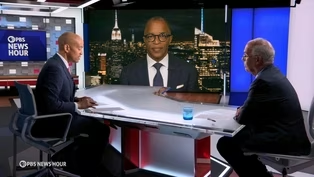
Brooks and Capehart on what's next for Democrats in Maine
Video has Closed Captions
Brooks and Capehart on what's next for Democrats in the Maine Senate race (9m 36s)

Farmers along Colorado River face more water shortages
Video has Closed Captions
Dry winter leaves farmers along Colorado River facing greater water shortages (7m 25s)

A look at housing regulations in the bill set to become law
Video has Closed Captions
A look at the new regulations and incentives in the housing bill set to become law (5m 54s)
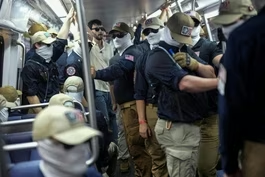
Metro rider recounts encounter with Patriot Front in D.C.
Video has Closed Captions
Metro rider recounts encounter with Patriot Front members in D.C. (5m 54s)
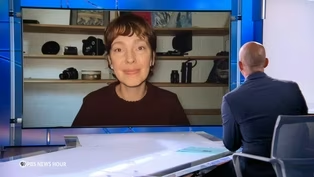
‘The Pitt’ actress Brittany Allen on betting on herself
Video has Closed Captions
'The Pitt’ actress Brittany Allen on betting on herself and earning an Emmy nomination (6m 39s)
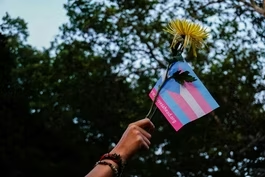
Trans advocates refocusing efforts after court defeats
Video has Closed Captions
Where trans advocates are focusing efforts after recent court defeats (6m 9s)
Trump fires Election Assistance Commission members
Video has Closed Captions
Trump fires election commission members in latest attempt to control voting process (4m 52s)
What we know about Mitch McConnell's health
Video has Closed Captions
What we know about Mitch McConnell's health and hospitalization (1m 57s)
Providing Support for PBS.org
Learn Moreabout PBS online sponsorship New Episode
- News and Public Affairs

Today's top journalists discuss Washington's current political events and public affairs.

- News and Public Affairs

FRONTLINE is investigative journalism that questions, explains and changes our world.
 New Episode
 New Episode
 New Episode
 New Episode
 New Episode
 New Episode
 New Episode
 New Episode
 New Episode
Support for PBS provided by:
Major corporate funding for the PBS News Hour is provided by BDO, BNSF, Consumer Cellular, American Cruise Lines, and Raymond James. Funding for the PBS NewsHour Weekend is provided by...