
Trans advocates refocusing efforts after court defeats
Clip: 7/10/2026 | 6m 9sVideo has Closed Captions
Where trans advocates are focusing efforts after recent court defeats
The Supreme Court wrapped up one of its most consequential terms for shaping LGBTQ rights. In one of the major decisions, the justices upheld state bans on transgender athletes in girls' and women's sports. But more challenges are already emerging. Liz Landers reports on the legal battle ahead.
Problems playing video? | Closed Captioning Feedback
Problems playing video? | Closed Captioning Feedback
Major corporate funding for the PBS News Hour is provided by BDO, BNSF, Consumer Cellular, American Cruise Lines, and Raymond James. Funding for the PBS NewsHour Weekend is provided by...
Trans advocates refocusing efforts after court defeats
Clip: 7/10/2026 | 6m 9sVideo has Closed Captions
The Supreme Court wrapped up one of its most consequential terms for shaping LGBTQ rights. In one of the major decisions, the justices upheld state bans on transgender athletes in girls' and women's sports. But more challenges are already emerging. Liz Landers reports on the legal battle ahead.
Problems playing video? | Closed Captioning Feedback
Where to Watch PBS News Hour
PBS News Hour is available to stream on pbs.org and the PBS app.
Providing Support for PBS.org
Learn Moreabout PBS online sponsorshipGEOFF BENNETT: The U.S.
Supreme Court wrapped up a consequential term for LGBTQ rights last week.
In one of its major end-of-term decisions, the justices upheld state bans on transgender athletes competing in girls and women's sports.
But the ruling left key legal questions unresolved, and new challenges are already taking shape.
Liz Landers is back and brings us a conversation she recorded earlier this week on the ongoing legal battles.
LIZ LANDERS: For decades, LGBTQ rights groups have turned to the courts to fight back against laws they view as discriminatory.
And while they have notched victories in the past, advocates are now facing challenges in that legal movement.
In the past two years, the Supreme Court's conservative majority has sided with Republican-led states on issues involving transgender people.
Those rulings include bans on gender-affirming care for minors, and, just last week, upholding bans on transgender women and girls from playing on sports teams that match their gender identity.
For more on where the legal movement goes next, I'm joined now by Chase Strangio, co-director of the ACLU's LGBTQ and HIV Project, and the first openly transgender attorney to argue before the U.S.
Supreme Court.
Chase, thank you for joining "News Hour."
CHASE STRANGIO, American Civil Liberties Union: Thanks so much for having me.
LIZ LANDERS: How are you and the ACLU responding to last week's Supreme Court decision?
CHASE STRANGIO: You know, we're going to do what we always do, which is assess the court's decision and prepare to mobilize whatever strategic next steps we need to take both in and out of the courtroom.
Whether we win or lose at the Supreme Court, there is always more work to be done, and that is how we are positioning ourselves for the coming months and years.
LIZ LANDERS: I want to ask you about the Bostock v. Clayton County decision.
That was from 2020 from the Supreme Court that protects employees against discrimination on the basis of sexual orientation or gender identity.
It was a major win for you all just a few years ago.
But public sentiment has shifted since then.
How much of that change comes down to politics?
CHASE STRANGIO: I think that the reality is that the Supreme Court's decision in Bostock in 2020 coincided with a change in the federal administration and was in the middle of the pandemic.
And in the aftermath of those three things all together, we saw a pretty significant backlash targeting LGBT people.
And it was part of the political changes that were happening, but it was also part of a very significant conservative investment in narratives targeting particularly transgender people and hundreds of millions of dollars that were paid in the four or five years between 2021 and 2025 to demonize trans people in particular.
And that, of course, changes public sentiment when they're internalizing incessant narratives about our community that situate us as a threat, despite the fact that we represent less than 1 percent of the population.
LIZ LANDERS: You are dealing with a Supreme Court with a conservative majority of justices that clearly don't share your vision.
How big of an obstacle is that?
CHASE STRANGIO: I think, right now, we are facing in all rights movements, all civil rights movements a serious set of obstacles, both from the federal executive and from the judiciary in terms of a desire to really narrow civil rights.
And now, as trans people are facing this uphill battle with attacks from the Trump administration and significant constraints on our rights from the Supreme Court, obviously, we need to think about ways to protect people without just relying on the federal government.
And so we're turning to state courts, we're turning to state legislatures, but we can't abandon advocacy in the federal courts.
And we and we won't, because that is a important part of fighting back against the type of attacks that we're seeing from the Trump administration.
And even though we are facing these obstacles from the Supreme Court, we are consistently still winning in the lower courts, delaying some of the most egregious harms that our communities are facing.
So it's about pursuing multifaceted approach and doing whatever we can to protect the rights and well-being of our community.
LIZ LANDERS: About those lower court battles, some critics say that it's risky to bring these legal challenges to anti-trans laws when courts at the state level are turning wins into losses at the Supreme Court.
Are these lower-level wins enough?
CHASE STRANGIO: It's easy to critique minority for advocating for their rights, when the problem is this larger set of structures that are targeting some of the most vulnerable members of our communities and absolving those structures and those people and institutions in power.
But if we sit back and don't challenge some of the most aggressive actions targeting trans people, then we have essentially just accepted the idea that we can we can exist in this baseline where trans people are denied access to education, to health care, to safe housing, even to privacy in their medical records.
And I don't think that that would be a safe or effective state of play to just let exist without challenge.
LIZ LANDERS: This has now been two years of setbacks for your advocacy when it comes to the Supreme Court, including last year's ruling on gender-affirming care for minors and this year's on conversion therapy.
Where does the movement go from here?
CHASE STRANGIO: These are losses that will have a negative impact on people's lives, on young people's well-being, and of course, we grieve those realities and we continue to fight on.
Movements are long, and the fight for justice is a multigenerational fight.
So we take in the setbacks.
We care for our community, but we don't let it deter us in this multigenerational fight to ensure that we continue to push towards justice.
LIZ LANDERS: Chase Strangio, thank you for your time.
CHASE STRANGIO: Thanks for having me.
Brooks and Capehart on what's next for Democrats in Maine
Video has Closed Captions
Brooks and Capehart on what's next for Democrats in the Maine Senate race (9m 36s)

Farmers along Colorado River face more water shortages
Video has Closed Captions
Dry winter leaves farmers along Colorado River facing greater water shortages (7m 25s)

A look at housing regulations in the bill set to become law
Video has Closed Captions
A look at the new regulations and incentives in the housing bill set to become law (5m 54s)
Metro rider recounts encounter with Patriot Front in D.C.
Video has Closed Captions
Metro rider recounts encounter with Patriot Front members in D.C. (5m 54s)
‘The Pitt’ actress Brittany Allen on betting on herself
Video has Closed Captions
'The Pitt’ actress Brittany Allen on betting on herself and earning an Emmy nomination (6m 39s)
Trump fires Election Assistance Commission members
Video has Closed Captions
Trump fires election commission members in latest attempt to control voting process (4m 52s)
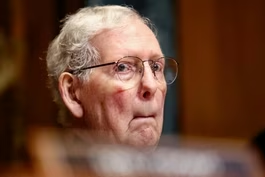
What we know about Mitch McConnell's health
Video has Closed Captions
What we know about Mitch McConnell's health and hospitalization (1m 57s)
Providing Support for PBS.org
Learn Moreabout PBS online sponsorship New Episode
- News and Public Affairs

Today's top journalists discuss Washington's current political events and public affairs.

- News and Public Affairs

FRONTLINE is investigative journalism that questions, explains and changes our world.
 New Episode
 New Episode
 New Episode
 New Episode
 New Episode
 New Episode
 New Episode
 New Episode
 New Episode
Support for PBS provided by:
Major corporate funding for the PBS News Hour is provided by BDO, BNSF, Consumer Cellular, American Cruise Lines, and Raymond James. Funding for the PBS NewsHour Weekend is provided by...