
How to get to Antarctica
Clip: Episode 1 | 2m 56sVideo has Closed Captions
Getting to Antarctica is a long road. Life manages to thrive in this extreme environment.
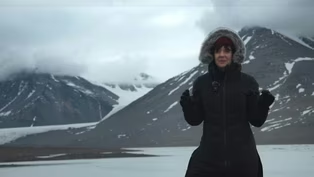
Explorer Ariel Waldman embarks on the long journey to get to Antarctica; a journey that doesn’t include a bathroom. Upon arriving, she observes wildlife thriving in an extreme environment.
Problems playing video? | Closed Captioning Feedback
Problems playing video? | Closed Captioning Feedback
How to get to Antarctica
Clip: Episode 1 | 2m 56sVideo has Closed Captions
Explorer Ariel Waldman embarks on the long journey to get to Antarctica; a journey that doesn’t include a bathroom. Upon arriving, she observes wildlife thriving in an extreme environment.
Problems playing video? | Closed Captioning Feedback
How to Watch Life Unearthed with Ariel Waldman
Life Unearthed with Ariel Waldman is available to stream on pbs.org and the free PBS App, available on iPhone, Apple TV, Android TV, Android smartphones, Amazon Fire TV, Amazon Fire Tablet, Roku, Samsung Smart TV, and Vizio.
Famous for its freezing temperatures, it's also the driest continent on Earth.
A seemingly desolate landscape that stretches across an area larger than the US and Mexico combined.
Yet here, in this extreme environment, against all odds, life endures, even if only at the smallest of scales.
To get to see the southernmost continent up close and personal is a long road.
Weeks of equipment shakedowns, medical tests, and cargo logistics all blur into one long fever dream until you wake up to find yourself miles from home on a C-130 military aircraft, crammed in knee- to-knee with the other tired souls making the eight hour journey from New Zealand to Antarctica.
There are no window seats or in-flight entertainment.
There's not even really any seats.
Just cargo netting, a couple of portholes to peer through, and if you need to go to the bathroom, a literal bucket with a curtain around it is provided.
It's a loud, cramped, and fundamentally awkward experience.
Cleared for landing on a runway of compacted snow, we lug our bags across the slippery terrain and prepare for the last leg of our journey into the frozen abyss.
Our final stop is a remote area 60 miles away that's only accessible by helicopter.
There are no roads, no runways, and no docks.
To get there, we must fly across Antarctica's expanse of sea ice.
This seemingly endless blanket of ice nearly doubles the size of the continent as it reaches out into the Southern Ocean each winter.
But in the summer, miles long cracks splinter the ice, giving penguins and seals an opportunity to take a break from swimming and bask in the 24 hour sunlight.
From the viewpoint of our helicopter, these animals appear as little more than tiny specks.
But you can spot them if you look closely.
Beyond the sea ice, our destination comes into view: the Dry Valleys.
A polar desert so inhospitable that even the hardiest of penguins are unable to survive in this region.
 New
NewVideo has Closed Captions
Preview: Ep1 | 30s | An explorer undertakes a solo Antarctic expedition to document the life beneath the ice. (30s)
Providing Support for PBS.org
Learn Moreabout PBS online sponsorship
- Science and Nature

Explore scientific discoveries on television's most acclaimed science documentary series.

- Science and Nature

Capturing the splendor of the natural world, from the African plains to the Antarctic ice.












Support for PBS provided by: