
The Neurodiverse Family
Season 2025 Episode 7 | 26m 46sVideo has Closed Captions
Carlton family; Ask the Experts; Difference Maker Aubrie Therrien.
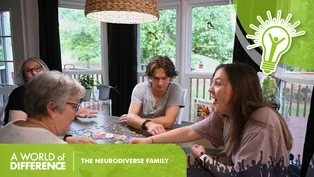
Travel to Georgia to meet a multigenerational family navigating neurodivergence together. Experts share strategies for creating harmony in neuro-inclusive homes, and Difference Maker Aubrie Therrien shows how EPIC Players elevates neurodivergent performers.
Problems playing video? | Closed Captioning Feedback
Problems playing video? | Closed Captioning Feedback
A World of Difference is a local public television program presented by WUCF
The Neurodiverse Family
Season 2025 Episode 7 | 26m 46sVideo has Closed Captions
Travel to Georgia to meet a multigenerational family navigating neurodivergence together. Experts share strategies for creating harmony in neuro-inclusive homes, and Difference Maker Aubrie Therrien shows how EPIC Players elevates neurodivergent performers.
Problems playing video? | Closed Captioning Feedback
How to Watch A World of Difference
A World of Difference is available to stream on pbs.org and the free PBS App, available on iPhone, Apple TV, Android TV, Android smartphones, Amazon Fire TV, Amazon Fire Tablet, Roku, Samsung Smart TV, and Vizio.
Providing Support for PBS.org
Learn Moreabout PBS online sponsorship(upbeat music) >>Welcome to "A World of Difference: Embracing Neurodiversity".
I'm Darryl Owens.
In many homes, neurodivergence isn't just an individual trait, it's a family affair.
It's a genetic thread weaving through the fabric of generations from grandchildren to grandparents.
For some parents, those differences are familiar.
For others, a child's diagnosis becomes a mirror, revealing traits they've carried all along, like son, like father.
When all or most of the household reads from the neurodivergent playbook, traditional how-to guides for family life often get shelved.
But families can find strength in shared experience, whether it's been-there-done-that parenting, or a grandparent guiding a child through terrain they know all too well.
On this episode, we visit Georgia to meet the Carlton family, where neurodivergence is a shared landscape navigated across three generations.
Our panel of national experts explore strategies for harmonizing life in a neuro-inclusive home.
And we meet our latest difference maker, Aubrie Therrien, executive artistic director of EPIC Players, who is creating professional stages where neurodivergent talent shines.
But first, for Jodi Carlton, life's Rubik's cube didn't click into place until adulthood when she was diagnosed with ADHD.
She wasn't navigating this alone.
As a mother to an autistic daughter and a son with ADHD and part of a family with neurodivergent roots, she found herself at the center of a multi-generational mix.
The Carltons have faced it all, educational hurdles, emotional burnout and communication breakdowns.
Yet through these struggles, came something powerful, growth that happens when a family stops trying to fit in and bear-hugs the way they were born to think.
(upbeat music) >>There's that, it's preheated now.
>>So, Abby and I said the oven is ready.
>>Like 20 minutes or so.
>>So the cookies getting baked.
>>Yeah, but then you wasted 10 minutes of cookie cooking time.
>>All of us are very creative and just very innovative, innovative minds, very creative.
We're musicians.
There's a lot of musical intelligence in our family, a lot of intellectual intelligence in our family.
My son's got the engineering brain.
My daughter is learning Chinese and becoming proficient in it for her career and blows my mind.
(Jodi laughs) (Jodi's daughter singing) (Jodi playing piano) When my daughter was five, I was going to a CEU workshop for therapy.
(Jodi laughs) And it was for an autism organization.
And I remember sitting in there.
And we already knew she had some developmental delays, but we didn't know it was autism.
So, I remember sitting in there and just recognizing my child.
And I remember calling her dad from the lobby saying, "I think she's autistic."
>>Yeah, yeah.
But like-- >>Yeah, it just makes sense in my head.
>>Yeah, it does.
>>Fortunately, we don't live in your head.
>>Okay, when I was really young, I could actually sing before I could talk.
If I just spoke regular words, my mom would call it word salad.
I just couldn't get words out properly, just tumble out.
But if I sang a tune, I could say like, my sentences correctly.
>>When Abby was born, my granddaughter, I think I was one of the first maybe to notice, because my daughter never had a baby before.
And when she was a couple of months old, I noticed that she didn't respond.
She didn't look at you.
She didn't coo, she didn't giggle.
And so, and she didn't smile.
That's one of the things that worried me.
She just didn't smile.
And so then eventually, you know, she received help and eventual diagnosis for autism.
So then when Aidan came along, Aidan's just, he marches to the beat of a different drum.
He's just all around good kid, fun to be around.
And then Jodi, of course was eventually diagnosed as ADHD his well.
And so I'm thinking, huh, there's a lot of things in this family going on.
And then I got to noticing that the more I learned about it, I started noticing some things in myself.
>>It's a real bag of mixed things that we all got going on, but we've all kind of learned how each other operates and can, you know, work around that.
For me, having ADHD, I feel like I can have like 20 trains of thought going at once, which again, is a good thing and a bad thing 'cause it allows me to be really quick witted and very quick thought, fire off thoughts really quickly.
But at the same time, it's hard to focus on any one particular thing at a time.
>>I don't, it was just so impactful for me to realize that I also am experiencing some of this and be able to relate to them in a really different way.
And also understand, have a lot more compassion and understanding for them at times as well.
We have a lot of fun with it too.
It's not all doomsday.
It's, there's a lot of strengths, a lot of things about neurodivergence.
It's really amazing.
It's not just all the deficits and the challenges.
We have all really learned how to just really just accept.
You really needed the recipe.
And I'm like, oh, just throw the bit of this bag.
>>I'm a recipe follower and a rule follower.
>>Yeah, you too.
>>You too.
>>Yeah.
>>Yeah.
Not, you are not a rule follower.
You've been following me for long, you know that I'm ADHD and my daughter's autistic and my son's ADHD and my mom's autistic.
And so we've been filming today talking about what it's like to be in this neurodiverse family of ours, how it impacts all of us, and what it was like when we discovered that we were neurodivergent.
>>The whole time I grew up, I always thought I was the only neurodivergent one in our family.
We didn't know that everybody else was also neurodivergent.
>>My sister, she's autistic, so she, you know, exhibits her love in a certain way, or affection or caring in different ways than I do.
But we found common interests and we'll have these long discussions, you know, about these topics that we're both really passionate about.
And I feel like that's a way that we really connect.
>>Being with this family has been so, I guess you say educational in a way.
We have so much respect for each other but when we're together, we joke a lot, we laugh a lot, sometimes we make fun of each other a lot.
And I think that helps us get along.
>>Being neurodivergent is not about, they're a disorder, it's not about being broken.
And that's the legacy I wanna leave them and the world.
That's my whole goal as a professional.
It's why I have educational courses and podcasts and all those things to help reach people so that they don't feel like they're not afraid of the label.
It's not about something being wrong with you.
>>I just love my family with all of our little differences in every way because they're just all beautiful people.
(upbeat music) >>Next three national leaders join us to share insights on creating harmony in multi-generational neurodivergent homes.
(upbeat music) Jillian Amodio is a licensed master social worker and adjunct psychology professor at Anne Arundel Community College.
She provides mental health services to families and individuals and writes extensively on parenting and wellness.
Dr.
AJ Marsden is an associate professor of psychology at Beacon College in Leesburg, Florida, the nation's first accredited college for students with learning differences.
She specializes in cognitive neuroscience and educational psychology.
Dr.
Ryan C. Warner is a licensed clinical psychologist and CEO of RC Warner Consulting based in Texas.
He equips families and organizations with practical strategies for resilience and inclusion.
And we're gonna begin our conversation with Jillian.
Sandwich generation homes where parents care for both kids and older relatives are on the rise.
What's one way to balance a neurodivergent child's need for movement with a neurodivergent grandparent's need for quiet?
>>Sure, so the most important thing to remember is that no one family member deserves to have their needs met over the other.
So it's important that we recognize that every member of the family needs to have their needs met.
And this can be as simple as offering design spaces in the home that are equipped for movement and equipped for rest.
So this might mean that the public areas of the home, such as the basement, the playroom, the living room, family room, might be opportunities that have play or movement focused activities.
Whereas the private sections of the homes such as bedrooms are more equipped for rest and quiet time.
It can also be helpful to have a set routine so kids know when there's time for quiet and when there's time for activity.
Quiet activities that involve movement such as exercise that is age appropriate or like swings, sensory swings, hammocks, even sensory bins or quiet walks around the neighborhood together can really help.
>>All right, thank you.
So Dr.
Marsden, many times mornings feel like a juggling act but is there any routine that you can suggest that can help everyone in a neurodivergent family feel supported?
>>Absolutely, Darryl.
First and foremost, do as much as you can the night before.
So prepare as much as you can.
Lay out the clothes, get the backpack ready.
You know, maybe you wanna make some overnight oats so you have an easy breakfast in the morning, something like that.
But prepare as much as you can the night before, so the morning doesn't feel so much like it's rushing.
I would also suggest having a visual schedule posted someplace in the house that's a common area.
Maybe the kitchen or the living room, have it color coded so each person has a color that they can look to be like, okay, what am I doing today?
What's today's goal?
What's today's outcome?
What's on the schedule for today?
And you can look at that for each family member, so you know exactly who's supposed to be doing what and when they're supposed to be doing it.
So that kind of helps organize your morning as well.
And then I would also suggest each morning and kind of in the thick of everything, when things are going kind of crazy, just take a minute, take a quick one minute family check-in.
This could be something like, collectively as a family, you just take one big deep breath together and you exhale and then woo, you are refreshed, ready to start your day.
Or it could be something like, just a quick verbal check-in.
What are you looking forward to today?
You know, what's on your agenda today that you're looking forward to the most?
Something like that can also help kind of make a nice easy morning and less rushing.
>>All right, good advice.
Dr.
Warner.
If both parent and child struggle with focus and flexibility, what is a way that they can turn that, the shared challenge, into teamwork instead of tension?
>>Yeah, so I know that this is a common challenge among a lot of families.
I know, especially within my family.
I have three children under five years old.
And that's something we struggle with just every single day.
And one thing we strive to do is how can we make this a team approach versus a personal approach.
So for instance, what we like to do in our household, it also would've shown clinically to be helpful, is how can we assign roles?
Okay, how can we assign roles to the children and say, hey, your job is to watch the time, you're the timekeeper, right?
And I'm the transition coach, I'm gonna make sure that everything can get done, gets done on time, right?
And in turn, when we assign roles now we are able to bring us together, we're able to identify the strengths that we all hold, and we're able to work together to accomplish a certain goal or mission.
And that could be simply, hey, the house is really dirty and we need to work together to clean it up, right?
Instead of pointing blame, in turn we can figure out, no, how can we come together to achieve this goal?
So that's one shift that may occur when we look at it as a shared responsibility versus a personal challenge.
>>Jillian, so if parent and child both share neurodivergent traits, what are some phrases that older relatives can use that help support the needs of the parent and child rather than offering them that toughen up advice?
>>Yeah, just validating the needs and validating the emotions of the child or the parent can be really helpful.
So sometimes you wanna jump into pointing out like what's wrong or what's being disruptive, but if we can validate the emotion rather than the behavior, it can be really helpful.
So something as simple as, oh, it seems like you're getting really overwhelmed.
Would you like to take a walk with me?
Is much better than, why are you being so loud?
Can you calm down?
>>Dr.
Marsden, you teach something called motivational interviewing.
Can you tell us what that is?
And can you give us one phrase that parents can use to encourage independence without nagging?
>>Absolutely, Darryl.
So first motivational interviewing, it's not like a job interview, right?
You're not going in there and trying to figure out their personality traits or anything like that.
But instead, it's more of, it's collaborative, it's very goal focused.
And the whole point of it is to pay attention to the language of change, it's really designed to strengthen our motivation and our commitment to a specific goal by kind of exploring our reasons for why we want that change and then exploring those reasons with acceptance and compassion.
So it's really all about we want a change to occur.
Why do we want that change to occur?
And then how can we go about making sure that that change actually happens, and change occurs slowly.
We know that, right?
So when we use motivational interviewing, really it's more about trying to get the child or the other person in the house to tell you or explain to you their train of thought, right?
How their actions are gonna contribute to their final goal.
So this works because you're not necessarily telling them what to do, but instead you're asking them, you know, show me what you're thinking or tell me what you're thinking.
We have this problem, we have this goal that we're trying to get to, how do you think we should get there?
And this puts some of the ownership of the process on them and it allows them to think and problem solve on their own and really allows them to be independent, which is good.
>>All right, thank you.
So Dr.
Warner, neurodivergent families often carry years of masking.
What's one way for families to be able to create a safe space where they feel safe to be authentic from grandparent to child?
>>Yes, great question.
So one thing that parents can do is start to normalize and approach difficult challenges and times and emotional challenges that may arise.
Oftentimes, right, we, when things get hard, we avoid as human beings, that's our natural tendency.
We try to mask it, we try to push it underneath the surface.
We try to say, hey, this needs to be fixed right now because it's uncomfortable.
However, if we take the opposite approach instead of approach those difficult times and emotional challenges that may arise, then we're opening the door to say, hey, no, this is okay, this is normalized and let's work together to figure out what we can do to manage the current issue that's arising.
So for instance, if a child is throwing a tantrum and there may be, they have a hard time getting their emotions under control, we can say, hey, what's going on right now?
How do we approach that with curiosity?
Right?
And so then now that opens a safe space and psychological safety within the home and say, hey, if I'm struggling or feeling some type of emotional difficulties, it's okay for me to express that, it's okay for me to talk about what's going on and then label it so that, and in turn I can feel safe and open within my home.
So that is one way that we can way try to work through this is to approach and not avoid.
>>All right, thank you.
So Jillian, if both the parent and a child struggle with anxiety or attention, what's one way that parents can model coping without shame to the child?
>>Sure, great question.
One thing that I find really beneficial with a lot of families I work with is narrating.
So let a child know what's going on in your brain.
I am feeling really overwhelmed.
I think I'm going to go read a book or listen to music for a moment so I can de-stress before I resume this task.
Oh my gosh, I'm super frustrated that I missed this deadline.
I can't believe I did that.
I know what I need to do next time.
I'm going to make sure that I put it on my calendar a couple days so that I don't forget, or I'm feeling really sad today and I'm gonna do something that makes me happy.
Would you like to come bake with me?
Would you like to come craft with me?
Identifying the emotion, acknowledging how you're feeling either in your mind or body, and then telling your child or telling yourself out loud what you're going to do to address that need that you have, either mind or body, is gonna help your child not only normalize the fact that our bodies and our mind feel different ways when we have different things going on around us, but it's also gonna help them understand, appropriate safe and healthy ways to make sure they're managing those emotions and those feelings appropriately.
>>Watch the full ask the expert segment on our website at awodtv.org.
If you wanna learn more about this topic, you can also watch or listen on Facebook, YouTube, or on your favorite podcasting platform.
(upbeat music) >>Now let's meet our latest difference maker.
In New York City, Aubrie Theron saw talented artists waiting in the wings and rewrote the script.
As executive artistic director of Epic Players, she built an atmosphere where difference isn't managed, it's embraced.
Auditions slow down for processing, rehearsals honor sensory needs, roles are cast for craft, not conformity.
Around her actors, designers and directors don't ask to be accommodated.
They lead shaping stories from the center.
Aubrie's advocacy is bold and practical.
Redesign the stage and to watch the art transform.
The result?
Work that feels truer, deeper, and more alive because minds are valued exactly as they are.
(upbeat music) (energetic music) >>Okay, places for the top of the show, places for the show.
Okay, I'm gonna scoot by with this here thing.
Great.
Are you wearing sunglasses?
Just, okay, gorgeous.
Do we have a pin?
Let's see, two pins.
We have to forfeit the hat though.
No, we won't forfeit the hat.
Needs to be pinned right there.
The difference is in what we do at Epic is that we approach our members with a huge amount of mutual respect and we always assume competence.
So we always assume that our players, our actors, regardless of disability, can learn the material, can perform on stage, can memorize the lines, can take this direction, can push themselves maybe beyond what anybody has given them in the past because they've been infantalized.
And the disabled community is often infantalized and not given the chance to show what they can do or how they can express themselves.
So I wanna see, let me see your thinking face, sort of a kind a... My name is Aubrie Therrien and I am the executive director of Epic Players Inclusion Company, which is a neurodivergent theater company here in New York City.
Sometimes in the theater there's this generality, everybody has to show on time, everybody has to memorize these same lines.
Everybody's expected to bring this, well not everybody can approach that material in the same way.
So we approach each person individually.
Some people may need noise canceling headphones for the rehearsals.
Some people may need to stim and vocalize and move around.
Some people might need a break.
>>Let's try this.
>>Some people might need their lines recorded to memorize them, you know?
So we figure out what that pathway is and we build that invisible ramp.
So all actors are gonna be really successful on stage and off.
And what we try to encourage, I mean we're preparing our players to go out and audition for their roles and get paid for their work.
We have players on Broadway, on TV and movies and we want them to advocate for themselves and go, no, no, I need this accommodation.
And that's happening, which is wonderful.
(crowd murmuring) >>I wanted to try the pack one more time before I do this.
>>With Epic, it's my first year.
But I've been doing a lot of makeup, like plays and shows that I've done like in drag.
And I got to know Epic, you know, Epic gave me the opportunity to be here.
And that I get the experience to get hands on even though I graduated.
But I feel really good like having more opportunity.
(crew members murmuring) (upbeat music) (crew members murmuring) (upbeat music) >>Do you have a larger strap?
>>Yeah.
>>You know, I'd always been a really kind of theatrical child.
My grandmother was disabled, she had polio at a young age and was physically disabled.
I have family members who are neurodivergent.
I've just been diagnosed with ADHD.
I started volunteering with a theater company that worked with individuals who were neurodivergent or developmentally disabled and wanting to do the arts.
And we just grew it and it became a really big part of my life.
And I saw that these performers really wanted to be taken seriously, wanted to do more, were very talented, wanted to tell their stories, wanted to, you know, be seen as someone who wants love, who wants companionship, who has ambition, wants a job, all of those things that, the stories we tell in the theater.
So, I left and started Epic and we quickly grew.
So within a year we started with about 20 participants and now we have over 140 people in New York and we just opened in LA.
So we grew rather, rather quickly.
And I think that is a testimony to the need of the program and for disabled stories to be told.
What I am most proud of with Epic this year, especially, you know, I did just have my first child.
I had to take maternity leave and that was hard, 'cause Epic is like my first baby.
And what made me really proud to see is although I had to step back, the community at Epic, including our amazing staff, all of our players stepped up in ways that I could not be more grateful of.
And it let me know like Epic lives beyond me and it will live and grow and build, you know, without me.
And that I am really proud of.
>>Do you hear what I hear?
Do you see what I hear?
(upbeat music) >>Congratulations Aubrie Therrien for making a difference.
And that does it for this episode of "A World of Difference: Embracing Neurodiversity."
I'm Darryl Owens.
Thank you for being a part of our world.
See you back here next time.
You can watch episodes of "A World of Difference" on the Beacon College Facebook and YouTube channels, and on the show's website, awodtv.org.
The website also provides tip sheets and other resources for your parenting journey.
You can watch the show from the PBS app available on your favorite streaming device and you can listen on your favorite podcasting platform.
Thank you for watching and supporting A World of Difference.
(upbeat music) (upbeat music) (theatrical music) (upbeat music)
 New
NewThe Neurodiverse Family | Preview
Preview: S2025 Ep7 | 30s | Watch a preview of the next episode of A World of Difference: Embracing Neurodiversity. (30s)
Providing Support for PBS.org
Learn Moreabout PBS online sponsorship













Support for PBS provided by:
A World of Difference is a local public television program presented by WUCF