
The Away Team
Season 2 Episode 1 | 24m 30sVideo has Closed Captions
Afghan women soccer players evacuated to Houston to rebuild their lives from scratch.
When the Taliban took over Afghanistan, women soccer players evacuated to Houston, where they had to rebuild their lives from scratch.
Problems playing video? | Closed Captioning Feedback
Problems playing video? | Closed Captioning Feedback
Production Support Provided By: Riptide Waters LLC; Texas Parks & Wildlife Foundation; Texas Rural Funders, H-E-B”
The Away Team
Season 2 Episode 1 | 24m 30sVideo has Closed Captions
When the Taliban took over Afghanistan, women soccer players evacuated to Houston, where they had to rebuild their lives from scratch.
Problems playing video? | Closed Captioning Feedback
Where to Watch Texas Monthly Presents: The Story
Texas Monthly Presents: The Story is available to stream on pbs.org and the PBS app.
Providing Support for PBS.org
Learn Moreabout PBS online sponsorship- I heard that there were some Afghan soccer players that had resettled here.
- [Sarah Labowitz] These women who had played in the Afghan Football Federation that were here in Houston.
- We have a big message for the world.
- I started seeing if we could get some cleats and a field and a coach.
- The symbol of football is peace, love, and stuff, but football is power.
- This is a chance for new beginnings.
(calming music) (no audio) (dramatic music) (dramatic music) (light music) - [Crew member] Dion just talk a little bit for your level.
- Check one, two, three.
Looking at the camera, sitting in the room, looking at the sunflower type light that's up there.
- [Interviewer] How did you come across this story, initially?
- I lived in Afghanistan for two and a half years and was there through a lot of the tumultuous times for the country.
And when I came to Houston, I knew that Houston had kind of been a hub for Afghans that had fled the country in 2021 when the Taliban took over.
(players cheering) I heard that there were some female Afghan soccer players that had resettled here.
Then when I sat down with them, they were sort of a bit adrift and have been struggling to start a new life.
This is a story about Exodus and reinvention.
It's a story about dashed hopes and the genesis of the Houston Shine.
I'm Dion Nissenbaum and I wrote the Away Team for Texas Monthly.
I live in Houston.
Houston's one of the most diverse cities in the country and it's actually been a hub for Afghan refugees.
So I've been writing a lot about immigration there.
It's a big issue in Texas and for the nation.
But before that, I moved to Afghanistan as a reporter in 2010 and it was a really interesting time to be there.
Even though Afghanistan in particular is a very conservative country, there was this real sense of hope and progress, especially among young Afghans and among young female Afghans.
They would be able to play soccer.
They owned businesses.
They would go out to cafes and socialize.
There was a sense that the advances that women had made in Afghanistan would not be reversed.
And you know, unfortunately that proved not to be the case.
In 2021, the U.S.-backed government collapsed in spectacular fashion and the Taliban took over the country and the last American forces left in this very chaotic withdrawal.
The Taliban are this incredibly conservative Islamist movement in South Asia.
You know, they believe in this very rigid brand of Islam that believes that women are not allowed to go to school.
They're not allowed to own businesses.
The Taliban banned women from playing sports.
So a lot of female athletes left their country and are in exile around the world.
And so I heard there was a group here, but they didn't have the kind of institutional support that the other players in other parts of the world had gotten.
So it was actually hard to track them down.
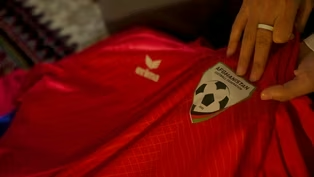
- So this is a first dress after leaving my country.
My name and my numbers, my favorite numbers.
It is number seven.
I don't like Ronaldo, but it's okay.
- [Dion Nissenbaum] You don't like Ronaldo?
- No.
My favorite person is Messi.
- [Dion Nissenbaum] One of the players in Houston is Rabi Yaqobi, who's a younger player.
She grew up in a conservative home.
Her brothers and her dad really didn't think that women should be playing soccer.
Oh, your mom supports you?
- Yeah.
- Just not your brothers?
- No.
No, my brother and my father.
- Your father?
- No.
Because my father and my brother say the girls can't play football.
Just my mom.
"Go ahead.
Don't worry about that, I'll fix it for you."
- [Dion Nissenbaum] Another Afghan player that I met was named Sodaba Khinjani.
- Can we join you guys?
- Yeah.
- Hi.
Okay.
If you need a ball, I have.
- [Dion Nissenbaum] She was able to get out of the country.
She was actually one of the players that helped get female soccer off the ground in Afghanistan.
She was very early on and sort of playing with pickup games and since one of the pioneers of female soccer in Afghanistan.
- Oh, nice.
- The symbol of football is peace, love and stuff, but football is power.
It has some power that make you bold, to raise your voice, to make you feel better.
So that's why I like it.
- [Dion Nissenbaum] I wanted to follow their stories and their odyssey and see how they were doing once they'd been able to escape.
All of them have these incredibly harrowing journeys of trying to get out.
So let's talk about 2021 now when the Taliban took over.
You were on the national team, is that right?
- Yeah.
(speaking Dari) (speaking Dari) (speaking Dari) - [Dion Nissenbaum] One of the best known teams in Afghanistan was the female Afghan soccer team.
So they were maybe more than other teams very high profile in terms of being a potential target when the Taliban took over.
Sodaba had an older brother who was killed by the Taliban in 2009.
So the threats of the Taliban were very real in her and her family's life.
- Literally, they prepare a kill list for those women that they was involved in sports.
They was trying to find us and catch us and kill us.
And I was burning all of my pictures, my photos, my certificates because it was really scary.
Yeah, we was trying to escape Afghanistan, but we couldn't.
- [Dion Nissenbaum] Everything was focused on the airport.
It was just incredibly chaotic scene.
- We went to the airport, but a bomb blast happened over there.
- [Dion Nissenbaum] There was this suicide bomber that killed a group of U.S.
Marines and I think 150, 170 Afghans, and that put a halt to a lot of people trying to get out of the country.
A few weeks later, FIFA, the World Cup body, was organizing a special flight out for female Afghan soccer players and told them to get to Kabul and try and get on that flight.
(speaking Dari) (speaking Dari) (speaking Dari) - There was a big group of them that got out to Australia and Europe.
And eventually there were some who FIFA got them visas to get to America and told them, "You can go anywhere you want.
But if you go to Houston, this is where the World Cup is going to be held in 2026."
You know, this is a place where we can provide you with support to start new lives.
There was an expectation, I think, from FIFA officials that the local communities and the local A groups in America would provide these women with the infrastructure that they needed when they got here.
It was kind of sad, you know?
I'd read a lot of stories about Afghan soccer players in Australia and in Europe that had kind of been embraced by the country and uplifted.
By 2023 when these players arrived, the support for immigrants in America was eroding.
And then President Trump comes in and cuts it off.
- Since taking office, my administration has launched the most sweeping border and immigration crackdown in American history.
(audience applauds) - [Dion Nissenbaum] And so these women ended up in America falling through the cracks.
Rabi is working in a dining hall at the University of Houston struggling to pay the rent.
(speaking Dari) (speaking Dari) Excuse me.
(speaking Dari) (speaking Dari) (speaking Dari) - We need support for education.
We need support for our families.
We need financial aid support.
We need for English classes.
And we try to contact with FIFA a lot.
Every time we heard from them a big rejection, a big deny.
They just left us.
- More importantly though, the place that these players felt like FIFA had broken their promise was in helping get their families out of Afghanistan.
- This photo that I'm looking at it is in Qatar.
It was me and president of FIFA.
And he was talking about our families with him, that can he bring our families too?
Because they promised us on that time that yeah, we will bring your families.
But unfortunately it have been more than four and a half years.
We couldn't see our families.
(speaking Dari) (speaking Dari) - The president himself - Yeah.
- Is telling you this?
That never happened, right?
- No.
(light dramatic music) - [Interviewer] How often do you talk to your family?
- Three times a week or four times a week because there is a difference of timing.
And whenever I'm free, they are sleeping.
So I can't talk that much with them.
You can talk with them through WhatsApp or social media, but this phone doesn't have the button to hug them.
You can share your emotion, but it just sounds.
You can't feel them.
You can't touch them.
Whenever they are sick, you can't be beside them.
I text my husband, "Did you eat?"
He sent this video that he's eating.
Yeah, he's really nice guy.
This is a gift from my husband.
He gift it to me.
And mostly he's sending clothes and stuff through the post.
It feel really good whenever you have someone in your back.
He's listening to you.
He's supporting you.
He loves you.
I think it's really nice of him and I love him so much.
- So not only are they struggling to just make ends meet, but they're not even being able to get back on the soccer field and pursue their dreams.
But then their lives kind of take a turn for the better in this incredibly unexpected way.
- Yeah.
- Hi, I have shoes for you guys and shorts.
You guys got shorts.
- [Dion Nissenbaum] There's a woman in Houston named Sarah Labowitz who is a former Obama administration State Department official, worked for Hillary Clinton.
Sarah ends up meeting these women and hears their story and is kind of appalled.
- I'd played soccer most of my life and you know, to hear this kind of amazing story that there were these women who had played in the Afghan Football Federation system that were here in Houston and they couldn't play because they didn't have cleats, they didn't have a coach, they didn't have a field.
It just felt like a symbol of kind of bigger injustice in this like way that we could offer something tangible and practical and honestly pretty fun.
(whistle blows) - [Dion Nissenbaum] The remarkable thing about this was Sarah was able to get them back on the soccer field in a matter of weeks.
- I started making phone calls and seeing if we could get some cleats and a field and a coach.
- Happy Friday.
(players cheer) - She called a friend who was a coach for a female varsity soccer team at a private school who agreed to coach them.
- I just think that the story, the background story was shocking and there was just no way that I could say no.
I am learning more about the cultural aspect of the team.
I am doing a terrible job at understanding Dari.
- It didn't take moving heaven and earth to make it happen and certainly FIFA could have done that.
- What we've seen from them is like with a little bit of opportunity, they are like ready to go.
- They have their first practice and the community support is starting to come in for them.
Sarah's connecting with local politicians who are providing them with cleats and balls and it's an optimistic period.
They're now like, "Hey, we're not just going to have a practice, like, let's form a team."
So they decide to call themselves the Houston Shine.
It's kind of like the rays of sunlight marking the new beginning.
And they decide to have the team colors be blue and white, the colors of the sky.
- The sky is really big and we want to have a big message to the world as a being a woman, as a being a refugee, as a being a woman from Afghanistan.
So that's why we accompanied these two color and we make Shine FC.
- From that first game to the first practice, it was like two and a half weeks.
- Okay, here we go, let's go.
- We play in the league called HWSA, which is the Houston Women's Soccer Association.
Currently we're in the third division of that league.
(speaking Dari) (spectators cheer) - This is our fans.
They are bringing this stuff for us.
They always bring like these things, like shine bright.
We are with you guys.
You can do that.
(spectators cheer) - Oh, she's mad.
She needs to calm down.
(speaking Dari) - In any sport and any team, it's hard to build camaraderie.
And you know, for a lot of these women working together as a team has been a challenge.
(speaking Dari) - Every team have their up and down.
Definitely we have too.
- Yeah, yeah.
Okay.
Let's take a deep breath.
Let's take a deep breath.
- But beside these things, we really respect each other.
We love each other.
We are supporting each other.
- [Dion Nissenbaum] They're getting better as a team, learning to play together.
They use the three musketeers chant, all for one.
- One for all.
- Marja, no.
No.
Let Rabi take it.
(speaking Dari) Nilofar, Nilofar, Nilofar, step.
(light dramatic music) Oh boy.
- [Dion Nissenbaum] It was really heartening to watch the transformation of this team.
Sarah understands that these women need more than just support on the soccer field.
- Okay, so the password has to be really long and it has to have uppercase letter, lowercase letter.
That's not long enough.
No, it has to be like really long.
It has to be 14 letters long.
- [Dion Nissenbaum] So she'll sit with a player for an hour and help them register for English classes at community college.
- My dream is I'm going up for college and I'm going to study computer science.
That's my dream and my goals.
- [Dion Nissenbaum] They're building a team.
They're building a new life here.
And the Shine is central to that as a team.
- Are y'all ready?
- Are y'all ready?
- Are y'all ready?
You have to say y'all.
- Y'all.
- I was there for this incredible moment.
It was after a game and their coach, Rachel, bought them all straw cowboy hats and taught them to line dance, to Cotton Eye Joe.
And then the Afghan players taught Rachel how to do the traditional Afghan folk dance.
(players clap) Watching that happen was such a unique moment to see what Houston can kind of bring together in terms of people when they want to do something better actually make it happen.
You know, there was a sense of joy in that moment.
(light dramatic music) - Wait, where's everybody's jerseys, jerseys, pink and green.
- Okay, let's bring it in.
Let's bring it in.
- Oh, we can shine on Shine.
- Okay Rabi.
- All for one, one for all.
(players cheer) - As the Houston Shine was created, FIFA announced that it was creating this new Afghan women's refugee team that was going to be made up of Afghan refugees from around the world.
And they were going to have tryouts for all of these players that were in exile around the world.
This was incredible for these women, right?
Like in a matter of months, they're going from not playing to the prospect of actually being on a FIFA-backed team again.
What these players didn't know was that FIFA had basically gotten cold feet.
The Trump crackdown on immigrants had gotten so bad that FIFA was worried immigration police would potentially detain them.
And so FIFA and U.S.
Soccer have this intense call with all of these women and say they won't hold a tryout camp in America.
The call in this moment I think was an ignition for all of their disappointment with FIFA.
(speaks in Dari) These women were just incredibly disappointed.
They were crying and upset and saying like, you know, how can you do this to us?
You've let us down over and over again.
- They tried to make us fools again.
When FIFA can do World Cup in 2026 and can spend millions of dollars, how they can't bring our families?
- How do you feel about FIFA?
(speaking Dari) - So FIFA was caught off guard by the intensity of the reaction.
For FIFA, they were like, "We're just trying to protect you.
We don't want you to be kicked out of the country."
- Really big arm swings, big arm swings.
All the way and back the other way.
- [Dion Nissenbaum] Regardless of the support they get, they're going to keep practicing and in hopes that they will be able to try out for this team.
They continue to work and build better lives here.
- Okay.
Mr.
Muhammad, do you have any allergy or medication?
2023 I come to United States.
I had to support my family back home and definitely I need money over here to pay bills, rent.
You need training how to be a dental nurse over here.
I already had a lot of experience to be a dental assistant because back home I had my own practice.
The Taliban, they want me to stop my study, my football, my career and everything.
They believe that if they kill me, this is something good for them.
It was really, really tough time.
During the night I was studying, during the day I was working.
And finally, finally I did it and I passed all the exams.
This is my dental assistant license.
Means officially I am an RDA, means I'm registered dental assistant in United States.
This is, I think, the Afghanistan's girl's power.
(light music) - For me personally, this is a unique story to follow it from Afghanistan to America.
I've seen so many things turn on a dime for the better and the worse.
It's hard to know what can happen with this team.
They continue to work and build and support each other.
I think that's the positive thing, you know, regardless of the support they get from FIFA, from the U.S.
government, they are building a sense of community here in Houston and it is a hopeful moment for them.
(light music)
Video has Closed Captions
Preview: S2 Ep1 | 30s | Afghan women soccer players evacuated to Houston to rebuild their lives from scratch. (30s)
Providing Support for PBS.org
Learn Moreabout PBS online sponsorship










Support for PBS provided by:
Production Support Provided By: Riptide Waters LLC; Texas Parks & Wildlife Foundation; Texas Rural Funders, H-E-B”