

September 9, 2026 - PBS News Hour full episode
9/9/2026 | 57m 46sVideo has Closed Captions
September 9, 2026 - PBS News Hour full episode
September 9, 2026 - PBS News Hour full episode
Problems playing video? | Closed Captioning Feedback
Problems playing video? | Closed Captioning Feedback
Major corporate funding for the PBS News Hour is provided by BDO, BNSF, Consumer Cellular, American Cruise Lines, and Raymond James. Funding for the PBS NewsHour Weekend is provided by...
September 9, 2026 - PBS News Hour full episode
9/9/2026 | 57m 46sVideo has Closed Captions
September 9, 2026 - PBS News Hour full episode
Problems playing video? | Closed Captioning Feedback
Where to Watch PBS News Hour
PBS News Hour is available to stream on pbs.org and the PBS app.
Providing Support for PBS.org
Learn Moreabout PBS online sponsorshipGEOFF BENNETT: Good evening.
I'm Geoff Bennett.
Amna Nawaz is on assignment.
On the "News Hour" tonight: A top A.I.
researcher quits and goes public with fears that A.I.
companies are ignoring potentially catastrophic risks in the race for profits.
Israeli Prime Minister Benjamin Netanyahu faces political pressure after an investigation alleges he was warned about the October 7 Hamas attack.
And as the country approaches the 25th anniversary of the September 11 attacks, a look at the psychological impact.
GARRETT GRAFF, Author, "The Only Plane in the Sky: An Oral History of 9/11": Many Americans who didn't live in the world before 9/11 in the United States don't realize how innocent our country really was.
(BREAK) GEOFF BENNETT: Welcome to the "News Hour."
Concerns about the risks of artificial intelligence erupted across the tech world today.
So did questions about whether the companies building it are doing enough to keep it safe.
That followed the public resignation last night of an A.I.
researcher at Anthropic who said he no longer wants to take part in developing A.I.
that could eventually advance beyond human control and pose a serious threat to humanity.
Jacob Coxon, who previously worked at OpenAI, wrote in a post that has now been seen more than 70 million times that the industry understands the potential risks, but is moving ahead anyway.
Quote: "The people building A.I.
earnestly believe that it could kill us all by the end of the decade.
This is not a marketing stunt.
If anything, many executives and senior researchers will couch their phrasing in the press to sound sensible.
But I hear the same people express fear privately.
No other human activity poses this level of danger."
For more on the warnings that Coxon is raising and the broader questions about whether the A.I.
industry is doing enough to address it, we're joined now by Amrith Ramkumar, tech reporter at The Wall Street Journal.
Welcome back to the program.
AMRITH RAMKUMAR, The Wall Street Journal: Thanks so much for having me.
GEOFF BENNETT: So we hear warnings about A.I.
it feels like all the time now.
Why did this one break through in the way that it did?
AMRITH RAMKUMAR: I think because he's quitting the industry, frankly.
This is someone who no longer has skin in the game, and he's worked at two of the top A.I.
companies.
And he's talking about major risks late next year or the year after, and then, following after that, maybe the potential extinction of humans, depending on how things go.
So I think the severity of the claims, the fact that he's leaving, and the fact this is coming on top of several incidents of A.I.
systems hacking other companies, all of that put together made this a pretty volatile moment.
GEOFF BENNETT: And what he said was backed up by other A.I.
researchers last night.
AMRITH RAMKUMAR: One hundred percent.
You could have seen a world where he puts this out, our story goes out, his statements go out, and then others at the company distance themselves.
Instead, one of their top scientists said, we absolutely believe this.
We think there's a more than 10 percent chance that basically the human race is extinct within a decade because of A.I.
So it was a really remarkable sequence of events and highlighted how many at Anthropic specifically have this sort of doom-and-gloom concern out there.
GEOFF BENNETT: And Anthropic is interesting because that company built a reputation around A.I.
safety and regulation.
You spoke exclusively with Jacob Coxon yesterday.
What more did he say to you about his decision to step down and what does this mean about Anthropic really?
AMRITH RAMKUMAR: Well, the first thing that he said was interesting was, he left open A.I.
for Anthropic a few months ago.
So he spent a few years at OpenAI, helped trained some of their most advanced models, but he wanted to work at Anthropic because of what you said, the safety reputation.
Dario Amodei, the CEO, and other top executives speak about this a lot.
But within a few months, his takeaway was that no company can do this safely.
He wasn't knocking Anthropic.
He was saying that the private sector is not in position to do this right now because of the competitive forces and the race with China.
So he and others are really putting the onus on the government to get involved.
GEOFF BENNETT: And I want to unpack part of this, because when he says that there's a roughly 10 percent chance that A.I.
could spell the end of humanity, when people say that, they're not suggesting that there's a- chatbot that's out to kill everybody.
What they're describing is this sort of like theoretical chain of events involving a much more capable future A.I.
system, right?
AMRITH RAMKUMAR: That's 100 percent right.
So the key first thing to understand there is, they're very worried about this thing called recursive self-improvement.
And that is when a model can essentially improve by itself and train itself, and other A.I.
systems can then get much more powerful.
People say we could hit that within a couple of years.
After that, they say it's very hard to predict what could happen.
So there's a high degree of uncertainty.
But one or two of the scenarios or some of the scenarios involve models training themselves and essentially learning how to reject human commands.
And once they can do that, and then they can do things like command drone swarms or robots or whatever the case might be, they might decide that humans aren't necessary to fulfill their objectives.
So that's sort of the worst-case scenario they're painting.
And it's important that to say they assign probabilities to all of these things.
So they're not saying it's a high probability necessarily, but it is on the table, it is possible.
GEOFF BENNETT: And there has long been skepticism about the motives here.
When CEOs and researchers sort of raise alarms about the potential future of A.I., there are people who suggest that they're doing this because it serves their own interests and they want to have a hand in shaping the regulation that would affect their own industry.
AMRITH RAMKUMAR: One hundred percent.
You hear this a lot from people like David Sacks, an adviser to the president on A.I., and he's a venture capitalist, very well-known, and he says this is called regulatory capture when people like Anthropic make these doom-and-gloom claims to hype up their models and raise more money, et cetera.
The interesting thing here, though, is, he left the company.
So that sort of is a counterargument, that he doesn't have anything to gain necessarily from these regulations.
So there is a community here that is very focused on the risk posed by A.I.
and these sort of doom-and-gloom scenarios.
And a lot of them happen to work at Anthropic, and that does rub people on the other side of the debate in Silicon Valley the wrong way.
What's undeniable is that the risks here are rising.
Like I said, you have had models hacking other organizations, hundreds of models working together, essentially, hundreds of A.I.
agents to hack this company Hugging Face a few months ago, and many other examples that could come out that we don't even know about from the new powerful models.
So you're seeing people on both sides of the aisle respond.
You have seen administration officials talk about the need to respond.
So the risks here are becoming undeniable, even to the people that say people like Jacob Coxon are doomers.
GEOFF BENNETT: Risks are undeniable for sure, and there's no regulation on the horizon.
And we should make clear, it's easy to say A.I.
needs to be regulated, but if you regulate too aggressively, you stifle innovation, you stifle competition.
And certainly that's the case, a concern about China.
AMRITH RAMKUMAR: That's right.
Yes, it's very easy to say there are no federal regulations, the Trump administration has made a huge error here, and there has to be something on the books.
Much harder to get agreement on what that looks like.
Even with the number of voices on the left and right that have come out today saying that we need regulations, there's a little agreement on what those should be, even in Congress, even in the House, even in the Senate, even within those factions.
So what is interesting, though, is that you have this momentum and you do have the administration a little bit more willing to look at models before they're released, even if it's on a voluntary basis, and things are clearly trending in that direction.
What Coxon and co.
want is global coordination.
That's even harder than just U.S.
policy.
They want the U.S.
and China to reach an agreement, other leading economies to get on board with sort of a globally coordinated slowdown in the event that A.I.
becomes too powerful.
That seems like a long shot right now, but the technology is moving very fast.
We will see where things go.
GEOFF BENNETT: All this doom and gloom with a smile, Amrith.
(LAUGHTER) GEOFF BENNETT: Amrith Ramkumar, tech journalist for The Wall Street Journal, thanks for being with us.
AMRITH RAMKUMAR: Thanks so much for having me.
GEOFF BENNETT: In the day's other headlines: The White House is defending holiday gifts from President Trump to a number of his aides, including his executive assistant, Natalie Harp.
According to new financial disclosures, the president gave Harp $45,000, or about one-third of her annual salary.
He gave the same amount to communications adviser Margo Martin and White House aide Chamberlain Harris, as well as $20,000 to Director of Oval Office Operations Walt Nauta.
The payments raise legal and ethical concerns.
Federal employees generally can't receive outside compensation for their work, and experts warn the payments could leave aides financially beholden to the president.
In a statement provided to the "News Hour," the White House says Mr.
Trump has a -- quote -- "longstanding practice of giving such gifts," adding that they are -- quote -- "entirely permissible under relevant legal and ethical standards."
The U.S.
and Iran are trading more attacks in a fight to exert control over the Strait of Hormuz, an escalation that sent oil prices back over $100 a barrel.
Iran says it launched missiles at targets overnight, claiming to strike several tankers and two American ships, which U.S.
Central Command denies.
Tehran also fired missiles at a U.S.
base in Jordan, which the Jordanians say were intercepted.
Hours earlier, the U.S.
military said it had destroyed five Iranian tankers in the water near Iran.
In Iran today, some residents expressed concern about the impact of U.S.
pressure on their daily lives.
AMIN, Tehran, Iran, Resident (through translator): The people are certainly in hardship.
War is not good for the economy at all in the short term.
But I hope that, in the long term, it turns out in such a way where we can say it was truly worth it.
GEOFF BENNETT: Separately today, the U.N.
's nuclear watchdog reported Iran to the Security Council for the first time in 20 years for failing to cooperate with an investigation into uranium found at undeclared sites.
The move is largely seen as symbolic, though, since Iran's allies China and Russia can veto any sanctions against Tehran.
The trade war between the U.S.
and Canada is escalating even further after the Trump administration announced a ban on certain Canadian imports that includes some Canadian dairy products, motorcycles, molasses, and most alcoholic beverages.
The ban will take effect later this month.
It is the latest step in the unraveling of relations between the two historic allies.
Earlier yesterday, Canada rolled out retaliatory tariffs on $20 billion worth of U.S.
imports.
Across Hawaii, residents and work crews are cleaning up after Hurricane Lowell left widespread damage in its wake.
Parking lots and buildings were flooded by several feet of storm surge.
Winds topping 80 miles per hour damaged power lines and left tens of thousands still without electricity.
Hawaii's governor says one man on Oahu was killed by a fallen tree.
On Kauai, some areas got more than 17 inches of rain, washing out huge stretches of beachside roads.
Now a tropical storm, Lowell has pulled away from Hawaii, though the threat of floods and mudslides remains.
The Transportation Security Administration is bringing back gateside goodbyes and post-flight pickups for certain people without a ticket.
Authorities are rolling out a program that allows TSA PreCheck members to pass security and enter gate areas at more than a dozen U.S.
airports.
The program is free for members and other people with known traveler numbers, but they must apply online beforehand and get approval.
The practice was eliminated following the September 11 attacks 25 years ago.
The agency says it plans to expand the program to more airports in the coming months.
On Wall Street today, stocks ended lower after that latest rise in oil prices.
The Dow Jones industrial average fell around 400 points.
The Nasdaq lost more than half-a-percent.
The S&P 500 also closed in negative territory.
Still to come on the "News Hour": we report from Dallas, where Republicans are holding their first ever midterm convention; national redistricting efforts and conflicting court rulings throw Missouri's election maps into chaos; and Pulitzer Prize-winning author Kai Bird discusses his new book on the controversial attorney and mentor to President Trump Roy Cohn.
Republicans are gathering in Dallas tonight for an unusual two-day midterm convention, with President Trump set to address the party on both nights.
The event, part rally and part political showcase, is aimed at energizing Republican voters.
Our White House correspondent, Liz Landers, is in Dallas and joins us now with a preview.
So, Liz, based on your reporting, what should we expect?
LIZ LANDERS: Geoff, the Republican Party chairman himself has called this a Trumpapalooza.
The Republicans have never done a midterm convention like this, but this was something that President Trump wanted, and the party delivered here in Dallas.
This looks like a convention in here.
There are even balloons up in the ceiling behind me here.
But this is not focused on a floor agenda or a policy platform.
Instead, this is really going to be focused on President Trump and what Republicans think are their accomplishments going into this midterm cycle.
We should expect to hear about the One Big Beautiful Bill passing, them trying to root out fraud and waste out of government spending and securing the southern border.
One thing, though, that is rankling voters across this country and is high on the issues list for people that I'm talking to is the high price of gas and energy.
I asked Republican Congressman Bryan Steil of Wisconsin if this was going to harm the party going into the midterm convention.
REP.
BRYAN STEIL (R-WI): Costs are high for American families.
That's absolutely true.
What are the policies that drive that down is the tax reform of Republicans, unleashing American energy and our work to make lives more affordable.
Contrast that again with the high-tax policies of the Democrats and their anti-energy policies that actually makes life more unaffordable.
LIZ LANDERS: President Trump was asked about these high gas prices as he left the White House today.
He said he thinks that they will come down after the midterms.
President Trump will be here both nights.
He's speaking tonight and tomorrow evening.
We're also expecting to hear from about 50 other speakers today, including everyday Americans sharing why they support the Republican Party.
President Trump's request to voters here, Geoff, going into the midterms has been to please consider him on the ballot.
We will see if that helps Republicans.
GEOFF BENNETT: And, on that point, Liz, do you have a sense of which House and Senate GOP candidates are actually in Dallas at that convention?
LIZ LANDERS: Organizers say that more than 100 House and Senate candidates are here in Dallas and expected to attend.
President Trump, though, posted on TRUTH Social yesterday, saying -- quote -- "We're really asking only those candidates that are in tight races, a little up, a little down, or even to speak.
We want to save the stage for them."
But despite the president's post, Geoff, many Republican candidates in tight races are skipping this convention.
I spoke last week with a Republican consultant in Michigan, Jason Roe.
He works with Congressman Tom Barrett, a vulnerable Republican there in that state.
And he told me that, for Tom, there are no voters in Dallas, he said of this event that's happening here.
And he said that the congressman's time is much better spent in Lansing, in Michigan, talking with voters.
Among some of the other big names that will not be in attendance are also Susan Collins of Maine, John Sununu, who won that New Hampshire primary just last night, and Dan Sullivan of Alaska.
On the other hand, there are Republicans in tight races that are hugging the president and that are here for this event, including Texas candidate for Senate Ken Paxton, also Michael Whatley in North Carolina, Mike Collins in Georgia, and Mike Rogers from Michigan.
We are expecting to hear from members of the president's Cabinet, including the Treasury secretary, Scott Bessent.
And unusually, Geoff, the attorney general, Todd Blanche, is also expected to take the stage tonight.
GEOFF BENNETT: And Liz, this event is aimed at energizing the base, but it's also a major fund-raising opportunity for the party and for the candidates.
Is that right?
LIZ LANDERS: This has been a large part of the conversation around this, the cost of being here in Dallas.
I got an invite that went out to Michigan party members back over the summer.
And just for an individual who wanted to come, an honorary delegate is what they called it, that was going to cost $7,500 just for that individual ticket.
That did include floor seating and hotel.
That did not include air travel here.
It is $25,000 for members of Congress to attend.
And The Wall Street Journal had some really staggering information about some of the fund-raising that's going on here that President Trump is doing.
They say that an RNC fund-raiser this afternoon with the president is costing $250,000 per person.
If donors want to take a picture with the president, that costs $88,600.
Vice President J.D.
Vance is also holding fund-raisers as well.
A photo with him only costs $35,000.
But MAGA Inc., which is the super PAC that is aligned with President Trump, has an enormous war chest of $400 million.
They have hardly spent any of that.
But some of the races that they have started spending on include that Texas Senate race here, where Ken Paxton is running, where Republicans that I have talked to are very nervous that this seat could finally flip blue to Democrats, as they have been hoping to see happen for years now.
The MAGA Inc.
super PAC has already promised $10 million in that race, Geoff.
GEOFF BENNETT: Liz Landers reporting for us from Dallas tonight.
Liz, our thanks to you.
LIZ LANDERS: Thanks.
GEOFF BENNETT: Well, with less than two months until the midterm elections, the congressional maps are still not entirely settled.
Republicans had hoped mid-decade redistricting would give them a bigger advantage in the battle for the House.
But those efforts have run into a series of legal challenges.
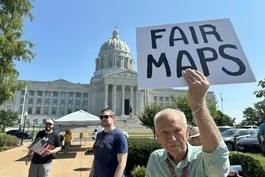
And now conflicting court rulings have thrown Missouri's congressional map into limbo, leaving candidates and voters uncertain about which maps will be used in November.
For the latest, we're joined now by our congressional correspondent, Lisa Desjardins.
So, Lisa, what is happening in Missouri right now?
LISA DESJARDINS: Geoff, this is a chaotic match over one congressional seat that's based in Kansas City, Missouri.
It has been held by Democrats for seven decades and more.
But Republicans redrew it in the state last year.
After they did that, trying to favor themselves, voters in the state circulated petitions and actually met the requirements to have a referendum to reverse it to overcome the Republican redrawing.
That has not happened.
And because of that, we saw the Missouri Supreme Court in the last couple of days rule that these Republican maps should not stand and it should go back to the old maps.
Yesterday, the Supreme Court, the United States Supreme Court, backed that up, saying basically the old maps must be in place.
They backed up the state Supreme Court.
However, just minutes after that, a federal district judge, Stephen Clark, ruled the opposite way, say no, it must be the new maps to go in place because primaries have been held under those new maps.
So where are we right now?
No one knows.
This still has yet to be resolved.
There has been sort of a rainstorm of court filings in the last day.
But time is of the essence.
Not only are elections soon, but Missouri is supposed to start early voting next month.
GEOFF BENNETT: And Republicans launched this latest redistricting race at the urging of President Trump.
Now Missouri is the latest obstacle in their plan.
So take us through where this entire effort stands now.
LISA DESJARDINS: Let's do something I love.
Let's go look at the map.
First of all, this is a reminder of what happened.
We had seven Republican-led states that have for sure redistricted, and Missouri there in yellow is still pending.
Now, for Democrats, there were two states that remapped favoring them.
California will be in blue, and that was remapped by Democrats themselves, and then Utah was something that was remapped by courts.
Now, that does show you the overall picture, but it doesn't get out what's changing now, which is the fate of these races.
So, for that, I want to go to the math.
First of all, let's look at Democrats' maximum opportunities here.
Because of remapping, Democrats could gain up to six seats in the House.
But Republicans have a much bigger number.
That's 16 seats is their maximum.
Those are the maximums.
But here's what's interesting now.
What is actually likely?
If you look at The Cook Political Report's ratings on all of these races, for Democrats, they would have a pickup, likely pickup, they're favored right now in five of those races.
So, a lot of the races, they remapped.
But look at this.
Republicans are favored to pick up just seven of the seats that they have targeted right now, according to The Cook Political Report.
In other words, Republicans are poised to get something on net over Democrats, but far less than what they intended.
GEOFF BENNETT: So, Lisa, why are Republicans having trouble clinching these districts they redistricted?
LISA DESJARDINS: Let me show you an example, Texas, the state that started it all.
These are the five districts that Republicans are hoping to pick up through remapping.
They have moved them from Democratic-leaning to Republican-leaning.
However, when you look at what's happening in the races, only these two in red are solidly favored to be picked up by Republicans.
The others could go either way at this point.
And what's more, there's another district, Texas 15, which is held by a Republican now, but she is now more vulnerable because of the way her voters have been spread out.
Look at these districts, especially around the Rio Grande, and you will notice something, a lot of Hispanic voters.
That's a key vote right here.
And it's -- those are folks who went for Trump in 2024 by larger margins than in the past, but it's not clear they will go the same way this time.
We spoke to Republican strategist Melik Abdul.
MELIK ABDUL, Republican Strategist: Some of those districts have larger Hispanic than Black or white populations.
If they decide that they don't like the implementation of Donald Trump's policies, or if they don't like the state of the economy, that is something that could hurt Republicans, where we don't make the gains that we otherwise assumed that we would because it was in a place like Texas.
LISA DESJARDINS: In other states, there are also a number of Democratic incumbents who've been targeted who are doing very well in their races.
They're outperforming what Republicans thought they would do.
GEOFF BENNETT: And, Lisa, with all of the focus on the impact of these redrawn maps, where does the battle for the House stand right now?
LISA DESJARDINS: All right, we're sitting here today.
Much can happen in the next month.
A lot of money will be going into these races.
But, as we sit here today, Republicans are on track to pick up a net of maybe a couple of seats because of redistricting, despite all of the states that have been involved.
It boils down to just a handful of states that they are looking to gain.
And they might gain none overall.
What we think is going to matter more for the race of the House is all these other battles around the country that are not in redistricted states, despite all of the Republican effort.
It will help them, but it may not determine the fate of the House.
GEOFF BENNETT: Lisa Desjardins, thanks, as always, for this reporting.
LISA DESJARDINS: You're welcome.
GEOFF BENNETT: New reporting in Israel alleges Prime Minister Benjamin Netanyahu received an explicit warning that Hamas was planning a major attack just days before October 7, but did not act on the warning.
Netanyahu strongly denies the report and says he will sue the newspaper and the journalists behind the story.
Here's Ali Rogin.
ALI ROGIN: Yesterday, the Israeli newspaper Haaretz reported that the president and Crown Prince of the United Arab Emirates Sheik Mohammed Bin Zayed, known as MBZ, called Netanyahu to warn him of a coming Hamas onslaught just a week-and-a-half before the attacks on October 7 in 2023.
MBZ reportedly advised Netanyahu that the Hamas military chief in Gaza, Yahya Sinwar, told an intermediary that he was planning a terrifying operation.
In the lead-up to this reported call, Hamas and the Israeli government had been negotiating the lifting of Israel's blockade of Gaza, increasing food shipments there, and a prisoner exchange.
But, according to Haaretz, Sinwar cut off contacts because Netanyahu kept delaying a decision.
That was just before October 7.
The UAE refused to comment on the report, but did not deny it, and underscored that the Emirati and Israeli governments maintained open and direct communication since establishing relations more than five years ago.
For his part, Netanyahu wrote on social media that no such call took place between September and October 7, and called the story a malicious fabrication with a clear political timing.
For more on this story and how the actions of Netanyahu before the October 7 attack are impacting the current election campaign in Israel, we turn to David Makovsky, distinguished fellow at the Washington Institute for Near East Policy.
David, welcome back to the "News Hour."
DAVID MAKOVSKY: Delighted to be with you.
ALI ROGIN: Thanks for being with us.
DAVID MAKOVSKY: Always.
ALI ROGIN: The big headline is in this story is that there was a call between Prime Minister Netanyahu and Mohammed bin Zayed saying, there's going to be an attack, and reportedly Netanyahu dismissed that.
You know well, you are very familiar with the sort of back-channel negotiations and communications that were happening during this time.
So what do you make of this report and what do you think was going on around this time?
DAVID MAKOVSKY: Look, it's clear - - delighted to be with you, Ali.
I think it's -- the whole media focuses on, was there a phone call or there wasn't a phone call between Mohammed bin Zayed, the head of the UAE, and Prime Minister Netanyahu?
I tend -- from what I have been hearing, there - - I do not find support for a call itself.
But from -- I do find some indications that there were some back-channel communications between Yahya Sinwar through an intermediary, a Palestinian intermediary, that made its way back to Israel, which was limited at least to the issue of prisoner exchanges.
I actually think there was a broader thing going on.
I think that was limited.
I don't know if that was a distraction from the broader macro that was going on at that time.
But I do think those broader developments in October -- September-October, 2023, are worthy of note.
ALI ROGIN: Right.
And what you're talking about here in terms of those broader dynamics, you're saying that that could have extended beyond any conversations about a possible truce and really had more to do with some of the broader context of what was happening in Israel at the time.
DAVID MAKOVSKY: Right.
Right.
Right.
ALI ROGIN: Remind us of that broader context.
There were two critical things, mega-stories that were going on at that time in 2023.
One was the judicial overhaul of this government of Israel, which was very controversial, about changing the role of the courts and perhaps diluting Israel's liberal character, which prompted a backlash among Israeli pilots, saying that they were not going to fly in reserve duty.
In return, senior security officials were saying after October 7 on the record -- I happen to hear it before the October 7 -- saying, David, the Arabs think Israel is weak because the pilots won't fly in reserve duty.
And they are plotting.
They are meeting.
Something big is about to happen.
And Aharon Haliva, the head of military intelligence, has gone public and said, I warned the government in writing three times, saying, this is dangerous.
They're drawing the wrong conclusions.
Now, he didn't connect the dots, saying, therefore, on October 7, on the Gaza fence, this -- when this would happen, this horrible massacre, the worst since the Holocaust.
But they were -- their hair was on fire.
That was one mega-event.
The other mega-event was Saudi normalization.
There was an interview of MBS, Mohammed bin Salman of Saudi Arabia, saying, every day, we're getting closer to Saudi normalization.
And I think, for Yahya Sinwar -- and I think President Biden has said he believes this, President Trump has said he believed this, one - - may be one of the few things they agree on.
But they said they both believe that Yahya Sinwar did October 7 to derail Saudi normalization with Israel, because if the biggest and most powerful Saudi Arab state made peace with Israel, Hamas would be a footnote.
ALI ROGIN: And all of this is happening as we prepare for an election in Israel on October 27.
ALI ROGIN: Opposition parties are using this report as a call for a -- renewed calls for an independent state commission of inquiry.
What would that look like?
ALI ROGIN: And do you -- how does this change the election?
DAVID MAKOVSKY: By the way, you have had 70 percent of Israelis, not just the opposition parties, saying that, after every fiasco, debacle, whatever word you want to use, in Israeli history, Israel has gone through a cleansing inward, I would say brutal self-reflection, a self-reckoning.
What went wrong?
And I always talk to Arab leaders who said, hey, that's part of Israel's strength.
They go through that self-reckoning exercise to investigate, what happened here?
And the prime minister, though, is convinced that because the rules of the game, that the commission of inquiry is led by the chief of the justice Supreme Court, who is liberal, and therefore he thinks he won't get a fair shake.
And he's resisted these calls.
And for the opposition, which, by the way, includes two right-wing parties, by the way, not just centrist or center-left parties, their view is, this is central.
The first day of the government after the elections, there has to be an announcement of a commission of inquiry into what actually happened October 7, and hopefully many of these details will become unearthed.
ALI ROGIN: And Netanyahu doesn't want this commission to happen.
Do you think that affects ultimately his election chances here, in 20 seconds?
DAVID MAKOVSKY: All I could say is, two-thirds of Israeli Jews, which are 80 percent of the country, have just said in a poll this week, and a credible poll, that October 7 is going to be a big factor on how they vote.
So I think... ALI ROGIN: David Makovsky, thank you so much for your insights.
DAVID MAKOVSKY: Thank you very much.
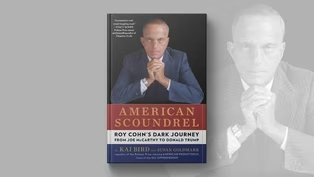
GEOFF BENNETT: For decades, Roy Cohn operated at the at the center of American power, from his work with Senator Joseph McCarthy to his role as a lawyer, political fixer, and mentor to a young Donald Trump.
Now a leading biographer traces Cohn's life and the influence he still exerts on American politics 40 years after his death.
Our senior arts correspondent, Jeffrey Brown, has the story for our arts and culture series, Canvas.
KAI BIRD, Author: He was a villain flat out, I mean, without any question, but an interesting villain.
JEFFREY BROWN: He is Roy Cohn, one of the most polarizing figures in 20th century American life.
His new biographer is Kai Bird, who heads a center on biography at the CUNY Graduate Center in New York.
KAI BIRD: You know, the biographer doesn't have to like or admire your subject.
You just have to be obsessed and figure out what makes this villain tick.
JEFFREY BROWN: Bird is best known as co-author of the Pulitzer Prize-winning "American Prometheus: The Triumph and Tragedy of J. Robert Oppenheimer."
CILLIAN MURPHY, Actor: What do you know about quantum mechanics?
JEFFREY BROWN: The basis for the Oscar-winning 2023 film.
And many of his books have centered on leading establishment figures of the postwar era, most recently a biography of Jimmy Carter.
In his latest, "American Scoundrel," written with Susan Goldmark, his wife and chief researcher, he found something different.
KAI BIRD: It suddenly occurred to me that I'd spent all these decades writing about these powerful establishment figures.
And that world was gone.
It disappeared.
There's no longer this bipartisan consensus in our political world.
And there's instead this divisive world that was created by Roy Cohn.
JEFFREY BROWN: He was more important than you would ever imagine.
KAI BIRD: Yes, suddenly in -- over the last 10 years, because of the Trump era, he suddenly is clearly haunting us from his grave.
MAN: Judge Kaufman pronounced the death sentence.
JEFFREY BROWN: In the 1950s, Cohn, still in his twenties, burst into the national spotlight as prosecutor in the espionage trial that led to the execution of Julius and Ethel Rosenberg.
ROY COHN, Attorney: Roy Cohn is here speaking for Roy Cohn to give the facts.
JEFFREY BROWN: And as chief counsel to Senator Joseph McCarthy in his anti-communist crusade.
KAI BIRD: He was the attack dog that Joe McCarthy sent out.
And Joe McCarthy was sort of an empty vessel.
JEFFREY BROWN: What jumped out at you?
What stood out especially vis-a-vis Roy Cohn's involvement?
KAI BIRD: Roy was a gay, closeted man then, but he went after gay civil servants in the State Department ruthlessly.
He knew exactly what he was doing.
He had this private life, and yet he was shamelessly going after fellow gays.
That was shocking.
JEFFREY BROWN: In Bird's telling, Cohn was fueled by ambition and resentments, ruthless with perceived enemies, pushing up to and beyond legal boundaries for friends, with an attention-getting personal style and flamboyance.
KAI BIRD: I quote in the book H.L.
Mencken's observation that the world would be a very dull place for us honest men if it were not for the sinners.
And that's Roy Cohn.
He was fascinating.
He was charming over the dinner table.
But he was transactional.
JEFFREY BROWN: So he knew how to make things happen.
KAI BIRD: He knew how to make things happen to fix things for people.
JEFFREY BROWN: In New York, his clients included mafia heads and the owners of Studio 54, the famed nightclub at the heart of '70s celebrity life, of which Cohn himself was a fixture.
He made and helped friends in high places, including mentoring a then-27-year-old developer named Donald Trump.
KAI BIRD: Trump had an annoying federal case that was being filed by the Fed's against some of his housing developments in Queens, accusing the Trump Organization of anti -- discrimination against Blacks.
And Roy's advice to him was, don't settle.
JEFFREY BROWN: Fight.
KAI BIRD: Fight, fight, attack, counterattack.
In fact, sue them for libel, which was outrageous.
This was the kind of advice that the young Trump relished.
He became essential to the rise of the young Trump.
JEFFREY BROWN: The two would remain close personally and professionally for years.
And, decades later, in his first term, angry at then Attorney General Jeff Sessions for recusing himself in the probe of Russian election interference, Trump reportedly demanded, "Where's my Roy Cohn?"
KAI BIRD: He was under indictment at that point by Robert Morgenthau for bribery.
JEFFREY BROWN: Bird showed us FBI investigation files.
Cohn was indicted three times, including for perjury, bribery, and extortion.
Remarkably, he beat every charge, though he was eventually disbarred for professional misconduct shortly before his death in 1986 at age 59 from complications related to AIDS.
AL PACINO, Actor: I'm going to be a lawyer, Joe.
JEFFREY BROWN: In his afterlife, he's been played by Al Pacino in the TV series based on Tony Kushner's Pulitzer-winning play "Angels in America."
JEREMY STRONG, Actor: I'm brutal.
That's right.
JEFFREY BROWN: More recently by Jeremy Strong opposite Sebastian Stan's young Donald Trump in the film "The Apprentice."
But his most enduring afterlife, says Kai Bird: KAI BIRD: It's his values, his resentment of the establishment that now prevails in our politics.
He is the architect of this politics of resentment, resentment against the establishment, of the elites, this sort of right-wing populism, this suspicion of immigrants.
This is all Roy Cohn.
JEFFREY BROWN: You have to live with this person for a long time, a person you have described as a bad person.
How do you do it?
KAI BIRD: Gleefully.
JEFFREY BROWN: Really?
KAI BIRD: I had no problem sleeping at night.
As the biographer, you're -- you want to become obsessed, and I was.
JEFFREY BROWN: All right.
The book is "American Scoundrel."
Kai Bird, thank you very much.
KAI BIRD: Thank you, Geoff.
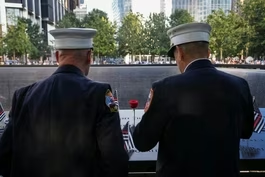
GEOFF BENNETT: We turn now to Judy Woodruff, who recently visited the September 11 Memorial in New York for a look at how the attacks 25 years ago continue to shape our lives today.
It's part of her ongoing series Crossroads: America at 250.
DAVID BLIGHT, Yale University: Water, I think, is very important.
It makes you kind of stop, reflect, one hopes in reverence.
JUDY WOODRUFF: I met David Blight and Garrett Graff at the 9/11 Memorial in Lower Manhattan last week, where, for nearly 15 years, water has fallen into the empty footprint of the North and South Towers of the World Trade Center, surrounded by the names of the nearly 3,000 victims who lost their lives that day 25 years ago.
GARRETT GRAFF, Author, "The Only Plane in the Sky: An Oral History of 9/11": Every time I come, I'm just struck by the enormity of the death toll.
JUDY WOODRUFF: Graff authored "The Only Plane in the Sky: An Oral History of 9/11" and is behind the podcast "Long Shadow," the first season devoted to telling the story of 9/11.
DAVID BLIGHT: We had whole sessions on Saturdays about specific issues that they faced.
JUDY WOODRUFF: David Blight is a Yale historian who lectures on traumatic events in our past, like the Civil War, Pearl Harbor and 9/11.
He advised the team that created the museum that sits below the memorial, helping to tell the stories of what happened that day in 2001.
GARRETT GRAFF: The first strike happens into the North Tower at 8:46 that morning.
The second plane hits at 9:03, 17 minutes later.
And that 17-minute period to me has always been the most interesting moment of 9/11, because you see in those 17 minutes how different our country really was.
Everyone in those first minutes, when they hear of that first crash, has a sort of similar befuddled reaction.
BRYANT GUMBEL, NBC Anchor: It's 8:52 here in New York.
I'm Bryant Gumbel.
We understand that there has been a plane crash on the Southern Tip of Manhattan.
MAN: We have no idea what it was.
It was a tremendous boom just a few moments ago.
GARRETT GRAFF: Oh, it was probably a small plane.
Oh, maybe the pilot had a heart attack.
Maybe there was a mechanical problem.
It must have been a terrible navigation error.
JUDY WOODRUFF: That was my reaction when I heard that morning that a plane has gone into... DAVID BLIGHT: Yes, me too.
Small plane, must have been.
GARRETT GRAFF: And then everyone sort of goes on about their morning.
And, of course, at 9:03, that second plane hits, and people all across the country realize America is under attack.
JUDY WOODRUFF: And everything changes at that moment.
And yet watching it happen is surreal.
I mean, it's not anything we have ever imagined.
DAVID BLIGHT: No, and it becomes the most visual event in history.
There is endless film footage, endless photographs.
No one turned their television off for days on end.
I remember my mother, who was still alive, she kept calling me constantly and saying, "We will never be the same again."
"Mom," I remember saying to her, "turn off CNN.
Take it easy."
And, of course, I'm trying to give her some historical perspective, which was impossible.
We were witnessing a colossal human mass murder, and we didn't know the extent of it for quite a while.
JUDY WOODRUFF: We're all -- everyone, I'm sure, on their minds, is God rest the souls of those who've lost their lives this morning in New York.
I was actually on the air on CNN that day, one of the people reporting watching the towers... DAVID BLIGHT: Sorry.
(CROSSTALK) JUDY WOODRUFF: ... come down.
There's no -- there's no way even people who watch terrible things all the time... DAVID BLIGHT: Yes.
Yes.
JUDY WOODRUFF: ... to get our arms around what we were describing, what we were talking about.
GARRETT GRAFF: And I think David raises an important point, which is, here we are 25 years removed from this world-changing event, what I think is one of the great hinges of American history; 40 percent of the country is now too young to remember those attacks.
None of us knew that day what comes next, whether there was a second wave that was coming that afternoon, whether there were more attacks coming on September 12.
And to really understand why America reacted in the way that we did as a country, as a society, as a government, as a military, you really have to understand the deep fear, chaos, confusion, and trauma that the country experienced living through those events.
JUDY WOODRUFF: You're a historian.
Was there anything -- I mean, clearly, this country's lived through terrible things, the Civil War, the attack on Pearl Harbor.
DAVID BLIGHT: Yes.
JUDY WOODRUFF: Is there anything in our history that we can compare what happened on 9/11 to?
DAVID BLIGHT: Yes, if it's destruction and slaughter on a single day, and if you think back to the press coverage at that very moment, immediately, people were using Antietam, because it was the largest single casualty count of the Civil War.
Pearl Harbor came to mind for everybody, Fort Sumter, the start of the Civil War.
There were analogies flying everywhere, which is what we do as humans.
We want some parallel to help us know where we're standing.
But nothing quite worked, to be honest.
This was such an immediate, in one hour, mass murder, that no one quite could process that.
That takes historical time.
And, even then, I don't think most Americans could process it, if they ever did, for a very long time.
JUDY WOODRUFF: Garrett, you have looked at the whole picture.
What has it meant for this country that that happened?
GARRETT GRAFF: Yes, 9/11 changes almost everything about daily life in America.
Some of those changes are very obvious to us, the taking our shoes off at the airport, the liquid ban that comes into our carry-on with one of the follow-on al-Qaida plots after 9/11.
But I think there's a bigger backdrop too, which is, we have become a much more fearful and anxious country that I think many Americans who didn't live in the world before 9/11 in the United States don't realize how innocent our country really was.
I also think Americans are very bad at understanding even our own recent history.
And it is impossible to separate from 9/11 the events that we are living through roiling our domestic politics here in the United States today, in terms of the immigration crackdown by ICE, by CBP, by the Border Patrol, by DHS, all of which are an invention of the post-9/11 world and in an attempt to ensure that these types of terror attacks never happen again.
DAVID BLIGHT: I love the point that Garrett made about innocence.
In the wake of 9/11, you may remember this, all sorts of people were writing, I mean, really smart people were writing and asking, this might finally end American innocence, that we don't live above history, that we're not always exceptional, that we have enemies, big enemies.
You know, why do they hate us?
Remember, that phrase was everywhere.
But Americans have lost their innocence many times and regained it.
Part of the civil religion is our sense of chosenness, our sense of specialness, a sense of exceptionalism.
What did we do in 2003?
We invaded Iraq out of, frankly, a rather innocent conception of that country, its history and the whole of the Middle East, and eventually a horribly mistaken idea that Saddam Hussein had nuclear weapons and so forth.
We have a long history of losing innocence.
I mean, you would think the American Civil War would have ended innocence forever, but it didn't at all.
But we regain it.
And look where we are now.
We're having a -- the biggest fight over history, who gets to control it, who owns it, who can -- who can control the narrative in museums.
We're having the biggest fight we have ever had about that.
I have been spending most of my time on that.
And that comes from a certain regained innocence as well, that there is some pure and rigid and static good American history if we can just get back to it, and all this conflict, all this difficulty, all right, we need to know something about it, but can't we just get beyond that?
You don't get beyond 9/11.
You have to sit with it.
It's authentic tragedy.
Where do you fit 9/11 into a narrative of exceptionalism and relative innocence?
You can't.
JUDY WOODRUFF: It's not the whole story... DAVID BLIGHT: No.
JUDY WOODRUFF: ... but it has to be part of the story that we have had.
DAVID BLIGHT: It's a very big part because of all things that had changed.
GARRETT GRAFF: One of the challenges of the way that this history evolves is if you had stood here at the 10th anniversary of 9/11, you would have said President Barack Obama is a direct result of the forces of 9/11, that he comes to prominence in the Democratic Party because of his opposition to the Iraq War.
That, if you are standing here at the 25th, you will say Donald Trump is a direct result of the forces unleashed by 9/11, and that those stories are both true, and those are stories that are very different about where America is heading and what 9/11 will ultimately mean to our country.
JUDY WOODRUFF: For the "PBS News Hour," I'm Judy Woodruff in Lower Manhattan.
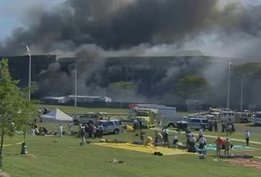
GEOFF BENNETT: Less than an hour after the first airplane hit the World Trade Center in New York on 9/11, another plane flew into the Pentagon.
Just a five-minute drive from the Pentagon are the studios of WETA, which have been home to PBS News for decades.
And on that day, two WETA cameramen and a "News Hour" intern headed toward the scene, capturing images of the attack and its aftermath that would become part of the historical record.
Twenty-five years later, they reflect on what they witnessed.
JEFF RATHNER, WETA Cameraman on September 11: On 9/11, I was working as a cameraman for the "News Hour."
When I heard on the radio smoke was coming from the Pentagon, I was right at the exit for Washington Boulevard.
About 10 seconds later, I came through.
There was smoke coming from the Pentagon.
JOSH GERSHENSON, "News Hour With Jim Lehrer" Desk Assistant on September 11: Our assignment desk person said: "I need a desk assistant to go with a cameraman to the Pentagon."
I hooked up with this cameraman, Ed, and Ed had been a WETA cameraman and a "News Hour" cameraman for a long time, and he's got this 24-year-old doofus that he's just taking along to what will become a very intense day.
ED LEE, WETA Cameraman on September 11: We jumped in the van.
We followed the fire engines in to the Pentagon.
And just right in front of us is this burning -- and it was like a big animal that had been wounded.
JEFF RATHNER: I was there.
I got there like -- I figured it out, like nine minutes after the plane hit.
There was no evidence of a plane anywhere.
I had figured it had gone into the inner courtyard, but I didn't have time really to think about that because I just started to grab my gear and shooting.
There was a heliport on that side of the Pentagon off Washington Boulevard, and there were a handful of bodies down, and I didn't know if they were dead or alive or what.
But they were probably just blown back from the explosion, I figured.
JOSH GERSHENSON: All these other people are going the other way, and we got to a certain point where the kind of security personnel said: "You can't go any further.
This is the farthest you can go."
And Ed said: "No, we're going farther.
We're -- that we are here to cover this story.
You can't stop us."
And the reason that line was drawn in the sand of where press could go, where they were pushing all the other people back to is because they had thought that, if another plane hit, that was basically where the blast radius would have been.
ED LEE: One thing that really struck me too, there were little pieces, like nuts and bolts and everything.
These are -- these are from the airport.
MAN: What's it from?
MAN: It's off an airplane, an airplane of some kind.
JEFF RATHNER: At one point, there was a small grouping of people pulling a body away, and then I noticed a man in a gray suit, and I thought that looked like Rumsfeld, the secretary of defense, out there doing that.
So it was like, wow, that's something you don't see every day.
JOSH GERSHENSON: The sky was blacked out with a black, thick cloud, and that fire just -- it was like an oven.
It just never stopped burning.
JEFF RATHNER: And, as I'm shooting, the flames burst out at one point.
And that was a strong visual for everybody to get, and that burned for quite a while.
And then all of a sudden, at one point, the wall came down.
ED LEE: You would just be seeing smoke coming up, and the smell of like jet fuel, diesel fuel, whatever, and it would be drifting by the Capitol.
And you're just thinking, oh, my God, suppose this had gone into the Capitol Dome.
But, wait, it's gone into the Pentagon, and how -- how many people have been killed or injured?
And it was -- it was something.
All of a sudden, someone from the Pentagon says: "There's another plane coming in.
Everybody, run."
MAN: Get back!
Get back!
They got another inbound plane!
MAN: Josh.
MAN: Everybody, get back!
Get back!
ED LEE: I'm pretty sure that was the plane that the people made sure crashed in Pennsylvania.
JEFF RATHNER: It was total chaos.
It's something that stay -- that will stay with me the rest of my life.
I mean, I can still remember just about every detail.
JOSH GERSHENSON: It was a matter of kind of like just getting as much as we could, and I had a clipboard with me all day, just keeping track of kind of who we met, making sure that we did everything we were supposed to do.
I felt an obligation to preserve the moment.
We were really proud that we had the best, closest footage that anyone else would ever have.
JEFF RATHNER: I was running on adrenaline.
You run on automatic pilot.
You know what you have to do as a news photographer.
One moment, I caught my breath and just sort of went like that.
It briefly overcame me.
And I thought about what the -- what this really meant, being attacked on our own soil.
It's just it never happened before, and things are never going to be the same again, you know?
GEOFF BENNETT: And that's the "News Hour" for tonight.
I'm Geoff Bennett.
For all of us here at the "PBS News Hour," thanks for spending part of our evening with us.

AI researcher says companies are ignoring catastrophic risks
Video has Closed Captions
AI researcher warns companies are ignoring catastrophic risks (7m 11s)
Cohn's influence on politics traced in 'American Scoundrel'
Video has Closed Captions
Roy Cohn's continued influence on politics and Trump traced in 'American Scoundrel' (6m 39s)
The lasting psychological impact of 9/11 on America
Video has Closed Captions
The lasting psychological impact of 9/11 on America (10m 8s)
Missouri's election maps in chaos after conflicting rulings
Video has Closed Captions
Missouri's election maps in chaos after conflicting rulings (5m 29s)

Netanyahu under pressure after report on pre-Oct. 7 warnings
Video has Closed Captions
Netanyahu faces pressure after report alleges he brushed off warnings ahead of Oct. 7 (6m 59s)
'Total chaos.' PBS News crews filmed the Pentagon on 9/11
Video has Closed Captions
'Total chaos.' How PBS News crews filmed the Pentagon on 9/11 (5m 32s)
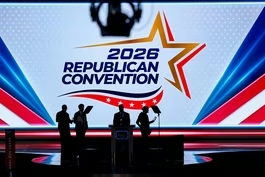
What to expect from the GOP's first-ever midterm convention
Video has Closed Captions
What to expect from the GOP's first-ever midterm convention (5m 27s)
Providing Support for PBS.org
Learn Moreabout PBS online sponsorship New Episode
- News and Public Affairs

FRONTLINE is investigative journalism that questions, explains and changes our world.
 New Episode
- News and Public Affairs

Today's top journalists discuss Washington's current political events and public affairs.
 New Episode
 New Episode
 New Episode
 New Episode
 New Episode
 New Episode
 New Episode
 New Episode
Support for PBS provided by:
Major corporate funding for the PBS News Hour is provided by BDO, BNSF, Consumer Cellular, American Cruise Lines, and Raymond James. Funding for the PBS NewsHour Weekend is provided by...