
September 22, 2026 - PBS News Hour full episode
9/22/2026 | 57m 46sVideo has Closed Captions
September 22, 2026 - PBS News Hour full episode
September 22, 2026 - PBS News Hour full episode
Problems playing video? | Closed Captioning Feedback
Problems playing video? | Closed Captioning Feedback
Major corporate funding for the PBS News Hour is provided by BDO, BNSF, Consumer Cellular, American Cruise Lines, and Raymond James. Funding for the PBS NewsHour Weekend is provided by...
September 22, 2026 - PBS News Hour full episode
9/22/2026 | 57m 46sVideo has Closed Captions
September 22, 2026 - PBS News Hour full episode
Problems playing video? | Closed Captioning Feedback
Where to Watch PBS News Hour
PBS News Hour is available to stream on pbs.org and the PBS app.
Providing Support for PBS.org
Learn Moreabout PBS online sponsorshipGEOFF BENNETT: Good evening.
I'm Geoff Bennett.
Amna Nawaz is away.
On the "NewsHour" tonight: President Trump defends the U.S.
war with Iran and threatens annihilation in a speech before world leaders at the U.N.
General Assembly.
What the Paramount-Warner Bros.
deal could mean now that a settlement with state attorneys general has cleared the way for the merger.
And researchers are finding new uses for abortion-related drugs, including cancer treatment, even as access to those medications becomes more restricted in the U.S.
DR.
LAURA ESSERMAN, University of California, San Francisco: I want to be able to stop saying to people, I'm so sorry that you have breast cancer.
But there has to be signaling from the administration that this is going to be -- and from the FDA that this was going to be safe.
(BREAK) GEOFF BENNETT: Welcome to the "News Hour.
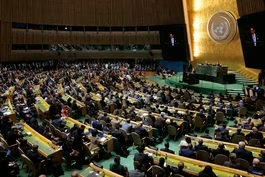
"President Trump took his America first foreign policy to the world stage today, using his address to the U.N.
General Assembly to defend the war with Iran and issue a stark warning to Iran's leadership.
Mr.
Trump said a deal could come after the midterm elections, and that the alternative was to -- quote - - "annihilate the Islamic Republic."
The president's speech and several of his meetings today were broadcast by the U.N.
's TV operation, which is separate from the U.S.
pool of TV networks that is suing the president over his ban of three news organizations.
Nick Schifrin starts our coverage from New York.
NICK SCHIFRIN: Today, in front of global leaders whose countries have been hit by unprecedented attacks, food shortages and higher energy prices because of the U.S.
Israeli war in Iran, President Trump defended his decision to go to war.
DONALD TRUMP, President of the United States: They were the bully of the Middle East, but they're the bully no more.
NICK SCHIFRIN: And at the U.N., whose charter bans countries from threatening military force except in self-defense, President Trump delivered a threat.
DONALD TRUMP: Will a deal be made with Iran that lets them rebuild and create a far greater country than it ever was before, or do I annihilate the Islamic Republic, and do it quickly, never giving them a chance to kill and destroy people and countries again?
Do I drive them into hell with no chance of survival and no hope of future greatness or generations?
But I believe we will make a deal right after the election, because it doesn't make sense for them not to.
NICK SCHIFRIN: For his part today, Iranian President Masoud Pezeshkian said Iran did not trust another negotiation, even though Foreign Minister Abbas Araghchi met today with U.S.
negotiators Steve Witkoff and Jared Kushner.
MASOUD PEZESHKIAN, Iranian President (through translator): We have been at the negotiating table several times.
The whole world sees that they are easily trample on, the agreements.
They cannot use force to compel people to submit.
NICK SCHIFRIN: But President Trump's threats of force against a NATO treaty ally led to today's agreement between the U.S., Denmark, and Greenland, which has been part of the Kingdom of Denmark since 1721.
The deal allows the U.S.
to add to its existing military presence with two new bases.
NATO will boost presence in the Arctic, and the world's largest island will permanently ban Chinese and Russian investment without giving up Greenland or Danish sovereignty.
DONALD TRUMP: We're going to have a tremendous relationship, a secure relationship, and we look forward to it.
NICK SCHIFRIN: That's a turnaround from his previous threats disrespecting Danish sovereignty that threatened overall NATO cohesion.
DONALD TRUMP: And all we're asking for is to get Greenland, including right, title and ownership, because you need the ownership to defend it.
You can't defend it on a lease.
NICK SCHIFRIN: But, today, Denmark and Greenland call this deal a win-win.
METTE FREDERIKSEN, Prime Minister of Denmark: The, day we are signing an even bigger and better agreement, a deal that can last forever.
This deal is good for the United States.
It's good for Greenland, for Denmark, for the NATO alliance, and therefore also good for Europe.
JENS-FREDERIK NIELSEN, Prime Minister of Greenland: This is not only an agreement about us, it is an agreement with us.
It takes into account the people of Greenland, our rights, our livelihoods, and the development of our country.
NICK SCHIFRIN: President Trump also met with Middle Eastern allies as the conflict with Iran has spread, this strike by the Iranian-backed Houthis on a public market in Yemen.
The Houthis are trying to expand their assault after seizing the Red Sea coast along the Bab al-Mandab Strait.
Regional officials are concerned the Houthi campaign gives Iran even more leverage, combining choke holds over both the Bab al-Mandab and the Strait of Hormuz.
The Houthis have also damaged a critical Saudi pipeline that the kingdom signaled today it's close to restarting.
DONALD TRUMP: Together, we're on the verge of overcoming challenges that have plagued this region for decades.
This has gone on for decades.
NICK SCHIFRIN: The president's positivity left it to outgoing Secretary General Antonio Guterres to acknowledge a world that feels fractured.
ANTONIO GUTERRES, United Nations Secretary-General: The fault lines in our world are widening.
Cracks have become canyons.
NICK SCHIFRIN: Today was Guterres' final U.N.
General Assembly speech after a decade in office.
He said challenges from climate change to AI require an interdependent world to avoid fragmentation and free-for-all.
ANTONIO GUTERRES: Building a networked future begins with the recognition, especially by superpowers that their power isn't so super, and governments with the greatest AI capabilities have the greatest responsibilities to humanity to establish channels for dialogue, transparency, trust, and cooperation, not despite geopolitical rivalry, but precisely because of it.
MARIA RESSA, CEO, Rappler: We cannot just keep raising the alarm.
We have to act.
NICK SCHIFRIN: A U.N.
independent panel also warned in a new report about AI threats.
But if the world came here hoping Washington would rein in AI, President Trump made clear it wouldn't be him.
DONALD TRUMP: The very same people who said we will all be dead in 12 years because of global warming, these are the same people that are now saying that AI is going to kill us all, that robots are going to attack us, and that everything is going to be a total disaster.
So we're going to encourage it, not rein it in.
NICK SCHIFRIN: And, tomorrow, the Security Council will hold a meeting about artificial intelligence with foreign ministers with addresses by both American and Chinese AI leaders -- Geoff.
GEOFF BENNETT: And, Nick, beyond what you have laid out in your report, the president today also offered his vision for Latin America?
What is it?
NICK SCHIFRIN: One in which the U.S.
has unvarnished military, economic, and diplomatic power.
Today, he said that the drug cartels across the region were -- quote -- "the ISIS of the Western Hemisphere."
He predicted also that Cuba will fall.
U.S.
officials tell me that there's a race between the U.S.
and Cuba.
The U.S.
is trying to impose enough pressure on Cuba to open up economically, to change politically, while Cuba is trying to wait out, to outlast President Trump.
And, tonight, President Trump will meet with Venezuelan acting President Delcy Rodriguez.
Today, the president was unabashed about the U.S.
exporting Venezuela to the U.S., despite the Geneva Convention explicitly prohibiting nations from using war to -- quote -- "pillage the country's economic resources."
DONALD TRUMP: It was a war, but it's perhaps the biggest deal ever made.
To the victor belong the spoils.
GEOFF BENNETT: And, Nick, shifting our focus back to Yemen now, what are officials telling you about how the Houthis can be stopped?
And you have some new reporting?
NICK SCHIFRIN: Yes, Geoff, it's a really big challenge.
The Houthis have recently swept through the Red Sea coast right along the Bab al-Mandab.
And anti-Houthi forces, including the Yemeni government, the internationally recognized Yemeni government, didn't put up much of a fight.
The Saudis have launched airstrikes on the Houthis, but they have not been effective.
And now the Houthis are trying to expand their control further east.
A senior U.S.
official tells me that President Trump is determined not to launch U.S.
airstrikes on the Houthis, despite a request to do so by Saudi Crown Prince Mohammed bin Salman, although, late last week, he did order the military to do an assessment about U.S.
airstrikes, leading some in the military to suggest that they thought airstrikes were imminent.
But the senior U.S.
official tells me that, no, that was just an assessment and that there are no U.S.
airstrikes on the Houthis on the table.
The U.S.
and the Houthis still have a deal, Geoff, in which the U.S.
has agreed not to attack the Houthis, and the Houthis have agreed not to attack U.S.
warships or any other ships in the Red Sea, with the exception of those strikes and threats against Saudi tankers in the area.
Meanwhile, a U.S.
senior official tells me that they would like to see Saudi Arabia make a deal with the Houthis.
The Houthis have been asking for restrictions on their airport and their flights lifted.
They have been asking for billions in cash in unpaid salaries and oil compensation.
And they have also been asking for political recognition.
That is not a list, Geoff, that the Saudis have been interested in giving in to.
But analysts say the Houthis think they're winning.
They're not about to give in or compromise at all on their side as well.
And so that leads to this very difficult, problem, Geoff, without a clear solution.
GEOFF BENNETT: Nick Schifrin reporting tonight from the U.N.
Nick, our thanks to you, as always.
NICK SCHIFRIN: Thank you.
GEOFF BENNETT: And we start the day's other headlines in Mississippi.
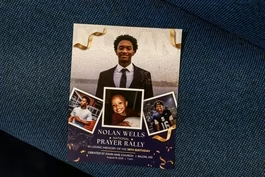
The family of Nolan Wells is pushing back after a grand jury declined to bring charges in the death of a Black teenager who was found dead following a July 4 boating trip with a group of white friends.
The grand jury report noted that both the state's medical examiner and the pathologist hired by the Wells family found his death to be undetermined, but -- quote -- "consistent with drowning."
In a press conference today, Wells' family and lawyers said that the conclusion was unacceptable.
BENJAMIN CRUMP, Attorney for Family of Nolan Wells: If it was your child, you would want the investigation to stay open and active.
We want the same thing for our children.
We love our children too.
We want to protect our children too.
GEOFF BENNETT: Nolan Wells' death sparked widespread anger and speculation, drawing renewed attention to Mississippi's long history of racial violence.
Jackson County's district attorney has rejected claims that race played a role, saying -- quote -- "There is not a shred of evidence to support these narratives."
In South Carolina, a coroner has found that actress Hayden Panettiere died from an accidental overdose of several drugs, including fentanyl.
The 36-year-old also had an anti-anxiety medication, a muscle relaxant, and a drug used to treat depression in her system.
The former "Heroes" and "Nashville" star was found unresponsive in an apartment in Greenville last month.
She had long struggled with substance abuse and spoke openly about her postpartum depression after the birth of her daughter in 2014.
An investigation into her death is ongoing.
In Massachusetts, a 20-year-old top influencer known as Clavicular has been charged with raping a 17-year-old girl.
The accuser told police that last may, Braden Peters, that's his real name, gave her alcohol during a livestream before the assault, despite knowing she was underage.
Peters is a prominent figure in the online looksmaxxing trend, which focuses on improving one's physical appearance.
A lawyer for Peters has previously denied the allegations against him.
His arraignment is scheduled for mid-October.
The Trump administration is removing more than 750,000 people from Affordable Care Act coverage, claiming they were fraudulently enrolled.
That's roughly 4 percent of the 19 million Americans using the program, also known as Obamacare.
Vice President J.D.
Vance announced the removals today, saying the cuts would save $2.2 billion.
J.D.
VANCE, Vice President of the United States: We're actually making sure that the people receiving Obamacare subsidies are actually entitled to receive them.
GEOFF BENNETT: Vance said the enrollees either did not meet eligibility requirements or didn't exist at all.
He's also said an additional 440,000 people are being evaluated for possible removal.
Health policy experts, though, have questioned whether fraud is occurring on the scale the administration claims.
Republican Senator John Curtis is calling for the Senate Judiciary Committee to investigate and subpoena Donald Trump Jr.
after news that a Russian businessman partially bankrolled his wedding party.
In a social media post accompanying the letter to the committee, Senator Curtis wrote": "A toaster is a wedding gift.
A private island party paid for by a Putin-connected oligarch is something else."
The Utah senator also raised issues with the Trump family's cryptocurrency ventures.
He's also calling for Hunter Biden to be subpoenaed, arguing that presidential families should be held to the same standard regardless of party.
DoorDash is paying more than $131 million to settle claims that it shortchanged delivery workers in New York City.
Officials are calling it the largest worker settlement in city history.
Most of that money will pay back more than 260,000 workers who were either paid late, underpaid, or not paid at all.
The online delivery company also agreed to a three-year monitoring program to ensure it's complying with local delivery laws.
In a statement, DoorDash said the errors weren't intentional, but added -- quote -- "Simply put, we screwed up."
Well, on Wall Street today, stocks ended mixed following the latest fall in oil prices.
The Dow Jones industrial average slipped almost 200 points.
The Nasdaq added nearly half-a-percent.
The S&P 500 ended virtually unchanged.
And a country hit has made history as Billboard's longest running chart topper of all time.
Ella Langley's "Choosin' Texas" has now spent 23 weeks at number one on Billboard's Hot 100 list.
That surpasses the longtime record held by Mariah Carey's holiday anthem "All I Want For Christmas Is You."
With its cross genre appeal and tale of heartbreak, "Choosin' Texas" has been streamed more than 900 million times in the U.S.
as of last month.
Langley herself has called the success of the track surreal.
Still to come on the "News Hour": a look at the competitive Michigan Senate race; the stories of Hurricane Helene survivors two years on; Hollywood super agent Ari Emanuel on how he's learned to spot the next big thing.
A day after Paramount Skydance and a group of state attorneys general announced a settlement clearing the way for its merger with Warner Bros.
Discovery, questions remain about whether the deal does enough to protect consumers and competition.
The $111 billion merger would create one of the biggest media companies in the world, bringing multiple film studios and cable channels, streaming services, and major franchises under one roof.
It would also put two major news organizations, CBS News and CNN, under the same corporate umbrella.
California Attorney General Rob Bonta, who helped lead the antitrust challenge before reaching the settlement, acknowledged he still has concerns about the merger.
ROB BONTA (D), California Attorney General: This settlement is not a vote of support for this merger.
It is not a blessing of the broader merger.
Broadly speaking, we believe further consolidation in markets that are central to American economic life doesn't serve the American economy, consumers, or competition well.
GEOFF BENNETT: But Bonta emphasized several key conditions of the agreement, including Paramount being required to release 30 films in theaters per year for the first two years, a $1.5 billion investment for homegrown film production, and the creation of an editorial independence board to support CBS News and CNN.
The deal itself still needs to be approved by a federal judge.
For more, we're joined now by Oliver Darcy of Status.
Oliver, thanks for being with us.
So what ultimately led to this settlement?
Was it Ellison's threat to move Paramount out of California or something else entirely?
OLIVER DARCY, Founder, Status News: The threat from Ellison to move out of California seems to have loomed large over this.
If you remember, Rob Bonta was calling this an illegal merger for some time and really vowing to go all the way with this and saying he was comfortable going to court.
And something happened in the recent weeks.
And that something is David Ellison was getting very serious about his threat to take production jobs from California and move them to maybe Nashville or to Texas.
And you saw the governor, Governor Gavin Newsom, and local officials really worried about this and say they would like to see a settlement.
And the pressure, from our understanding, reporting on this, was really great on Rob Bonta.
He really needed to settle this to make sure that David Ellison left those Paramount production jobs and potentially the Warner production jobs in California.
GEOFF BENNETT: Of all of the conditions attached to this settlement, which is expected to have the biggest effect on the entertainment industry?
OLIVER DARCY: Yes, I mean, a lot of this can have a huge effect on the entertainment business.
I think that people are looking at the settlement that Rob Bonta got and not super thrilled with it.
For instance, the big point about they have to release 30 films a year in theaters, if you look at the fine print, they do have to release 30 films, but they can co-produce half of them.
So they only really have to release 15 films on their own, and then they can co-produce the other half and get those in the theaters to satisfy that requirement.
Ultimately, Geoff, this is going to result in a lot of layoffs in the entertainment sector.
And that's going to happen because there's going to be a lot of synergies between Warner Bros.
Discovery and Paramount, the back offices, people who support communications and publicity, people who support H.R.
jobs, legal jobs.
Those jobs, I would imagine, would be almost immediately consolidated, and you're going to see a number of layoffs, and then it's going to just continue.
This company that's going to be formed is going to be under billions of dollars in debt.
They're going to need to find a lot of cost savings.
And that's going to result regardless in a loss of jobs moving forward.
GEOFF BENNETT: And Ellison has agreed to create this independent editorial board for CBS and CNN.
But critics say what is described as a safeguard is in many ways hollow.
Explain why.
OLIVER DARCY: Yes, there's a number of concerns here.
One, usually, when you have an editorial board that's supposed to safeguard the CNN and CBS from management, you wouldn't have management get to select all the board members.
In this case, Paramount gets to choose the five people who are going to be on this board.
This board reports directly to Paramount's chief compliance officer.
So, again, Paramount ultimately controls this board.
It's unclear what power this board has.
I mean, it doesn't say what power they have.
If they find, for instance, that Paramount's management is interfering with editorial, what power do they have to remedy that situation?
It's very unclear and not certain.
This board also doesn't have to be formed for 180 days, meaning that David Ellison and company can, I guess, overhaul CNN, as they have overhauled CBS News, without having to deal with this board for the first six months or so.
And so there are a lot of concerns this board is really just, as Kara Swisher, the CNN contributor and technology journalist, said, a fig leaf for management to get this deal across the finish line.
It's something that Rob Bonta can hold up and say, look, we got this board that's going to safeguard CNN's editorial independence.
But, ultimately, this board does not seem to have any real teeth.
GEOFF BENNETT: And, Oliver, who actually polices all of this?
How quickly could the states act if Paramount decides to start testing the boundaries of this settlement?
OLIVER DARCY: I mean, they theoretically have some avenues to enforce this.
That's what Bonta wanted.
And so, for instance, if they don't release 30 films a year, for each film they don't release, they're on the hook for I think $30 million or so.
But, again, ultimately, this was not what Bonta was asking for.
The state attorneys general, if you remember, they were asking for structural remedies, a change to the structure of this Warner Bros.
Discovery acquisition.
And what they got ultimately were behavioral remedies, saying basically that Paramount will behave in certain ways moving forward.
And that's not what they said they wanted.
And so I think, when you look at whether it's the Writers Guild that's upset with this deal - - a number of critics, like Mark Ruffalo, who's been outspoken, said this deal was handing a win to oligarchs and Donald Trump supporters.
If you look at why they're upset with this deal, it's because they basically didn't get anything that they wanted, and you're now allowing a deal which you had previously described as an illegal merger to go through.
GEOFF BENNETT: Oliver Darcy of the media newsletter Status.
Oliver, thanks again for your time.
We appreciate it.
OLIVER DARCY: Thank you, Geoff.
GEOFF BENNETT: As we continue our coverage in the lead-up to the midterm elections, one key state, Michigan, is in the spotlight tonight.
One of the Democrats' biggest names made their first major campaign stop of the cycle there.
Our Lisa Desjardins has more.
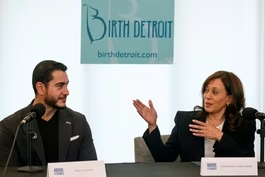
LISA DESJARDINS: Former Vice President Kamala Harris was in the Wolverine In state today to campaign for Democratic Senate candidate Abdul El-Sayed.
This was at a roundtable in Detroit focused on Black maternal health.
Harris lost the state in 2024, struggling with progressives there.
Today, she both criticized President Trump and aimed to boost El-Sayed.
KAMALA HARRIS, Former Vice President of the United States: The United States Senate should be a stopgap on the abuses of this administration.
And I would suggest to you that the fellow sitting to my right would be one of them when elected.
LISA DESJARDINS: For more on moment in Michigan and what it means nationally for Democrats, I'm joined by strategist Joel Payne, who worked for the Hillary Clinton campaign and others.
This is a big moment.
Voting has started in several states by mail, including parts of Michigan.
Why is it that the El-Sayed campaign wants to be next to Kamala Harris, someone who lost that state?
JOEL PAYNE, Democratic Strategist: Well, I think this is a part of a continued effort by the El-Sayed team to continue to bring together that coalition in Michigan.
It was a very tough, rough-and-rumble primary, and you do have to kind of heal some of the divisions that existed there.
I think Kamala Harris certainly represents a lot of those establishment votes that went to Haley Stevens in that primary.
Also, she will help him with African American voters in key strongholds like Detroit and Lansing.
I think this will be a good opportunity for El-Sayed to continue to do some of that work.
LISA DESJARDINS: I want to talk more about those African American voters.
Looking at the competitive Senate races -- I just did this before we sat down -- I don't see any Democratic candidates in them who are Black.
Do Democrats have an issue with elevating Black leaders right now and therefore with motivating Black voters?
JOEL PAYNE: Well, I think certainly Democrats continue to have to do the work to bring together the type of coalition that they want.
I might say that the folks in Florida might be - - might pick a nit with you about Angie Nixon.
LISA DESJARDINS: If it's competitive, yes.
JOEL PAYNE: If it's competitive.
And, by the way, there's some polling out there... LISA DESJARDINS: Going by The Cook Political Report's ratings.
JOEL PAYNE: Sure.
LISA DESJARDINS: They have not rated it competitive yet.
JOEL PAYNE: Yes.
And I wouldn't disagree with Amy about anything.
But what I would say to you is that I do think that Democrats have to continue to do work to bring back in some of those folks into the coalition that they maybe lost in 2024.
Remember, Donald Trump maybe overperformed with some African American populations.
And I think embedded in your question is part of that, how do you bring back that working-class people of color coalition?
I think candidates that not only represent in who they are and their identity, but in their issues, are a part of that work.
LISA DESJARDINS: Back to this race in Michigan, we have already seen some attention-getting ads, and they are about the politics of identity.
Let's take a look.
JOEL PAYNE: Yes.
NARRATOR: Abdul El-Sayed grew up as Michigan as you get.
NARRATOR: Parents worked the auto industry.
Football.
NARRATOR: Abdul El-Sayed runs around with a terrorist sympathizer who said America deserved 9/11.
HASAN PIKER, Livestreamer and Political Commentator: America deserved 9/11, dude.
ABDUL EL-SAYED (D), Michigan Senatorial Candidate: I'm not here to disavow people's views.
HASAN PIKER: America deserved 9/11, dude.
MIKE ROGERS (R), Michigan Senatorial Candidate: Abdul is too extreme for Michigan.
LISA DESJARDINS: OK, that's particularly a reference to the controversial leftist streamer Hasan Piker, who did campaign in the primaries with El-Sayed, but El-Sayed has distanced himself.
He's gone so far to really stress he disavows antisemitism in all forms.
However, this is an issue we keep seeing come up, and especially identity as a Muslim man in this race.
I have to say, even some Democrats I spoke to on the ground there told me in private that it was off-putting to them.
This is 2026, but, being honest, this is something I heard.
How much of an issue is this in Michigan, the identity of El-Sayed in particular, and how's he dealing with it?
JOEL PAYNE: Well, look, I think the fact that the Rogers campaign and Republicans nationally are trying to kind of otherize El-Sayed in the state kind of shows you what their hand is that they have to play, which is to scare up more votes in their base and to bring out more people by kind of going with a base strategy.
Certainly understand that.
I don't think that that's going to have the success that I think it's intended to have, for a couple of reasons.
One, they're trying to weaponize kind of Abdul El-Sayed being outside of the system.
I actually think in this cycle, in this moment, an anti-insider moment, I think it helps that El-Sayed is kind of a newer voice and someone who represents a newer generation of politics.
Also, I think he's going to bring out a different coalition of voters, some who were, frankly, turned off by Democrats in 2024 and in past cycles.
So while I think Republicans might see it as opportunity that El-Sayed speaks differently, represents a different subset of issues, I actually think El-Sayed and the folks behind him think that that's an advantage for them.
LISA DESJARDINS: Right.
Kind of on that, the policy of it, Republicans are going to harp on the things that get a lot of attention, not his policies more broadly, but -- he is not a Democratic socialist, but he has spoken at DSA events.
He has said some things that most Americans don't agree with, like he kind of frowns on Fourth of July fireworks as unhealthy.
He's also in the past indicated an openness to some form of defunding the police.
Now, those are more serious kind of policy and philosophical issues.
How do Republicans deal with that nationwide?
Because they're taking what he believes in Michigan and those kinds of quotes from him and running with it nationwide against him.
JOEL PAYNE: Yes, you might see that Cheshire Cat smile on me, because Abdul El-Sayed played lacrosse at the University of Michigan.
I mean, I think that that's a pretty common experience for a lot of Michiganders, and as he said, he's always been Abdul from Michigan.
So, I think that this might be a situation where, if you're flying in from maybe outside of the state, you may not understand some of the issues and some of the parochial issues in the state.
But be that as it may, I take the point that belies your question.
I do think that Republicans are going to look for these ways to again try to cleave off people who might decide, hey, maybe I will take a chance with someone new in a cycle and in a political moment where they're feeling dissatisfied, where voters are feeling dissatisfied with what they've gotten from the first two years of Trump.
I think the big problem for Mike Rogers in this moment is that not only is he attached to Donald Trump.
He's attached to the establishment from a different generation and a different era, which, by the way, this moment is a rejection of.
I mean, Mike Rogers represents as much of the politics of the past for Republicans in the state as Donald Trump does.
And I think that that's a real challenge to this, maybe something that gets underplayed here.
LISA DESJARDINS: Joel Payne, part of our continuing conversations, thank you.
JOEL PAYNE: Thank you.
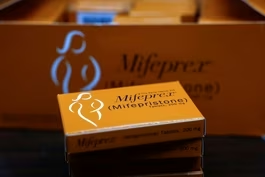
GEOFF BENNETT: For years, mifepristone and similar drugs that can induce abortion have been used to treat common, but often debilitating conditions, including uterine fibroids and endometriosis.
Now researchers around the world are exploring whether these drugs could have other uses in women's health, including preventing some cancers.
In the second part of our series beyond abortion, special correspondent Sarah Varney traveled to the U.K.
to look at that potential and how the politics and restrictions surrounding these drugs in the U.S.
could affect the research.
SARAH VARNEY: On a gray summer day in a small village outside of Manchester, England, I met up with Pamela Cachart.
PAMELA CACHART, Medical Trial Participant: This is made here.
SARAH VARNEY: Pam grew up here with her brother Chris (ph) and her mother, Dee (ph).
PAMELA CACHART: She was quite a young woman.
So we were very good friends, best of friends.
My mom was just perfect, amazing, very strong, and incredibly courageous for what she went through.
SARAH VARNEY: At just 43 years old, Dee died from breast cancer.
Decades earlier, Pam's grandmother was killed by the same disease, also in her early 40s.
I think sometimes for women who have a history of breast cancer in their family... SARAH VARNEY: ... you can feel almost fatalistic about it.
PAMELA CACHART: Yes.
SARAH VARNEY: Like, when is it just going to happen to me?
PAMELA CACHART: You can -- you feel like you're looking at the clock, waiting for that moment to happen when, oh, it's me now, this is my turn.
SARAH VARNEY: That's why Pam joined a study aiming to prevent breast cancer in people with a family history before they hit menopause.
So mammogram machine, I'm very familiar with one of these.
Published last year, the trial was led by Dr.
Sacha Howell, an oncologist and breast cancer researcher at the University of Manchester.
Participants were given a drug called ulipristal acetate, or UPA.
It's approved in the U.S.
as an emergency contraceptive and has been shown to end an early pregnancy at higher doses.
The drug blocks the effects of a hormone called progesterone that causes cells in the breast to grow and divide.
DR.
SACHA HOWELL, Oncologist, University of Manchester: The more cell divisions, the more proliferation there is in the breast, the higher the chance that there is going to be a breast cancer.
SARAH VARNEY: Dr.
Howell and his team recruited 24 women, including Pam.
The women all had breast biopsies and MRIs and then took a daily dose of the drug for three months.
Researchers wanted to see if it would block the growth of breast cells that can turn into cancer.
DR.
SACHA HOWELL: We got the message very early that it was going to be successful.
BRUNO SIMOES, University of Manchester: Basically, the important part for us here is that we can see the cells where tumors originate.
SARAH VARNEY: One of Dr.
Howell's colleagues showed me what happened to those problem cells after the women took the drug for just 12 weeks.
DR.
SACHA HOWELL: We saw a reduction in the number and activity of cells that we think go on to cause quite aggressive breast cancers like triple-negative breast cancer.
So we think we may have a treatment here.
But the other thing that we saw was that the architecture, as you put it, of the breast, does change.
SARAH VARNEY: The breast tissue started to relax.
Dr.
Howell says that's important because stiff tissue tells the cells to mutate, which further increases breast cancer risk.
Other researchers are building off this work to see if, by relaxing dense breast tissue with UPA, it will be easier to detect cancer on mammograms.
Is early detection worse for women who have dense breasts?
DR.
SACHA HOWELL: The worry with breast density is that we will actually miss a cancer that is there.
And the recent study in the U.K.
showed that on average about eight women were diagnosed with breast cancer on a mammogram for every 1,000 that had one.
SARAH VARNEY: Wow.
DR.
SACHA HOWELL: And that's with dense breasts.
But a trial like Dr.
Howell's would be hard to replicate today in the United States.
WENDY WRIGHT, Concerned Women for America: So it's important for people to know that this is an abortion drug and that it may end up harming women.
SARAH VARNEY: Anti-abortion activists have targeted ulipristal acetate, or Ella, since it was approved as an emergency contraceptive in 2010.
Those calls increased after a study published last year found a higher dose of the drug can be used for medication abortion.
Why is it that you think it's not available here in the United States?
DR.
LAURA ESSERMAN, University of California, San Francisco: Well, I think, unfortunately, these drugs have gotten caught up in politics.
Because of the pressure from this administration or from others, I think people are concerned that they will be punished for doing this work.
So there's just a very hostile environment to doing research and pushing innovation.
SARAH VARNEY: Dr.
Laura Esserman is a breast cancer surgeon at the University of California, San Francisco.
She worries that holding back research now will mean fewer choices for patients in the future.
DR.
LAURA ESSERMAN: I have spent my life trying to prevent people from dying of breast cancer.
It would be terrible to have women dying of completely preventable causes.
Imagine if we get a contraceptive that reduced your risk of breast cancer by half, and we would maybe have, instead of 325,000 cases of breast cancer, we'd say, have maybe back to 150,000 cases of breast cancer.
How great would that be?
SARAH VARNEY: Last year, one of those hundreds of thousands of cases was Mary Benjamin.
MARY BENJAMIN, Medical Trial Participant: When I was diagnosed, I'm sure, like most people who were diagnosed with cancer, it's like, oh, cancer, is this a death sentence?
SARAH VARNEY: The 57-year-old came to New York from Egypt three decades ago.
Last year, she was diagnosed with triple-negative breast cancer, which is known to be aggressive and difficult to treat.
It's the type of cancer Dr.
Sacha Howell says UPA might help prevent.
MARY BENJAMIN: I have daughters.
I have a granddaughter.
I have nieces.
I have a sister.
So it means so much to me if I can prevent their cancer journey.
So having an option to take to take that medication in advance to prevent their chance of getting any type of cancer, and specifically breast cancer, is a win-win.
SARAH VARNEY: Mary is a Christian and against abortion.
Is it possible to be -- to be opposed to abortion rights, but also want those drugs to be studied specifically for breast cancer?
MARY BENJAMIN: Absolutely.
And being anti-abortion, it doesn't mean I'm going to stop every woman from taking that.
So at least we can study it on women who choose to do that, especially in states where they are allowed to do that.
So, yes, I am against the politics coming in the way of science.
DR.
LAURA ESSERMAN: These drugs are approved.
They have been in use.
We know they're safe.
They have been out there for decades.
SARAH VARNEY: Dr.
Esserman points to multiple studies outside of the United States that show the abortion drug mifepristone could also be effective in preventing breast cancer, particularly for those with the BRCA gene mutation, which increases cancer risk.
And other research is demonstrating these anti-progestin drugs have the potential to reduce the risk of ovarian cancer.
WOMAN: That's wild.
DR.
LAURA ESSERMAN: Isn't that something?
SARAH VARNEY: But Dr.
Esserman says political leaders need to help advance, not hinder, that science.
DR.
LAURA ESSERMAN: I want to be able to stop saying to people, I'm so sorry that you have breast cancer.
But there has to be signaling from the administration that this is going to be and from the FDA that this is going to be safe, that, if we show that there's an effect, that someone's going to approve the drug.
No one is going to invest in making these medicines available if they can't get them approved.
DR.
SACHA HOWELL: There are some fantastic collaborators that I got in America, and I would love to open the study over there.
I think that would be a huge uphill struggle given the current political climate.
SARAH VARNEY: Dr.
Howell says, in the meantime, European researchers will push ahead with the backing of their governments.
DR.
SACHA HOWELL: Politics is intimately involved with science, because so much science is funded by central governments.
So I don't think we can really disentangle politics from science.
But I think we do have a problem when politicians start to dabble with things that they don't really understand.
And I think that's where I would try and draw the line.
SARAH VARNEY: It's been nearly seven years since Pamela Cachart was involved in Dr.
Howell's study.
PAMELA CACHART: I think the progression of the medicines is amazing.
I think that needs to just continue, a quicker rate, if it can do.
Moving aside from the politics, if we can just keep going and keep trialing these medicines, we're going to be in a lot better position in 20 years' time to what we are today.
SARAH VARNEY: Pam says she benefited from people who volunteered for previous drug trials.
And now she's paying it forward.
PAMELA CACHART: It's unfortunate that I have got this family history.
However, in some ways, it's a gift that I'm being able to trial the medicines, and then, going forward, that might help my nieces and their nieces or their children in the future.
And if you can help someone else, why wouldn't you do it?
SARAH VARNEY: For "PBS News Hour," I'm Sarah Varney in Cheshire, England.
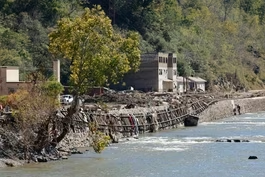
GEOFF BENNETT: Two years after Hurricane Helene ripped through much of the Southeastern U.S., many of the communities affected by that storm are still recovering.
And now a new project has chronicled their journey using what might seem like an unlikely medium, a graphic novel.
Our William Brangham has more for our arts and culture series, Canvas.
WILLIAM BRANGHAM: In 2024, Hurricane Helene crossed the Florida Panhandle, went through Georgia, and stalled out over the Carolinas.
In all, six states were badly damaged, and thousands of homes and buildings were destroyed.
The storm officially killed 250 people, making Helene the deadliest hurricane since Hurricane Katrina.
But out of that storm also came stories of resilience.
It's a theme that's explored in a new graphic novel called "Islands in the Sky: A People's History of Hurricane Helene."
In the book, 11 different stories are told, each from the perspective of a different person or family in North Carolina, and all illustrated by different artists.
The book and project founder is Andrew Aydin, and he joins us now.
Andrew, so good to have you here.
Such a tremendous piece of work you have done.
In the preface to this book, you write this about what Helene has wrought -- quote -- "It was the total, thorough existential collapse of the infrastructure that makes life here possible."
I mean, I remember reporting back during Helene that it was, again, seemingly the final nail in the coffin to this idea that anywhere in this country was protected from the climate crisis.
What was it from your perspective that made that storm so unprecedented?
ANDREW AYDIN, Appalachia Comics Project: It was both the level of rain, the number of days in which it did rain, and then you had the mudslides and the trees and all the debris and everything that then started to fall and coalesce around, just damaging whatever it could over a series of days.
That was the physics of what actually damaged everything so much.
WILLIAM BRANGHAM: And is that where this title come from, "Islands in the Sky," that they're all of these mountain peaks that are now flooded becoming islands?
ANDREW AYDIN: The title came from the fact that the region is known as the Land of Sky.
And I was listening to a radio broadcast.
It was the first signal I could get after the storm.
And it was from a tiny little church just perched up on a mountain, and they were broadcasting the names of the survivors.
And he said: "We are known as the Land of Sky, but, tonight, I think, as the water surrounds us, we are islands in the sky."
And that phrase just stuck in my mind.
WILLIAM BRANGHAM: You had created several award-winning graphic novels before this book.
But this idea of doing this in the first person, where each individual person tells their own story with different artists, how did that coalesce for you as the idea for what you wanted to do for this story?
ANDREW AYDIN: There's a long history of outsiders telling the story of Appalachia.
And I thought this was incredibly important to be a moment where Appalachia got to tell its own story.
And it also needed the support of professionals who maybe have done comics before, so that the survivors of these storms could really bring their vision onto the page, not be burdened with learning how to do something in all its complexity, but be supported and be able to put their vision into the telling of what they went through.
WILLIAM BRANGHAM: Did you feel like the media did a bad job of -- I mean, both historically, but also with regards to this storm, to telling those people's stories?
ANDREW AYDIN: I think they have been doing a bad job for a really long time, probably 100 years, since there was a mainstream media.
But it's not as if there's one outlet or one thing that's a problem.
There's so much misinformation online, on social media, and that seemed deliberate and systematic to me, like it was trying to make something political in the face of the election, in the face of all the exploitation of Appalachia.
They were trying to use this in a way that it just seems wrong.
WILLIAM BRANGHAM: We talked with one of the contributors to your book, Jessica Stepp Edney.
She's a community college director and she lives in Henderson County.
She told us about why she did this and what the legacy of this storm has been.
Let's take a listen.
JESSICA STEPP EDNEY, Hurricane Helene Survivor: I wrote this for my son Carter (ph).
Carter struggles with a lot of anxiety, and I would not wish a storm like that on any human being that faced anxiety.
Every storm that we have now terrifies him in a way that I can't help, right?
We are all terrified.
Every heavy rain, every thunderstorm, many of us here in West North Carolina are triggered by every boom and by every additional inch of rain and the fears that it will come back.
WILLIAM BRANGHAM: I see you nodding along as she's talking.
ANDREW AYDIN: Yes.
WILLIAM BRANGHAM: I mean, she's both memorializing this for her son, she said, but also acknowledging that, recovery aside, these things leave a mark.
ANDREW AYDIN: Yes, I mean, it hurts.
You live in this place that you thought was safe.
I mean, everybody said Western North Carolina was a climate change haven.
And to have your safety violated, not just by a person or an object, but in some ways by God or by Mother Nature, it changes the way you look at the world and where you feel like you can be human, where you can be safe, where your future is, where your past was.
It changes everything.
WILLIAM BRANGHAM: The media and the cameras have largely left now.
What is it like?
I know this is a generalized question.
ANDREW AYDIN: Yes.
WILLIAM BRANGHAM: But how is recovery going there?
ANDREW AYDIN: Not great.
There's still debris in my yard.
There's burned-out buildings.
There's a building just down the street from my house where someone passed away and still sits there condemned.
It hasn't been dealt with.
Small businesses are struggling.
That's one of the reasons we're doing this project.
It's not just about preserving the history, though that's our primary mission.
It's that every time we do an event in one of the cities, in one of the small towns that we go to, we generate economic activity.
And this is our way of rebuilding ourselves.
I mean, I think there's this pride in Appalachia of taking care of yourself.
And if you give them a handout, they don't want it.
But if you give them a way to take care of themselves and help them out that way and work with them, that's dignity.
That's what they want.
WILLIAM BRANGHAM: I mean, as you say, the book does deal with the rampant misinformation, the slow government response.
But the real thread that seems coursing through this is how people came together to help each other.
That seems to be like the overarching mission of this is to remind us that people bound together.
The storm made us put down our phones.
It made us put down all the distractions, the social media that tells us we should be this, all of the identities that come with it, and talk to our neighbor, help our neighbor.
Are you hungry?
Here's food.
Are you thirsty?
Here's water.
You need fuel to power your generator?
Here, I have got a tank.
We shared.
Everybody talks about, are you far left, are you far right?
Nobody talked about that during the storm.
They just talked about sharing.
They just talked about each other, life, nature.
And I think there's a part of us that all look back on that as that was when it was simple.
That was when we were human.
That was when we just showed that we cared.
And I think, if you read this book and you take that from it, which is a constant theme in all of the stories, maybe it's a guide for the rest of the country in how we deal with what we're going through.
WILLIAM BRANGHAM: The book is "Islands in the Sky."
Andrew Aydin, great to talk to you.
Thank you so much.
ANDREW AYDIN: Thank you for having me.
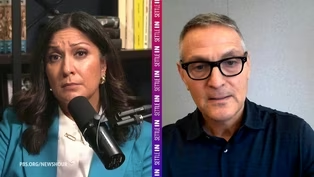
GEOFF BENNETT: Ari Emanuel is a Hollywood institution in his own right working behind the scenes to strike deals for his legion of clients, actors, musicians, writers, and athletes.
In this week's episode of our "Settle In" podcast, Amna Nawaz spoke with him about his new memoir called "Roll the Calls."
He talks in this excerpt about how he built his career by spotting the next big thing before anyone else did.
AMNA NAWAZ: Ari, it's fair to say you -- you're able to spot trends, to spot things happening before they kind of become what they eventually are.
Now, you were very early to see the potential in the World Wrestling Federation, which later became WWE, same with the UFC, the Ultimate Fighting Championship.
What did you see in that said to you this is something we want to get involved in, and also the idea that you own the product, right, that it's not something typically agents do?
ARI EMANUEL, Author, "Roll the Calls: A Memoir": Right.
Right.
Well, first of all, when I was a young kid, my grandfather and I on Saturday mornings or Sunday mornings used to watch WWF.
AMNA NAWAZ: You did?
ARI EMANUEL: Right, yes, with the -- and that's when it was in the different regions.
The genius about Vince back then was, he saw cable was coming and decided to do the roll-up and got Hulk Hogan and did that.
And he saw a lot of trends.
AMNA NAWAZ: Yes.
You're talking about Vince McMahon, we should mention.
ARI EMANUEL: Yes, Vince McMahon.
And when we signed them, he had seen kind of where the ratings were going.
And we signed them because we were television people and realized the impact that the television business and the cable business was going to need.
Same thing happened with the UFC.
Saw the ratings that had happened on Spike, thought they were undervalued, approached Dana White and Lorenzo Fertitta, screwed up the first meeting and then finally signed them.
ARI EMANUEL: Sports is the ultimate reality show with no understanding of the ending, and, yes, just understanding reading and talking to partners and realizing, OK, here's what we can do.
And I -- again, as I said earlier, everybody thought we were crazy at $4.2 billion, thought we were crazy.
And now... AMNA NAWAZ: I mean, to hear you say sports is the ultimate reality show sort of segues perfectly into this other idea I want to ask you about, which is that Dana White, obviously, the head of UFC, is a vocal supporter of this president, right?
AMNA NAWAZ: And we have seen this president really embrace the UFC, host a big UFC match on the White House lawn.
I should point out too that you represented Donald Trump when he was at NBC hosting "The Apprentice."
AMNA NAWAZ: You have also made clear you support the Democratic Party, right?
Your brother, of course, is a senior part -- a leader in the... (CROSSTALK) ARI EMANUEL: I have been a Democrat my whole life.
AMNA NAWAZ: When the UFC and this president and politics become sort of more deeply intertwined, is that a tougher line for you to walk?
ARI EMANUEL: No.
So here's what I would say.
AMNA NAWAZ: Yes.
ARI EMANUEL: I think the president was a - - supported Democrats back in the day.
And he's the president of the United States now.
I -- my mom brought us up and my dad.
Like, you talk to everybody, you make friends with -- I mean, you make peace with enemies, not with friends.
I'm not of the ilk that you don't talk to the other side.
You're not in this echo chamber.
I don't want to be part of a cult that only talks to people that they agree with.
I want to be part of a society.
And in a society, you have to talk to the other side.
I learn stuff and take from them.
I think I sway them if I'm good at my argument.
And that's the society I want to live in.
There's certain times it's a no-no, I'm not talking to the other side just because of certain things.
But very rarely is it just completely black and white.
And I think young people -- I don't want to be -- generalize.
Young people kind of, I don't want somebody that I don't agree with on campus expressing their views.
That's insane.
That's not a society.
That's a cult.
And I was never brought up that way.
And I'm OK having a conversation with somebody I vehemently disagree with to say, here's my opinion, here's my thoughts, what are your thoughts, and let's have that back-and-forth.
That's a society, and that's what we should be striving for.
AMNA NAWAZ: You mentioned that you called President Trump after he won the election.
Have you spoken to him since?
ARI EMANUEL: I spoke to him two weeks ago about the tax credit in the entertainment business and how important it is for the -- keeping one of our great exports in the world and keeping it onshore, and sent him a memo about it and my thoughts, and talked to him again or after that about it.
And I think he's pushing it forward.
And the great thing is, he praised Schiff about his stance on the tax credit.
So they have now come -- Senator Schiff.
They have now come together on that.
On that, this -- and they're talking.
AMNA NAWAZ: Yes.
ARI EMANUEL: And they're - - it's a beautiful thing.
AMNA NAWAZ: But so you can call the president directly and he will answer?
You do speak?
ARI EMANUEL: Not always, but I can call the president.
I can get him on the phone, yes.
AMNA NAWAZ: Yes.
AMNA NAWAZ: That's an incredible amount of power to have, right?
ARI EMANUEL: I don't know.
It's just -- again, this whole thing about representation and roll the calls, it's a crazy thing how it all kind of... AMNA NAWAZ: It's just one of the calls that you're rolling through the day, is to the president of the United States.
Do you... ARI EMANUEL: Yes.
Yes.
Yes, not always, but when I want to -- when I want to think that's -- I think the tax credit's important, yes.
AMNA NAWAZ: Yes.
GEOFF BENNETT: And you can watch that full conversation and all episodes of "Settle In" on our YouTube page or wherever you get your podcasts.
And there are many more stories online, including why one team of scientists has spent the summer deliberately flying into firestorm clouds.
That's at PBS.org/NewsHour.
And that is the "News Hour" for tonight.
I'm Geoff Bennett.
For all of us here at the "News Hour," thanks for spending part of your evening with us.
 New
NewAri Emanuel joins Amna Nawaz on 'Settle In'
Video has Closed Captions
Ari Emanuel and Amna Nawaz discuss finding the next big thing on 'Settle In' (6m 1s)
 New
NewGraphic novel tells stories of Hurricane Helene survivors
Video has Closed Captions
2 years after the storm, graphic novel shares stories of Hurricane Helene survivors (8m 14s)
 New
NewHarris joins El-Sayed as Dems focus on Michigan Senate race
Video has Closed Captions
Harris joins El-Sayed on campaign trail as Democrats focus on Michigan Senate race (6m 33s)
 New
NewNews Wrap: Grand jury declines charges in Nolan Wells case
Video has Closed Captions
News Wrap: Grand jury declines to bring charges in death of Nolan Wells (5m 19s)
 New
NewResearchers explore new uses for abortion-related drugs
Video has Closed Captions
Researchers explore new uses for abortion-related drugs (9m 31s)
 New
NewTrump defends Iran war at UN General Assembly
Video has Closed Captions
Trump defends Iran war and threatens annihilation at UN General Assembly (8m 50s)
 New
NewWhat the Paramount-Warner Bros. deal means for Hollywood
Video has Closed Captions
What the Paramount-Warner Bros. merger settlement means for Hollywood (6m 55s)
Providing Support for PBS.org
Learn Moreabout PBS online sponsorship
- News and Public Affairs

FRONTLINE is investigative journalism that questions, explains and changes our world.
 New Episode
- News and Public Affairs

Today's top journalists discuss Washington's current political events and public affairs.
 New Episode
 New Episode
 New Episode
 New Episode
 New Episode
 New Episode

 New Episode
 New Episode

Support for PBS provided by:
Major corporate funding for the PBS News Hour is provided by BDO, BNSF, Consumer Cellular, American Cruise Lines, and Raymond James. Funding for the PBS NewsHour Weekend is provided by...