
Sept. 9, 2026 - Full Show
9/9/2026 | 26m 48sVideo has Closed Captions
Watch the Sept. 9, 2026, full episode of "Chicago Tonight."
New reforms to public transit are on the horizon — we have the details. And as the summer months end, a look at violent crime in Chicago and what’s being done to prevent it.
Problems playing video? | Closed Captioning Feedback
Problems playing video? | Closed Captioning Feedback
Chicago Tonight is a local public television program presented by WTTW
WTTW video streaming support provided by members and sponsors.
Sept. 9, 2026 - Full Show
9/9/2026 | 26m 48sVideo has Closed Captions
New reforms to public transit are on the horizon — we have the details. And as the summer months end, a look at violent crime in Chicago and what’s being done to prevent it.
Problems playing video? | Closed Captioning Feedback
Where to Watch Chicago Tonight
Chicago Tonight is available to stream on pbs.org and the PBS app.

WTTW News Explains
In this Emmy Award-winning series, WTTW News tackles your questions — big and small — about life in the Chicago area. Our video animations guide you through local government, city history, public utilities and everything in between.Providing Support for PBS.org
Learn Moreabout PBS online sponsorship>> Hello and thanks for joining us on Chicago Brandis Friedman.
Here's what we're looking at.
A new era for CTA, Metra and Pace has some long-awaited reform start taking shape.
What changes you expect coming down the tracks.
And many Chicagoans believe violent crime is increasing even as shootings and homicides remain on pace with last year's historic lows.
First off tonight Night Court customers may save a few bucks.
Now that the natural gas utility has reached a settlement agreement with the Illinois Attorney General's office.
>> The agreement slashes the company's requested rate increase from 221 million dollars down to 81 million dollars.
That original higher amount was a 14% increase over current rates.
And the request for it had come just 2 months after a 168 million dollar hike was approved.
The utility at that time said the increase was necessary to help enhance the safety reliability and resilience of its natural gas system.
Mike, we're serves 2.3 million customers across northern Illinois.
The settlement still requires the approval of the Illinois Commerce Commission.
The number of people living on Chicago's streets or in shelters remains near an all-time high results of the city's annual point in time.
Count show just over 6500 Chicagoans lacked a permanent place to sleep on January 22nd of this year and night when the wind chills plunge.
35 degrees below 0.
It marked one of the highest levels since 2015 when homelessness was near 6800.
The count is done by volunteers who track the number of unsheltered people in the city streets on a single night and it's been used by officials to determine federal funding levels.
This year's results are the first since 2022. not distinguish between longtime residents and new arrivals to Chicago in total more than 46,000 migrants arrived in Chicago between August 2022.
In January 2024. after fleeing their home countries and requesting asylum in the U.S.
If you wanted to get a look inside some Chicago buildings that are rarely open to the public, your chance is coming up.
The Chicago Architecture Center's annual OPEN House Chicago returns next month with 20 new sites.
Among them, a sneak peek at the vision for the Chicago Fire's futures soccer stadium, which will anchor the mega development known as the 78.
Also new this year, the Muddy Waters Mojo Museum in the Kenwood neighborhood and smashed plastic custom record pressing plant in Hermosa.
Some sites returning after taking a break included the AL Sadiq Mosque in Bronzeville.
The Auditorium Theatre in the loop and we talked center in Chinatown.
This year's open House features 200 locations of our across 30 Chicago neighborhoods and is free to attend to find more locations.
Check out our Web site.
What changes are coming for the Chicago area's public transit.
Nick Blumberg breaks it down for us right after this.
>> Chicago tonight is made possible in part by the Alexander and John Nichols family.
The Pope Brothers Foundation.
And the support of these donors.
>> new era for Chicago area Public Transit.
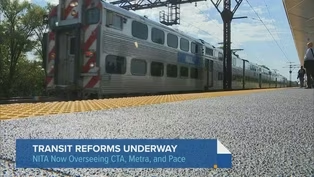
Tomorrow marks the first meeting of the new northern Illinois Transit Authority Board.
Nida was created last fall when the Illinois General Assembly passed a major transit funding package to keep CTA, Metra and pace from going over a fiscal cliff along with an overhaul of how public transportation in the region is governed.
Our Nic Blumberg joins us now to explain what changes riders will see.
And Nick, remind us how we got here.
What brand is that Bill, you mentioned that state lawmakers passed last fall.
It came after years and years of debate over how best to manage Chicago area transit.
>> And of course, that debate was really exacerbated by the drop in passengers and therefore passenger revenue during and after the COVID-19 pandemic.
So federal COVID relief money was running out.
Lawmakers managed to pass a measure to infuse a billion and a half dollars in additional public funding into the system each year.
And that will also created needed to replace the regional transportation authority.
You know, critics said the RTA didn't do enough to coordinate CTA, Metra and pace really create a seamless system for riders.
Some advocates wanted all 3 of the transit system's rolled into one.
This doesn't go quite as far but Meta has significantly more oversight authority and the 3 transit operators there now more so in charge of just moving buses and trains day today.
So what are some of the big changes that riders will see?
And when will there are a few key areas in a series of rolling deadlines that are built and to make sure that progress stays on track to pun intended.
one of the big ones is creating a universal fair system has until July of next year to put a procurement process for that system in place.
And then it's supposed to be up and running by February of 2030.
There's also public safety need a has a law enforcement task force.
Its report is due in March 2027 and then no later than June 2029, that task force has to be disbanded and they're going to be a transition to some kind of crime prevention program that uses sworn law enforcement officers.
Now on the non-law enforcement side, there's a new transit ambassador program scheduled to launch in July of next year.
Those are customer-facing employees aimed at improving riders experience is helping them with any issues they might encounter.
There's also a big focus on truly regional service planning.
So essentially, you know, making sure a metro train doesn't pull into a station right as a CTA pace buses pulling away.
There's a transition report on everything from service coordination to capital planning.
You name and that report.
That's due next July.
And then CTA, Metra and Pace have to submit coordinated service plans to meet up by April of 2028 for board approval by year's end and that new service schedule will go into effect in 2029.
Lots of work ahead.
media is overseeing the transit system who's overseeing need a good question.
As we mentioned, tomorrow is the first meeting of need is newly installed board of directors.
The governor, the mayor, Chicago and the Cook County Board president each get to name 5 directors.
The Collier County executives that's came Lake McHenry to page.
Will they get one pick each that it was something of a bone of contention when the bill was being negotiated with a lot of suburban officials arguing that the debt will be stacked in Chicago's favor and its supporters say they are committed to a truly regional approach, an equitable approach.
And Chicago transit advocates also point out that the vast majority of rights do occur on the CTA.
So a lot of the need to board appointees.
They'll also serve as directors for CTA, Metra and pace.
They'll still be having will be keeping their own boards.
So as you said, there is lots to keep track of.
But lots of big changes in the coming years.
Okay.
I'm sure you will keep track of it for us.
Thank Nick Weinberg, thanks so much.
Up next, we unpack Chicago violence data as the summer months come to a close.
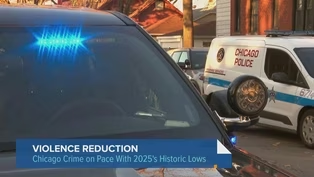
>> As summer comes to a close, Chicago remains on pace with last year's historic drop in violent crime.
The Chicago Police Department has reported the fewest number of homicides in June, July and August since 1965.
But even as violent crime declines, public safety concerns remain for many residents.
Joining us to talk more about this are Kristen Hamilton, president and CEO of you can youth advocacy organization that provides support for youth and families in Chicago.
Harry Steiner, a former Chicago police officer and founder of First Responders Wellness Center, a psychological and training resource for first responders, veterans and federal agencies and Emanuel.
Andrea, Chicago's deputy mayor of community safety.
We also invited a representative from the Chicago Police Department but did not hear back.
Thanks to a 3 of you for joining I'm so let's start with some CPD data.
Chicago saw 135 homicides and 502 shootings.
That's 4% decline from 2025 between Memorial Day and Labor Day this year as well as the lowest summer murder total.
As we said since 1965 total homicides and shootings in 2026.
Are about the same as last year which saw the fewest homicides in 60 years.
I want go to all of you on this, Chris, to to you first.
What is the tell us about what works to reduce crime?
So I you know, over the last maybe 10 years we've seen.
>> Partnership, right?
We have law enforcement.
We have community violence, interruption, aid organizations like you can we have the social service networks.
We have a mental health and behavioral communities coming together.
They're what we have seen is both strategies working collectively.
That is what is moving the needle.
We are.
We approach that targeting different areas and aspects of the work you can.
We have violence interruption, workers that are on the ground in communities.
We have come you.
Hospital advocates.
We have case managers and that's across the city of Chicago.
There's lots of a street outreach workers that are doing this work they're credible messengers.
So people have learned to come to trust and learn that they can rely on this system.
We work very closely with law enforcement.
So we are their boots on the ground in some ways so we can mitigate things before they have to be involved.
Kerry.
>> I think that again, law enforcement is really trying to work more with the community and to respond as their, you know, suggesting and again, trying very hard to consider each area.
What do they need?
Every area of Chicago is different and their needs are different.
And so instead of a one size fits all you're really trying to get to the community and seeing what works for that.
Many wonder.
>> Yeah, thank you in.
And even as we start have this conversation again, one homicide is too many and we want to acknowledge that especially for those at home or struggling and may have been exposed untold violence.
But with with that said, I think I agree with my colleagues here.
It is the the whole approach like this idea of the ecosystem of public safety.
So you have government working better together.
First responders working better together.
All of that is absolutely critical to be able to continue to move the needle can see to keep us in this right direction.
Now we're moving so when nation.
Yeah.
So despite overall crime being down in the city, there was a recent uptick in shootings on the west side of recent mass shooting in Washington Park.
>> And then what's being done to make sure that some neighborhoods, some pockets of the city don't fall behind in.
Don't also see declining client declining crime that some neighborhoods are seeing.
>> Yeah.
And think even last time I was here, there was there was an uptick and some of the stuff that we've done even since then is again around that continued coordination and being able to work and make sure we're trying to move forward on having, you know, the right response at the right time because we acts so many things of law enforcement and everything else.
So we're we've moved of these resources.
Where then will there whether it be big gatherings or anything else like that?
We don't have the appropriate resources in play.
So we're reorganizing that.
I think moving that in the right direction, better coordination CVR Partners.
I think that's helped out a lot.
And of course, you know, we have to be thankful that lot of men and women are spending countless amount of overtime miles throughout this summer to be able make this a reality now.
So there's thousands of people out there, whether it be first responders of people.
The mayor's office says thousands of feet in the CVR community.
That's his work.
Countless sounds the somebody be able to help move the needle.
had something to >> So what we're seeing at you can and across the city, there's more domestic violent incidents that are happening.
So our teams have been trained for years to group violence.
We know how to track that.
We know how to mitigate that.
We know how to create peace contracts, but we don't know what's happening to someone's home behind closed doors so unpredictable.
So we've and we also have to evolve our strategy.
Our CBS strategy has to change now.
So we're learning to how we connect with domestic violence institutions to get trying it so we can identify those issues and hopefully be able to mitigate those and reduce the risk of that happening as well.
>> Krista, what we're with you, you know, do different neighborhoods respond differently when there is, you know, with with their violence prevention efforts, like we said, you know, with what makes what works in one neighborhood minute working another.
Absolutely.
So when we go into a new community, we had a credible messages from that community.
So we are You know, every community is different like cool respect is different in the community.
Church may be powerful.
One community, the school system.
So we have to identify and create a customized approach to each of the communities that we are working.
now some communities don't have community violence, intervention agencies and we have to at times if they have an incident, we have to go and deploy our teams to support those people in their time of crisis.
And that's a little bit more difficult because the relationships really matter.
Violence intervention is a relationship business people have to trust.
You all may be comfortable with you to share things with actually appreciate appreciate the approach to to stop right to to even all participate in those violence at those violence intervention activities with you, Kerry, CPD, they establish that temporary assistance Center for people who are impacted by that shooting Washington Park.
So far the department's made no arrests just yet.
>> But how can law enforcement continue to provide support and resources for communities that are impacted?
>> I think again, when officers are in the community, they're trying to gather information and develop relationships.
And with that intelligence, you can potentially make arrests find people that are in conflict and try to see if we can de-escalate bat.
So I think that the goal always for officers is to try to find the root of the issue and trying to find how can we stop this?
Because usually when there's a shooting, there's going to be retaliations.
So if we can find out you know, how can we stop that?
So there isn't that retaliation and try to stop it right there.
That's going to be the best solution.
>> You know, if I can just the importance of of things like the EA sees is just importance of being able to continue to work with survivors and how critically important that is continue to build that trust that's needed with government in addition to law enforcement, but continue trust.
We've seen an increase in clearance rates.
I mean, that's it's gone better.
But it's not still.
We still have a ways to go to continue that.
So we could really bring into this and figure out what's needed for healing to happen.
So as so as a city, we can be able to move forward.
>> Yes, psychological studies show that the more violence somebody sees and watches, the more they get desensitized to it.
So if we start making that not normal in the community and the neighborhood and that they see victims and how that impacts the victim.
That's a very different approach.
And so they may think about in a different way.
And so I think that that's what you have.
fellow prisoners here.
Yeah, exactly.
Are trying to do and again, not making that a norm.
>> Carry a recent North Pole says that 44% of Chicago residents think crime is going up.
But as mentioned, we know that city data actually shows otherwise.
She did.
The numbers really matter of public safety is still a concern for for so many people.
So many members of the cities and residents personally.
I don't think that the numbers are accurate because what I'm hearing from a lot of my Chicago police friends is that they're saying that in the community, people are saying we don't call the police anymore because >> nothing gets or like, for example, if But one of my fellow officers, he arrested somebody, the carjack somebody that person was out a half hour later.
They arrested him 3 hours later.
So there's no consequence to younger people.
They're going to keep going out there and doing the same thing and the people that are seeing this are saying what's the point then?
Why should they even called the police?
And because also the numbers again, when I worked, there is 13,500 of us.
I think now like 9500 to 10,000 I'm not exactly sure.
But it's lower.
And there's just not enough police to be able to respond to call.
So a lot of people have to wait for their police response because police are already taking calls.
So I don't know if numbers are actually accurate.
I think that sometimes people are just now not reporting the crimes because they don't feel like it's going to matter a menu you want to respond to that.
do you think that there's more crime happening than even the police department is aware of?
Well, I think there's always been a level of people not report it, right.
So so I don't know if that's changed.
>> I'm not sure agree with in terms of the numbers not being accurate, that something CPD and is well researched and everything else like that.
But what I would agree with is this idea that, you know, people don't feel safe and we have to respect that.
And also just looking at where we're at right now in this moment where, you several years ago, even the reporting of crime and very different right now, we have social media now you could see you can almost see everything in real time and and going back to this idea when you expose like that and how it stays within you with the DNA.
So it's that's the reality to be able to react in certain ways and be able to feel that that fears still consuming you.
So, you know, I believe as crime data goes down, continues, go down.
You know, this idea feel you have really follow that.
I do want to acknowledge Jones just where we're at with that.
And what's important to be able to make sure that people feel safe.
I mean, safety is more than just crimes.
safety is this idea of belonging and right.
People want to know that their buildings that the building is not taken care of, that there's nobody on that corner.
Now, you know, is just hanging out people want to feel those all or incredibly important to this idea of safety.
And I think is some want to continue address.
>> Krista, you can another community violence intervention organizations, you all been working with CPD to reduce violence throughout the city.
Of course, head of the strategies differ for young people, which is a population.
You specialize Absolutely.
Social media.
You know, we have to be on social media as much as they are on social media.
We have to be watching and tracking their activity.
We think about the team trans the summer.
You know, my team was chastened team shines across the city.
>> Because, you know, social media to get them.
The cars information moves quickly, but we have access to the information as well.
So we working with, you know, our elected officials are our local police, law enforcement to ensure that we were in front of some of those trends and then we're able to, you know, we have team members as they're following young people in our communities on they're able to jump and hopefully, you know, stop retaliation from happening.
As you mentioned earlier, we're able to identify what conflict is rising a lot quicker and sonar on what we see locations being dropped.
able to go to some of those locations.
And Alma tried to, you know, reduce the risk of something happening in those areas.
So we use it as a as a resource in our work.
>> Emanuel, as we discussed earlier in the show, of course, we just heard about the Northern Illinois, a transit authority recently replacing the and has oversight for the CTA.
They're promising, you know, safer rides, a better experience.
House the city working with the brand-new needed to ensure that the CTA remain say first is safer.
>> Yeah, I mean, CDs actively working with So we have space there.
And you know, we're we're constantly just trying to figure out how can we tighten up a partnership there to be able to make sure people feel safe.
You know, I the 16 year-old takes takes public transportation she reminds me all the time and so just what does that look like?
I think some of it, includes involving CBI and also involving of the key players within that public safety ecosystem to be able to make sure that people are safe on city's public transportation.
>> Kerry cp's consent to create supposed to be supposed to be completed by next year.
How crucial is it that CPD continues to work towards completing that consent decree specifically towards building trust with the community?
I think that that will always be something that's a work in progress.
Again, the Chicago Police Department is a large department.
And so when there are these mass shootings and other things going on, it's very hard to get all of the officers trained in to be able to meet consent decree.
>> Even though I think that is the goal, I don't think they're not trying to do good, but I think it's just hard because of these types of things right now.
I know all of that Chicago police officers have had their days off canceled because of Labor Day and Mexican Day parade so they're doing a lot to try to do this.
And I think that, again, they are building relationships with the community.
I think that they're also, though some people that don't want to build that relationship.
And that's where right?
There's that stuck this and we have to be able to try to work through and we're hoping agencies like can help with that in bridge.
That gap, Christa and a few months, Chicagoans will be voting for the next mayor.
We've got a few months.
Thankfully what role might public safety play in this year's election in the campaign?
I'm hoping that it is the top of mind for every as we move forward.
You know, I think we have been very with our past leadership.
>> the mayor's office that they have been advocates for CV at work.
You know, we have the Office of Public Safety some other initiatives that have been very successful and we need that type of leadership.
And we need that voice and support from that office.
>> So we will continue to be funded because this funding is critically important.
Recently we've lost funding.
So there let's boots on the to sustain the level of decrease a reduction that we've seen over the last year.
So I'm hoping that is the top of mind for every candidate in the office.
>> Yeah.
And if I could just really quick, I mean, just in terms of when we think about just some of the gains as been made over the last few years.
2 crew.
I mean, to that point, how do we sustain that and what does that look like?
So that's why we've been very interested in pushing for it on the Department of was a gun violence reduction.
What does that look like to be able to have 5 year strategic plan saying, this is the goal.
We want to reach, you know, as the city and United goal that everyone's working together to be able to make that, you know, make make continue those successes, I think is critically important.
of course, we know CPD will have a new superintendent in the future.
I think the community coalition for public safety accountability has will be submitting their 3 candidates to the mayor in November.
So we'll be keeping our eyes on that.
But that is what we'll have to leave it for now.
My thanks to.
>> The 3 of you Emanuel, Andrea Deputy Mayor Chris to Hamilton in Cary Steiner.
Thanks.
Thank >> Up next, details about A W T Tw news that.
You are invited to.
>> W T Tw news coverage of policing and police reform is supported by the Joyce Foundation.
>> And that's our show for this Wednesday night on a programming note.
Be sure to join us next Tuesday for a candidate forum with the 4 contenders vying for President Chicago's school board.
Head to our website to RSVP to be in our studio audience.
That's W t Tw dot com slash events.
And don't forget, you can stream Chicago tonight on our W T Tw YouTube channel every evening and catch up on any programs you have missed now.
Join us tomorrow night at 5, 30 10 now for all of us here at Chicago Brandis Friedman, thank you for watching.
Stay healthy and safe.
We have a good night.
>> Closed captioning is made possible by Robert a cliff and Clifford law, offices of personal injury, law firm that
 New
NewPublic Safety Concerns Remain as CPD Reports Lower Violent Crime Rates
Video has Closed Captions
Chicago police reported the lowest number of homicides in June, July and August since 1965. (16m 55s)
 New
NewWhat Is NITA? Here's What to Know About the New Transit Authority
Video has Closed Captions
The Northern Illinois Transit Authority board will meet Sept. 10, 2026. (3m 44s)
Providing Support for PBS.org
Learn Moreabout PBS online sponsorship New Episode
- News and Public Affairs

Top journalists deliver compelling original analysis of the hour's headlines.
 New Episode
- News and Public Affairs

Today's top journalists discuss Washington's current political events and public affairs.



 New Episode
 New Episode
 New Episode

 New Episode
 New Episode
Support for PBS provided by:
Chicago Tonight is a local public television program presented by WTTW
WTTW video streaming support provided by members and sponsors.