
October 30, 2026 - PBS News Hour full episode
10/30/2026 | 57m 46sVideo has Closed Captions
October 30, 2026 - PBS News Hour full episode
October 30, 2026 - PBS News Hour full episode
Problems playing video? | Closed Captioning Feedback
Problems playing video? | Closed Captioning Feedback
Major corporate funding for the PBS News Hour is provided by BDO, BNSF, Consumer Cellular, American Cruise Lines, and Raymond James. Funding for the PBS NewsHour Weekend is provided by...
October 30, 2026 - PBS News Hour full episode
10/30/2026 | 57m 46sVideo has Closed Captions
October 30, 2026 - PBS News Hour full episode
Problems playing video? | Closed Captioning Feedback
Where to Watch PBS News Hour
PBS News Hour is available to stream on pbs.org and the PBS app.
Providing Support for PBS.org
Learn Moreabout PBS online sponsorshipGEOFF BENNETT: Good evening.
I'm Geoff Bennett.
AMNA NAWAZ: And I'm Amna Nawaz.
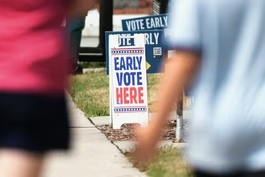
On the "NewsHour" tonight: Republicans and the Justice Department continue to cry foul in Alaska's Senate race, while early voting surges across the country.
Republican Senator Thom Tillis and Democrat Rahm Emanuel weigh in.
GEOFF BENNETT: Six billion dollars hacked in 20 minutes.
A record theft involving the world's biggest cryptocurrency exchange puts investors on edge.
GEOFF WHITE, Author, "The Lazarus Heist": It has to be said, the advice is, if you're in cryptocurrency and you have got money in crypto, be prepared to lose that money.
AMNA NAWAZ: And we visit a Ukrainian village hit by a Russian drone attack, in part because of the slowdown to Elon Musk's Starlink system, a vital piece of Ukraine's war effort.
(BREAK) AMNA NAWAZ: Welcome to the "News Hour."
Candidates around the country are making their final campaign stops before Election Day with just three days left to go.
GEOFF BENNETT: President Trump is in Florida tonight and will then head to Iowa and Kansas, a last-minute change after initially canceling those rallies.
But we start our coverage tonight in Alaska, where a ballot lineup is stirring up a key Senate race, as the GOP presses the issue.
Our Lisa Desjardins has more.
LISA DESJARDINS: As a Justice Department investigation swirls, last night, a public denial from Democratic Senate candidate Mary Peltola.
REP.
MARY PELTOLA (D-AK), Senatorial Candidate: I just want to clear the air.
I knew nothing about any other candidates on the ballot except for me and the incumbent.
That is all I have ever known about.
I am not interested in tricking voters.
LISA DESJARDINS: Peltola is running against the incumbent, Republican Senator Dan Sullivan.
And in this key Senate race, the ballot has been a focal point of confusion and controversy.
Peltola's comments come after The New York Times found that her campaign and national Democrats recruited a retired schoolteacher named Dan J. Sullivan to run, stacking the ballot and potentially costing her actual opponent, Dan S. Sullivan, crucial votes.
As for Alaska voters, they appeared split on whether the scandal is damning or merely distracting.
PAT RACE, Alaska Voter: It feels like the accusation is that Mary has done something untoward, when we're talking about a president trying to overturn an election.
And that's where the focus should be.
JOHN DELGADO, Alaska Voter: I think there's no denying it.
And if I heard her say that it didn't happen or I didn't know nothing about it, I would just at that point just think even less of her because I believe she'd be lying.
I think the proof's there.
LISA DESJARDINS: Multiple outlets report the Justice Department has issued new grand jury subpoenas.
In California, the DOJ faced a setback.
An appeals court rejected its request to set aside some 20,000 ballots.
The department alleges they were sent to non-U.S.
citizens.
Across the country, millions of voters have already cast their ballots.
Early voting continues to outpace the last midterm elections, especially in closely watched states like Maine, where early voting has jumped more than 30 percent.
Republican Senator Susan Collins is seeking reelection for a sixth term.
Yesterday, she emphasized to voters her record of challenging the Trump administration.
SEN.
SUSAN COLLINS (R-ME): There are several major issues where I've differed from the president,most notably his signature legislative accomplishment, the Big Beautiful Bill, which I voted against.
LISA DESJARDINS: In Ohio, Sherrod Brown is holding rallies with gubernatorial candidate Amy Acton, and he's a rarity, a former senator running against the status quo.
FMR.
SEN.
SHERROD BROWN (D-OH): We see people showing up like never before, angry, frustrated, and demanding change.
LISA DESJARDINS: In Pennsylvania, voters saw one of the last debates of the election.
PAIGE COGNETTI (D), Pennsylvania Congressional Candidate: This has been a war of choice, and the American people are waiting for answers, and we are not getting them.
LISA DESJARDINS: Scranton Mayor and Democrat Paige Cognetti raised the Iran war and incumbent Rob Bresnahan's votes against forcing it to end.
He insisted he has broken with Trump.
REP.
ROB BRESNAHAN (R-PA): I feel the mission has been accomplished and the war absolutely needs to end.
My concern would be ripping out the rug from underneath our service members that are serving overseas.
LISA DESJARDINS: Meantime, the biggest campaign donor in history, Elon Musk, said he fears the country moving toward a Democratic sweep, writing on his platform X: "This would result in America becoming a permanent one-party state and the end of democracy."
STATE REP.
JAMES TALARICO (D-TX), Senatorial Candidate: This Senate seat doesn't belong to Elon Musk.
This Senate seat belongs to you.
LISA DESJARDINS: In Texas yesterday, James Talarico accused Musk and other donors of bankrolling his opponent, state Attorney General Ken Paxton.
The president himself is in Florida tonight after spending yesterday campaigning in South Carolina.
There, Trump voters voiced support for him.
EDWARD UDOVIDCHIK, South Carolina Voter: It's a little scary about the inflation, because it's all going on with this war.
But I trust Trump.
He will be good.
LISA DESJARDINS: And civic duty all the way from the Vatican.
Pope Leo has mailed his ballot to his hometown Chicago, becoming the first pontiff in history to participate in a U.S.
election.
The Vatican didn't say which candidates he voted for, but that he -- quote -- "expresses his belief in the right and duty of citizens to participate."
For the "PBS News Hour," I'm Lisa Desjardins.
GEOFF BENNETT: Binance, the world's largest cryptocurrency exchange, says it's working to recover funds after the biggest crypto heist in history.
The company halted withdrawals after hackers made off with $6 billion in assets.
Since then, Binance has said it has frozen $3 billion of those stolen assets and has said it will cover any investor losses.
But the cyber heist is raising questions once again about the security of crypto and who pulled this off.
For more on the ripple effects of this attack, we turn to Geoff white, investigative journalist and author of several books, including "The Lazarus Heist: From Hollywood to High Finance, Inside North Korea's Global Cyber War."
Thanks for being with us.
GEOFF WHITE, Investigative Journalist: Hi.
Thanks for having me.
GEOFF BENNETT: So these hackers made off with $6 billion in just 20 minutes.
How were they able to do that?
And what evidence actually points to North Korea?
GEOFF WHITE: Yes, well, this is the theft of cryptocurrency.
It's digital money.
So, unlike trying to rob a bank can take out banknotes, with the click of a mouse and a few keystrokes, you can transfer these funds.
So stealing $6 billion in under 20 minutes sounds remarkable, but it really is just typing lines of code in.
It's as simple as doing a bank transfer to a friend or relative, really.
But in terms of why fingers are pointing at North Korea, there's two real reasons for that.
Firstly, North Korea has form on this.
You know, for years and years, we have seen North Korea being accused of breaking into big cryptocurrency companies and stealing big amounts of money.
I mean, last year, 2025, they were blamed for a hack on a company called Bybit that netted them something like $1.5 billion worth of crypto.
And then just over a year later, suddenly it's $6 billion.
Now, the other thing that led to people blaming North Korea for this is that so investigators have started tracing the cryptocurrency.
Currencies like Bitcoin are traceable and trackable using this thing called the blockchain, so, public ledger of movements of cryptocurrency.
And what investigators have noticed is the money from this heist moving into wallets that they claim are North Korean-controlled wallets.
GEOFF BENNETT: So when Binance says it's working to recover stolen assets, that's essentially how they're doing it?
GEOFF WHITE: Yes.
The tracing of cryptocurrency will be a large part of that.
In this heist, the hackers stole different types of crypto.
Now, some types of crypto are actually controlled by a central entity.
So, one of them's called Tether.
There's a company called Tether.
They control that currency.
So when Tether discovered and found out that this money had been stolen, they're able to freeze that currency.
And so something like $3 billion worth of it has been frozen, because it's been stolen in currencies that are controllable and trackable.
The other half of the money, though, just over $3 billion.
$3.3 billion, was in currencies like Bitcoin.
There is no central entity, no central authority that can press a button and prevent that money moving.
It is in the wind and it is moving, and moving very rapidly.
GEOFF BENNETT: So, when Binance promises to cover the losses and they say that customers' balances won't be affected, how much confidence should customers put in that assurance?
GEOFF WHITE: It is a very large amount of money, this.
I mean, they have got to cover $6 billion.
Binance seems to be saying that they have the money to do that.
And actually it's worth saying that in previous hacks we have seen like this, including that case I mentioned last year, the $1.5 billion theft from Bybit, the crypto industry sort of swings in.
The crypto industry wants people to have faith in this new type of money.
And so, when one of these hacks happens, there is an impetus on them to backfill this and to make sure that people don't lose out.
Because, otherwise, the crisis of confidence could be catastrophic.
So it's in Binance's interest and the industry's interest to do this.
And I have to say the amounts of money that sometimes appear seemingly out of nowhere to patch the whole are quite astronomical.
It remains to be seen, though.
I mean, Binance is really going to have to work hard to cover this.
GEOFF BENNETT: And we should be clear.
The hack of an exchange like Binance isn't necessarily a vulnerability in Bitcoin itself.
Still, how damaging is this for the broader industry?
GEOFF WHITE: Well, you are absolutely right.
What's been exposed here isn't some particular vulnerability, as you say, in Bitcoin or one of the other cryptocurrencies.
From what we know, employees of Binance were targeted in the same way lots of us get targeted, probably phishing messages, and were inside Binance at a level where they could actually transfer out money and move money around.
What this does show, and we have had repeated cases of this now, is that security around cryptocurrency and these cryptocurrency companies does seem to be weaker than around traditional banks.
And it has to be said the advice is, if you're in cryptocurrency and you have got money in crypto, be prepared to lose that money.
And you don't have things like government guarantees behind that and police investigations and regulators backing it.
The cryptocurrency is still outside a lot of that type of protection.
You just need to be clear about that.
GEOFF BENNETT: Investigative journalist Geoff White, thanks again for your time.
We appreciate it.
GEOFF WHITE: Thank you.
AMNA NAWAZ: We start the day's other headlines in Washington, D.C.
A federal judge is opening an investigation into whether Justice Department lawyers misled the court about plans to renovate an historic golf course.
During a hearing today, Judge Ana Reyes said she'd appoint a special master to look into whether officials misrepresented or withheld information regarding renovation work on the course.
Government lawyers have said no final plan is in place, but President Trump says the course will be shut next month for a 15-month renovation.
Speaking outside the court, a lawyer for those trying to stop the work echoed the judge's concerns.
NORMAN EISEN, Democracy Defenders Fund: What we saw today was the continuation of a profoundly concerning course of conduct.
It's eminently clear from all of the evidence in the record, from everything we have seen so far that there is a final plan.
AMNA NAWAZ: Earlier this week, the judge barred the administration from carrying out further work on the course without first giving prior notice.
The administration has appealed the ruling.
The Justice Department told a judge today that it may bring more charges against former FBI Director James Comey.
The judge then held off on deciding whether to dismiss a pending case to await further action by prosecutors.
The Trump administration is pursuing its third criminal case against Comey, this time accusing the ex-FBI director of a news media leak back in 2016.
Comey's lawyers say the 10-year statute of limitations for those charges has expired.
He has said he is -- quote -- "still innocent."
In Tennessee, Christa Pike says she's in constant pain following her botched execution last month.
In her first public statements and surviving two doses of a lethal injection, the 50-year-old said -- quote -- "My body hurts, my arms hurt, my hands hurt, my throat hurts.
I still struggle to speak, and the pain isn't just physical.
There's pain in my mind and in my soul."
Pike also said she's -- quote -- "deeply hurt by the incompetence" of those who failed to carry out her execution.
She was sentenced to death for the 1995 killing of her classmate Colleen Slemmer.
Pike's attorneys have urged the state's governor to reduce her sentence to life in prison.
In Ukraine, hundreds of civilians who've been trapped for months in the frontline city of Oleshky are finally leaving.
Russian broadcasters showed a convoy of vehicles heading into the city earlier today, with enough seating to evacuate some 750 people.
At last count, about 2,000 people were stuck there.
Local residents welcomed human rights representatives from both Ukraine and Russia.
Each side documented the mission as they helped people board the correct buses bound for either Ukraine or Russia.
Others chose to stay.
Ukraine's official praised the cooperation between the warring sides.
DMYTRO LUBINETS, Ukrainian Human Rights Commissioner (through translator): First and foremost, I want to emphasize that a cease-fire between Ukraine and the Russian Federation has been in place for more than 75 hours.
Neither side has breached it even once.
Today's phase will lead us to jointly delivering humanitarian aid to Oleshky for all residents who remain there.
Everyone who wishes to receive aid will receive it.
AMNA NAWAZ: Buses with evacuees bound for Ukraine could later be seen passing through Russian-annexed Crimea.
Their journey will continue to the Southern Russian city of Anapa before they are flown to Belarus.
They're then expected to cross the border into Northern Ukraine.
The roundabout route is intended to avoid frontline fighting.
In Israel, final election results out today confirm that neither Prime Minister Benjamin Netanyahu nor his rival, Gadi Eisenkot, won enough seats to immediately form a government.
Netanyahu's bloc won 53 seats in the 120-seat Knesset, while the main opposition secured 48.
Arab-led parties won the remaining 19, a historic showing for the bloc.
So while Netanyahu remains in power for now, a tense period of negotiations lies ahead as parties try to form a coalition.
If that effort fails, another election could be held early next year.
In Washington, D.C., residents were startled when the president's plane flew low over the city's downtown as part of pre-Halloween festivities.
The White House posted this video of the jet flying past as the president and first lady handed out candy last night.
Eyewitness video shows just how low the plane was, less than 1,000 feet, according to flight tracking data.
City officials say they received word of the fly over only 15 minutes beforehand.
Traffic at the nearby Reagan National Airport was temporarily disrupted.
The military plane is designated Air Force One when President Trump is on board.
Wall Street saw its worst day in months today, as a tech sell-off soured the mood.
The Dow Jones industrial average dropped nearly 600 points.
The Nasdaq plunged more than 700 points, or nearly 3 percent.
The S&P 500 closed out a third straight losing week.
And, in Wisconsin today, thousands of Milwaukee Brewers fans lined the streets to celebrate their first World Series title in franchise history.
In downtown Milwaukee, streets were shut down and classes were canceled citywide to make way for a parade 57 years in the making.
Fans cheered from the streets and from the rooftops, some leaning out of windows to catch a glimpse of the festivities.
The Brewers sealed their first championship on Wednesday with a victory over the Tampa Bay Rays in game five of the seven-game series.
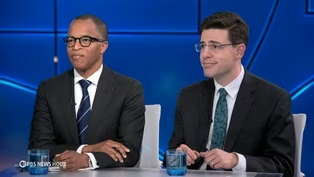
Still to come on the "News Hour": Republican Senator Thom Tillis on the state of his party leading into the midterms; Rahm Emanuel gives his take on the path forward for Democrats; and Jonathan Capehart and Matthew Continetti weigh in on the week's news.
This week in Ukraine, President Volodymyr Zelenskyy made the clearest indication yet that a disruption of Starlink technology contributed to Ukrainian civilian deaths, saying Ukraine's ability to shoot down jet-powered Shahed drones fell by up to 50 percent.
Starlink's owner, Elon Musk, admitted last week to ordering the slowdown of the service.
Whether the Trump White House was involved remains unclear.
The intentional hindrance of Ukrainian defense has led to bipartisan anger in Washington.
Democratic Senator Richard Blumenthal opened a congressional inquiry into why Ukraine's access to the system and its military-grade program known as Starshield was suddenly degraded without prior notice.
On the ground in Ukraine, the consequences were deadly.
"News Hour" special correspondent Simon Ostrovsky and producer Katia Patin went to Lutsk in Western Ukraine and filed this report on the fallout from the disruption.
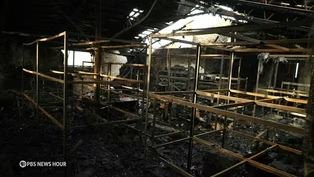
SIMON OSTROVSKY: It's completely burned out.
This is what Russia's campaign to terrorize civilian targets that are far behind the front line looks like from the inside.
And Ukraine's president has said the Starlink slowdown hampered the country's ability to defend against attacks like this one.
On October 14, shortly after Ukrainian troops began noticing that some drones flying faster than 100 miles per hour couldn't connect to the network properly, a Russian jet-powered Shahed-type drone slammed into this supermarket in the Western Ukrainian city of Lutsk, killing six people.
The strike started a fire that burnt this whole building down, and the people who died inside actually suffocated or burned to death.
One of the victims was Maria Matviiuk, who worked at the European goods store.
Her mother, Olena, told us Maria had considered calling in sick before coming into work that day.
"It was noon.
I heard the explosion, Maria's husband, Serhii, tells me.
I immediately tried calling her, but I couldn't get through."
"She loved flowers, sir," he tells me.
"And she planted these with her mother."
Ukraine's defensive capabilities are heavily reliant on Elon Musk's constellation of satellites, where they're used for everything from communication between units to drone operations on the battlefield and behind the front lines.
Without them, the war could grind to a halt, a senior U.S.
military officer told "The Atlantic" magazine.
The SpaceX owner, who is a Trump ally and also the largest contributor to Republicans in electoral history, admitted to causing the outages last week on his social media platform, X, describing it as the closure of a loophole that had allowed Ukraine to -- quote -- "kill people."
I asked Serhii and Olena whether they'd heard Ukrainian President Volodymyr Zelenskyy say that the Starlink shutdown was one of the reasons that civilians were killed when Maria died.
Serhii tells me: "Yes, we'd heard that they'd cut off access."
"And possibly not just on that day," adds Olena.
Russia increasingly relies on high-speed jet-powered Shahed drones like the one used in Lutsk to break through Ukrainian air defenses.
In response, Ukraine deployed a new cruise missile, jointly developed with Germany in October, according to Zelenskyy.
They rely on Starlink, and some of them unexpectedly fell out of the sky on the day of the Lutsk attack, allowing enemy drones to enter the country.
OLENA MATVIIUK, Mother of Russian Strike Victim (through translator): During those attacks, I wanted to draw a picture of Putin and Trump sitting together, each holding a glass of Ukrainian blood, as if Putin had invited Trump to drink Ukrainian blood with him.
I'm sorry, but that's the image that came into my mind.
And it's still there.
SIMON OSTROVSKY: The "News Hour" sent an e-mail to Elon Musk's company SpaceX, which operates the Starlink satellite network, to ask how it responded to the allegations Zelenskyy made about civilian casualties and for an explanation of the service disruptions.
No response was made available by the time of broadcast.
For the "PBS News Hour," I'm Simon Ostrovsky in Lutsk, Ukraine.
GEOFF BENNETT: Republican Senator Thom Tillis of North Carolina is sounding the alarm about the future of his own party.
In his new book, "How to Lose Friends and Antagonize Presidents, Tillis warns that Republican lawmakers are afraid to challenge President Trump, that Congress is surrendering its power, and some of the president's closest advisers are leading him toward failure.
And Senator Tillis joins us now from North Carolina.
Thank you for being with us.
SEN.
THOM TILLIS (R-NC): Thank you.
GEOFF BENNETT: And you write in this book that, unless more Republicans are willing to voice their concerns about the White House, that the country could be headed into what you call perilous waters.
What concerns you the most about the direction of this administration right now?
SEN.
THOM TILLIS: The lack of a feedback loop with Congress, really dating back to when I wrote a letter to my colleagues in the Senate Republican Conference back in April of 2025.
I tried to warn that, if we were not active participants in formulation, execution, and timing of policy, that I was afraid we were going to make the same mistakes that Obama did.
And we're seeing the same thing.
We did not have that feedback loop.
We got a little bit of ahead of our blockers.
The voters can only absorb so much change over a period of time, and I think we exceeded their capacity, and that's a part of what's driving people to the polls.
GEOFF BENNETT: In your book, you estimate that at least 30 Republican senators privately share your concerns about President Trump.
And that's an enormous amount of political power, especially when the president's approval ratings are in the low 30s.
If those senators stood together, wouldn't they have more leverage over the president than he has over any one of them?
Why aren't they using it?
SEN.
THOM TILLIS: That was what I was trying to get at last year, last April.
And I also said in my communication to my colleagues that we will know everything that we need to know about the environment by early first -- fourth quarter last year.
And we did.
We could see that things were not moving quite in the direction that we should have.
And that was really our last chance, in my opinion, to recalibrate before we were going to have -- the only thing we'd have there is lessen the maybe negative impact of the election cycle.
But I believe this was pretty much baked by the fourth quarter that we were going to have challenges.
And back to the point of 30, I will also tell you, on any given day, there are probably 30 Democrat members that don't like what leadership is sending them, and yet they capitulate.
The point that I was trying to make is, if we didn't have that separation, then it was also going to expose the president.
And I communicated that to the president.
I told him, when we were moving too quickly on the so-called Big Beautiful Bill, that, if we weren't careful, he was going to have two of the most miserable years of his life.
And what I meant by that was an election outcome that I don't want.
I want President Trump to be successful.
I want Republicans to have the gavel, but you have got to be smart, you have got to be strategic.
And that separation has only existed in -- episodically.
So, there's maybe one thing concerned a member and they push back a bit.
But we needed a consistent, separate, but equal sort of posture with the president to help him implement policies that on their face were probably OK.
It was the timing and how they went about it that became a problem for the voters.
GEOFF BENNETT: In your view, what's the clearest example of something that the Republican-controlled Congress allowed President Trump to do that they should have stopped?
SEN.
THOM TILLIS: I think the Big Beautiful Bill is probably the best example, because that's an example of where, if we had just passed the Tax Cuts and Jobs Act that basically make permanent what we passed in 2017, we would have had a huge win that we would be running on right now.
But we -- but we passed health care bills.
You're already seeing the narrative that the health care portion of the bill was the problematic portion that I believe was going to cause some headwinds in this cycle, even more in the 2028 cycle.
That was probably the best example.
I think another one could have been we may have been able to help the president from what I consider to be largely -- I lay the blame at the feet of Pete Hegseth for the execution of the war with Iran.
We should have fairly quickly said, we're glad you went in there, like I told the president.
I'm glad he did.
He's the first president to have the guts to do it.
But we needed an after-action, and we should have pressed on either the war powers resolution or very clear communication to Congress sooner.
And the president should have communicated to the American people why it was important for him to do what he did.
That's another one where we have lost the narrative.
And all people think about is the fact that it's cost them $20, $30 more to fill up their gas tank.
GEOFF BENNETT: Regarding Secretary Hegseth, whom you mentioned, you have called your vote for him one of the biggest regrets of your Senate career.
You had serious reservations about his qualifications and judgment before the vote.
What caused you to set those concerns aside?
SEN.
THOM TILLIS: A unanimous vote from every person on the Senate Armed Services Committee, up to and including one member who had expressed some concerns.
I served on the Senate Armed Services Committee for eight years.
And I decided with the -- with any of the nominations that came out of committees that I wasn't on, on the committee of jurisdiction, that I would put a lot of weight on a unanimous vote, even if it was a party-line vote.
And I did spend the week after -- that he was voted out of committee and before we voted on the floor really trying to find evidence to substantiate the allegations that came out after his confirmation vote.
My goal there was to find information that may be compelling that would convince other members of Armed Services that we may need to hold on voting, if not withdraw his nomination.
But I could not get that information.
So all I had was a committee hearing full of glowing statements about Pete Hegseth and a party-line vote.
And I wasn't going to counter that.
I know it's easy for everybody to say that -- I don't view things and you can't view things at atomic level when you're a U.S.
senator, particularly if you're a serious one who legislates.
I think about the relationship that I have with that committee and many other things that were going on, and I didn't simply want to look like I was bowing to pressure and going against the majority of my colleagues, a unanimous majority of my colleagues who voted them out of committee.
So I deferred to them, and I regret that.
The fact of the matter is, though, if I were presented with the same circumstances, I'd vote the same way again.
GEOFF BENNETT: Does Secretary Hegseth, in your view, deserve to be impeached?
SEN.
THOM TILLIS: You know, I hope the president will simply fire him or get him to move on.
And after the election, I think that we're clearly going to take some losses.
I still hold out the hope that we can have a slim majority in the Senate.
I believe that the House is lost.
It's a matter of what the margins are going to be.
I think the president should take stock.
He should look at the -- some of the root causes behind this rejection.
If the president thinks that the losses next week are about the candidates, I think he's got it completely wrong.
This is about a national environment that's been created in part by his administration and amplified by some of the members who just blindly or are completely moved along without any separation from the president.
But the president needs to own some of the outcome for next week.
We need to learn from it and improve.
GEOFF BENNETT: I want to ask you about the president's approach to Ukraine, because you have been unusually forceful for a Republican in criticizing President Trump's approach to Russia, making clear that Vladimir Putin is the aggressor in all of this and cannot be trusted.
Why do you think the president continues to give Putin the benefit of the doubt?
SEN.
THOM TILLIS: I don't know.
It is frustrating to me.
And I can't explain it.
I don't know how -- well, and there's several layers to it.
I don't know why the president had the kind of relationship that he does or did with Viktor Orban.
I mean, Viktor Orban from Hungary was clearly a wink-and-a-nod friend with Vladimir Putin.
We have Vucic down in Serbia who's been rejected, who was also a buddy of Putin and had a relationship with members of the administration.
Then he'd go to the Republika Srpska with Dodik, who's not in power right now, but effectively one of the most powerful people in Bosnia and Herzegovina, buddies with Putin.
Those are all bad signs, in my opinion.
I have never seen an instance where a Republican president ever wanted to have a relationship with a Russian leader or a USSR leader that wasn't one that was trying to convince them they needed to free their people and become democracies and stop threatening Western democracies.
We can't coexist with Russia with their current -- in their current form.
My God, just this week, they have agreed to start recruiting or through forced labor getting people from North Korea to go.
This is a guy who was described by Witkoff as a humanitarian last week.
Now they're talking about forced labor North Koreans coming to Russia to help them with the war effort in Ukraine, and it's an American administration that thinks that's OK?
GEOFF BENNETT: I wonder, Senator, what do you say to your Republican colleagues who agree with everything that you just said, but don't have the luxury of retiring, as you do?
SEN.
THOM TILLIS: Well, what I would tell my Republican colleagues is to look back to everything I have said for the last 11 years.
The only difference between my -- between me after I decided to retire is that maybe I use a little bit more profanity, and I damn sure don't worry about what I say, because I don't have a campaign to run where I'd have to explain it.
But, my gosh, my position on January 6, my position on Russia, my position on Mueller, my position on tax policy, my position on health care policy all predate before I retired.
So what I would tell my colleagues, come on in, the water's fine.
As long as you're satisfying your people back home, you will get reelected.
And what happens when the president picks winners and losers, you have things like Texas happen, where we're spending hundreds of millions of dollars, when John Cornyn would have walked into that race.
We have spread ourselves out in a negative environment, just like Obama did in 2010, and we're going to get what we get.
Now we have got to learn from it and not let this be what we're stacking up right now.
I think we need to go back on Wednesday of next week and draw a parallel between 2006 and 2026.
And then what we need to do is not repeat the mistake that we made between 2006 and 2008, where we dug ourselves a deeper hole.
If we don't acknowledge that we're a part of this problem, instead of blaming it on other people, we did not execute properly, the American people gave us a chance to govern -- and the premise of the book is we almost -- every party since Obama has mistaken an opportunity to govern as a mandate.
Then they take their eye off the ball, they shove policy down members' throats in Congress that were not fully vetted and not really ready for prime time, and you get what you get.
This environment is no different than the environment Obama created and that Biden created.
I just hope my party figures it out so that we don't repeat the mistake in '28, we gain back some of our losses, and maybe have a shot at the White House.
GEOFF BENNETT: North Carolina Republican Senator Thom Tillis.
The book is "How to Lose Friends and Antagonize Presidents."
Great title.
(LAUGHTER) GEOFF BENNETT: Thanks for making time for us.
We appreciate it.
SEN.
THOM TILLIS: Thank you.
GEOFF BENNETT: Senator Tillis mentioned what he sees as the striking parallels between this year's midterm elections and the Democratic wave of 2006.
Rahm Emanuel helped engineer that victory 20 years ago.
Now, as his party looks to regain power, what lessons does he see for Democrats today?
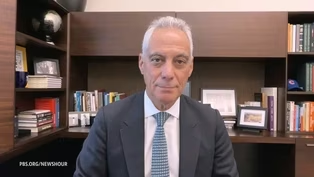
We're joined now from Chicago by Democrat Rahm Emanuel, the former Chicago mayor, congressman, White House chief of staff, and U.S.
ambassador to Japan.
Welcome back to the "News Hour."
RAHM EMANUEL (D), Former Mayor of Chicago, Illinois: Thanks, Geoff.
Thanks very much for having me.
GEOFF BENNETT: So, before we turn to domestic politics, I want to start with Israel's election, because when we spoke on this program this past summer, you said the U.S.-Israel relationship was at a tipping point, and you called for a fundamental change in direction.
Now, as a result of this election, neither major bloc has won a governing majority.
And the question for you is, in your view, can anything fundamentally change as long as Netanyahu remains in power, even in a weakened coalition?
RAHM EMANUEL: The short answer is no, both because of both the person and the policies.
He would have to have a fundamental difference in calculation.
This has all been said by the top echelons of the military, people that used to work for him.
Everything runs through the calculation of what's in his interest, not as what is in the nation's interest.
And in illustration of this point, every prime minister that had a major military setback had an independent commission.
He has refused to have it because the judgment would be unambiguous about the role he played in one of the worst military and strategic catastrophes in Israel's history since its founding in '48.
GEOFF BENNETT: All right, let's shift our focus now to the midterms.
You helped Democrats win back the House 20 years ago in 2006.
What lessons from that experience apply to this moment?
RAHM EMANUEL: Well, two things.
I mean, it was very -- the similarities are here, unpopular president, unpopular president, corruption, corruption, unpopular war, unpopular war, spiking energy prices, spiking energy prices.
So the outline, very similar.
Big difference, people were tired and frustrated with President Bush.
Here, they are angry at President Trump.
And what I mean by angry, President Trump promised to drain the swamp and he put the swamp right in the Oval Office.
He promised to end the endless wars, and he actually started one.
He promised to get prices under control, and he has spiked them.
And he promised to put money in your pocket, and he's only putting money in his pocket.
And nobody likes to be played like a fool.
There is an anger at being had that is fueling this election more than just frustrated.
GEOFF BENNETT: And on that point, you already have some Democrats focused on impeachment.
Some are calling for impeaching Defense Secretary Pete Hegseth.
Others are calling for what would be a third impeachment of Donald Trump if Democrats retake the House and/or Senate.
Would that be a mistake?
I mean, look, I'm very straightforward that, in Tuesday, the Republicans will lose.
What the Democrats do in 2027 will determine whether we have won.
And what I mean by that is, I'm absolutely for all the hearings about follow the money, Venezuelan money, oil deals with Russia, everything, what the Witkoff and Trump children have.
Follow the money.
What you should do immediately within the first three months is pass an ethics package, five quick things for all three branches of government, no stock trading, no prediction market participation, mandatory blind trust, mandatory retirement age or term limits, and what I call fifth and finally the Kushner rule, no foreign money while you're in service or for two years afterwards.
And the Democrats, if you get that type of change done, you will deliver a victory to yourselves and to the American people.
Pass a minimum wage.
Hasn't been passed since 2007, when we took control.
Third, restrict the tariffs.
Both of the last two deal with affordability.
The first one deals with the ethics and corruption around this administration.
Vote and give the public, in fast order, both on speed and substance, a down payment on change.
You will not only tell the coalition that voted you into the majority.
You heard them and you acted, and then, B, setting up 2028, which is, we are the party of change, that is the party of corrupt failed status quo.
GEOFF BENNETT: Well, say more about that, because how should Democrats turn what might be an anti-Trump vote on Tuesday into lasting support for the party, a mandate for their own agenda?
RAHM EMANUEL: Geoff, it's a great question.
What you do in 2027 will both confirm to the coalition that they got the change they hoped for, and then set up for the next presidential election, because we become the party of change.
If you do, by way of reference, an impeachment versus an ethics bill, impeachment will take all the oxygen out of the air, and it will just -- the American people will just say it's just nothing but retribution and nothing but Democratic version of a food fight.
If you deliver significant change, like a comprehensive ethics package, in quick order, they will say that's the change I voted for.
Show up, get your work done, produce the work for the American people.
That would shock them that -- if Washington actually produced something that mattered in their lives.
The minimum wage hasn't been raised in 20 years.
There hasn't been a lobbying and ethics reform in 20 years.
Change both.
GEOFF BENNETT: Rahm Emanuel, great to speak with you.
Thanks for joining us this evening.
We appreciate it.
RAHM EMANUEL: Thanks, Geoff.
AMNA NAWAZ: With Election Day just around the corner, the last week has been filled with last-minute rallies and campaign events as the parties deliver their closing messages.
Just today, The Cook Political Report shifted a dozen more house seats toward Democrats.
To discuss all that and more, we turn now to Capehart and Continetti.
That's Jonathan Capehart of MS NOW and Matthew Continetti, a Wall Street Journal opinion columnist and scholar at the American Enterprise Institute.
David Brooks is away tonight.
Great to have you here.
JONATHAN CAPEHART: Hey, Amna.
MATTHEW CONTINETTI: Good to be here.
AMNA NAWAZ: Good to see you both.
All right, let's just look ahead.
Three days to go now.
It seems very likely the House will flip to Democratic control.
Matt, do you see Republicans hanging on to the Senate?
And how big of a wave are you expecting in the House for Democrats?
MATTHEW CONTINETTI: Well, I'd say the House is probably going to be 15-to-20 seat majority for the Democrats, and then for the Senate, I do see Republicans holding on, but just by their fingernails.
A 50/50 Senate, I think is a very probable outcome.
And that means that Vice President Vance is going to be spending more time casting tiebreaking votes on Capitol Hill than hitting the campaign trail ahead of 2028.
AMNA NAWAZ: You agree with that?
JONATHAN CAPEHART: Look, I'm out of the prediction game.
AMNA NAWAZ: You're not going to give me something to play back to you later?
MATTHEW CONTINETTI: You can't get out of it that easy, Jon.
I'm on the line here.
(CROSSTALK) JONATHAN CAPEHART: Watch me.
Look, I will believe all the prognosticators and the Republican operatives who are freaking out that the House is gone.
I will grant it -- no, 50-50.
I know some Democratic operatives who would love for a 50/50 outcome simply because it will take the 2028 candidates, let them off the hook for whatever Democrats wouldn't be able to get accomplished if they had both chambers.
Now, the thing about the about the Senate, and what gives me pause about whether the Democrats will take the majority is, in a lot of key races, I'm looking at ticket-splitting, ticket-splitting in Florida, ticket-splitting in Texas, ticket-splitting in Michigan.
And so until the American people go and vote and we see how they have actually voted, then we will know.
MATTHEW CONTINETTI: Well, that really is the case that makes this election very unusual... MATTHEW CONTINETTI: ... is that you have the toss-up races increasing in number, all on Republican territory.
There are two toss-ups, I think, that RealClearPolitics rates in Democratic states, Michigan and Minnesota.
And Minnesota seems farther out of reach the closer we get to the election.
So, if the polls are right, that means it could be a very long night for Republicans, but the polls might not be right.
AMNA NAWAZ: We will wait and see.
As you say, and we always say, it's in the voters' hands now.
Let's talk about the closing messages we have been seeing from the candidates and from the parties.
Matt, as you have seen, the president has been busy on the road in this final stretch.
He's been going back to states that he very handily won back in 2024, including Mississippi and South Carolina, Texas and Ohio.
He's got visits planned to Iowa and Kansas this weekend.
In terms of a closing message, we have covered this too, he's really intensified a lot of his anti-Muslim rhetoric, specifically targeted at the Michigan race and the Democratic candidate there, Abdul El-Sayed.
He's been commenting on men's bodies.
He's been boasting about how much money oil companies are making.
He's not centered on affordability, which is the number one issue.
Is this the closing message Republicans want?
MATTHEW CONTINETTI: It's not the closing message that the Republican political class wants, but is it the message that is necessary to motivate Trump's supporters to come out?
That, I think, is still an open question.
And, again, we're just going to have to wait.
When Trump goes to these states, he's there to mobilize the base of the Republican Party.
The voters most devoted to him who we have seen are not as enthused to come out when he's not at the top of the ticket.
And the story of the past two years has been parts of that 2024 Trump coalition have veered off.
Young men have veered off.
Independents have moved farther toward the Democratic Party.
Hispanic voters, of course, have moved toward the Democratic Party.
What's left is the base rural and working class white vote.
That's what Trump is trying to mobilize.
And, right now, Republicans are very nervous that they might not show up too.
AMNA NAWAZ: Jonathan, what do you make of that?
JONATHAN CAPEHART: And why should they show up?
I mean, great, the die-hards are there at the -- at his rallies listening to him do the greatest hits.
But they're also the folks who are paying high diesel prices, high gas prices, high health care prices, if they have health care, dealing with -- dealing with inflation.
So, in all the groups you talked about, young men, Latinos, even African Americans, he did better with them in '24 than he did in '20, those are all the same people who are living in the reality of Earth One and voted for him because they thought he was going to do something about those issues.
And we will find out on Tuesday, but it looks like they're not there.
That's how he won reelection.
You can't -- he cannot have won the White House solely with rural white voters.
AMNA NAWAZ: Can I ask you, though, is there a danger here for Democrats?
Because there is a very strong anti-Trump message in their closing messages here.
Could this wave, whatever it is, could it hide weaknesses, that this isn't necessarily an affirmation vote for the party necessarily, but it's a rejection of the president?
JONATHAN CAPEHART: Oh, I think the Democrats running absolutely know that the votes are rejection of the president.
A lot of the people who are running are running because they don't -- they do not like the president's policies and what he's doing.
And if you look at, say, Senator Jon Ossoff and a bunch of other Democratic candidates, they have been very good about taking their anti-Trump message and marrying it to real issues, take it corruption -- tying the corruption to the affordability crisis and talking about what they would do about it.
So it this is not an either/or.
This is a this is a both/and.
They are talking about both, because you can talk about both.
AMNA NAWAZ: What do you make of that, Matt?
MATTHEW CONTINETTI: Well, I think if this election is like 2018, there, the anti-Trump message didn't really shift the overall dynamic, right?
I mean, you had the Democratic House, but Republicans retained the Senate.
And heading into the pandemic, it looked like Trump could win reelection, especially if he drew a far left opponent.
This election is more like 2006, where the Democrats take both chambers of Congress.
In retrospect, 2006 signaled a shift to the left that persisted up through the 2010 Tea Party midterm.
AMNA NAWAZ: I want to talk about Alaska.
We have covered it a lot this week, specifically the Senate race there.
The New York Times reported this week that the Democratic Party and the campaign of the Democratic candidate, Mary Peltola, played a role in recruiting another Dan Sullivan to run, that is Dan J. Sullivan, to dilute the vote of the Republican incumbent Dan S. Sullivan.
Mary Peltola even last night denied any involvement or knowledge in that.
Jonathan, we all know here look these kinds of political tricks and stacking of the ballot, this is a story as old as time in America, third-party candidates being recruited as well to dilute votes.
But was this a smart move for Democrats, or does this just fuel all the claims of fraud and rigged elections that President Trump has been making?
JONATHAN CAPEHART: I mean, this is a story I could not muster any kind of enthusiasm for.
AMNA NAWAZ: Why not?
JONATHAN CAPEHART: Well, because as you just said, these sorts of things happen all the time.
Was it a boneheaded move and they got caught doing it?
Absolutely.
But I go back to why we're even talking about Alaska in the first place.
A week ago, we were sitting here talking about the president of the United States directing the attorney general of the United States to sue proactively Alaska to prevent them from certifying the election -- the election for Senate in Alaska if the Democrat won.
There are at least three sins in what I what I just said.
That is what I'm focused on.
And, as we see, the administration is hell-bent on gumming up the works with the Alaska Senate race.
AMNA NAWAZ: Does this now devolve into some kind of legal fight?
The DOJ is already suing in the Alaska case.
MATTHEW CONTINETTI: Well, the extent of the legal fight will continue at the level of who wins and by what margin, but there's also now going to be investigations about whether there was coordination, whether there was lying, not just in terms of lying, as people may have been saying that had nothing to do with recruiting this decoy Dan Sullivan, as he's called up in Alaska.
But, also, were there any illegal filings, campaign ballot filings you have to do that could be legally liable as well?
So I think it will continue.
But I think, fundamentally, since you talked about it last week, what interrupted the story was this New York Times scoop.
And this is The New York Times.
It's not Donald Trump, and they have the receipts here.
And it's put Mary Peltola's honesty into question.
AMNA NAWAZ: Matt, do you expect President Trump to come out on election night or the morning after and claim fraud, claim that it was a rigged election?
Are you anticipating that, based on what we have seen in the past?
MATTHEW CONTINETTI: I don't know.
I mean, I think that, again, depending on the results there, he's very he's very likely to say something was up, especially if it's a narrow Peltola victory in Alaska.
There may be some races in the House that he will say that there is some noncitizen voting in.
There's some predicate for that.
But Trump... AMNA NAWAZ: Predicate for him claiming that, correct, yes.
MATTHEW CONTINETTI: Right, with these investigations that are ongoing.
But Trump, I think, is going to want to change the subject very dramatically if the night doesn't go well for him.
And that's why I expect some big move on foreign policy, maybe even on election night.
AMNA NAWAZ: Oh, I want to ask you more about that in a second, but, Jonathan, first to you on the claims of fraud, what are you anticipating on the night?
JONATHAN CAPEHART: Oh.
I have been here how many election nights where we have sat and watched him come out and claim fraud.
I mean, this is what he's going to do.
And I suspect that Democrats around the country, and particularly national Democratic leaders, are also expecting him to do that, which is why a lot of them are hoping, praying that this is actually a tsunami, meaning that in all of these races there will be so -- the results will be unimpeachable, to use a phrase.
AMNA NAWAZ: OK, talk to me more about what else you expect to hear from the president.
JONATHAN CAPEHART: Yes.
Let's hear about this.
AMNA NAWAZ: Because he has threatened or at least been reported that he's weighing restarting the war in Iran.
Do you believe he will?
MATTHEW CONTINETTI: He's been briefed by our military commanders.
He's been talking to Prime Minister Netanyahu.
There are forces moving into the region.
Everything is set for Trump to make a decision to restart the war or to have some kinetic action against Iran.
AMNA NAWAZ: And is that a good move?
MATTHEW CONTINETTI: I actually am skeptical that he will do a big attempt to really dramatically change the picture.
There is a chance that he will have punitive strikes in order to reduce Iran's capacity to harass the traffic through the strait, which, of course, the attacks have been increasing in recent weeks.
Overall, though, what you find after an election like we might have on Tuesday, in those final two years, presidents turn to foreign policy.
Obama did it.
George W. Bush did it.
Bill Clinton did it.
Ronald Reagan did it.
Trump is going to move, I think, to decide what will happen in Iran.
He will move more on Ukraine.
But, with Trump, you also have the added twist is that he will be devoting a lot of time to golf courses.
AMNA NAWAZ: Jonathan, I will give you the last word here.
What do you expect from Mr.
Trump after the election?
JONATHAN CAPEHART: Look, what piqued my interest was you, Matt, saying that it could happen on Election Day.
That would be -- that would be wild.
But for him, for the president to take some kind of action against Iran in the weeks after Election Day, maybe even the days after Election Day, that's, to my mind -- again, the number one thing I learned during the first Trump presidency is to have an open mind and an active imagination.
And if you can think that it could happen, it could happen.
So I am prepared for whatever the president's going to do, whether it's election night or the day after.
AMNA NAWAZ: Stay tuned.
We will find out.
Jonathan Capehart, Matthew Continetti, great to see you both.
Thank you so much.
MATTHEW CONTINETTI: Thank you.
AMNA NAWAZ: Well, remember to tune in next Tuesday, November 3, for live election coverage.
You can join us and our panel of experts for analysis as the results come in.
That coverage starts at 7:00 p.m.
Eastern.
And on election night, we will be reporting results based on the Associated Press.
Online, you can learn more about how the AP tracks the vote, how they call the winners, and how they conduct exit polls on Election Day.
You can watch that conversation with our Deema Zein on our YouTube page.
GEOFF BENNETT: Well, be sure to tune into "Washington Week With The Atlantic" later tonight right here on PBS for a look at the final scramble to Election Day and why, despite all the talk of a blue wave, the balance of power in Washington is anything but settled.
AMNA NAWAZ: Meanwhile, on "Horizons" this weekend, William Brangham and his guests look at why concert ticket prices have surged and the corporate and technological forces behind it.
On "Compass Points," a special edition with Nick Schifrin in Israel for a look at the nation's election results and what they mean for Prime Minister Benjamin Netanyahu.
You can watch both "Horizons" and "Compass Points" on our YouTube channel, wherever you get your podcasts, or on your local PBS station.
Check your local listings.
GEOFF BENNETT: And that is the "News Hour" for tonight and this week.
I'm Geoff Bennett.
AMNA NAWAZ: And I'm Amna Nawaz.
On behalf of the entire "News Hour" team, thank you for joining us.
 New
$6 billion cryptocurrency heist puts investors on edge
Video has Closed Captions
$6 billion cryptocurrency heist puts investors on edge (5m 13s)
 New
Candidates make final midterm stops as early voting surges
Video has Closed Captions
Candidates make final midterm stops as early voting surges (4m 52s)
 New
Capehart and Continetti on closing messages and predictions
Video has Closed Captions
Capehart and Continetti on closing messages and midterm predictions (12m 15s)
 New
Inside a Ukrainian city hit by Russia during Starlink cut
Video has Closed Captions
Inside a Ukrainian city hit by Russian drones during the Starlink disruption (4m 50s)
 New
News Wrap: Judge investigating if DOJ misled court
Video has Closed Captions
News Wrap: Judge investigating if Trump officials misled court about D.C. golf course plan (6m 9s)
 New
Rahm Emanuel on what Democrats should do after midterms
Video has Closed Captions
'A down payment on change': Rahm Emanuel on what Democrats should do after midterms (6m)
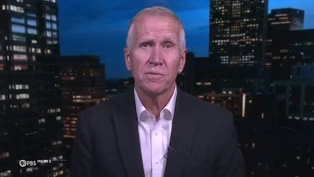 New
Trump should 'own' election outcome, Sen. Tillis says
Video has Closed Captions
Trump should 'take stock' and 'own' election outcome, Sen. Tillis says (11m 42s)
Providing Support for PBS.org
Learn Moreabout PBS online sponsorship New Episode
- News and Public Affairs

Today's top journalists discuss Washington's current political events and public affairs.

- News and Public Affairs

FRONTLINE is investigative journalism that questions, explains and changes our world.
 New Episode
 New Episode
 New Episode
 New Episode

 New Episode
 New Episode




 New Episode
Support for PBS provided by:
Major corporate funding for the PBS News Hour is provided by BDO, BNSF, Consumer Cellular, American Cruise Lines, and Raymond James. Funding for the PBS NewsHour Weekend is provided by...